Chapter 0 — The Single Truth
Chapter 0: Time and the Divinity of the Moment
Consider Chapter 0 a reference point.
March 4, 1789, is a day that more than 331,000,000 people relive every day. From the moment they wake up till they lie down to sleep, a past over 231 years ago—raw as ever. They have moved past the moment, but it still resides within them. It is an experience that controls their behavior and understanding of the world. One is manipulated to a point where it strangles them, a binding imprisonment they know but do not see. On March 4, 1789, the United States Constitution went into effect, providing the framework for the United States as we understand it. All of the good and bad that the world has experienced through this political technology began within a moment long ago, yet its influence still dominates much of the world stage. This single example illustrates a central theme of this text: our experience of time as both the independent observer within the moment and as the totality of happenings throughout the history of the universe. Many challenges face humanity today, and if we examine them from a bird’s-eye view, we can see that they cumulatively form what we will refer to as the crisis. At the very core of our journey toward self-actualization in the age of crisis is the reimagination of how we frame and conceptualize the human relationship with time.
Time through the lens of the observer is both the expansion of singular moments and the simultaneous experience of all moments prior. Each individual observer inhabits a fraction of the nearly infinite happenings occurring simultaneously throughout the universe within a given moment. These event chains coalesce as an experience containing both the immediate present and pasts, far gone but as real as ever. The immediate present of intersecting realities occurs through each observer bringing their own complex and unique histories to the moment with an unavoidable bias toward specific ways of thinking and acting based on their inheritance of being. As our earlier example of the United States Constitution highlights, we experience past moments in real time alongside new ones formed in the immediate present. For better or (more often) worse, we are bound to frozen moments in time that we had no voice in crafting.
Our time experience is an intersection of vast event chains spanning eons and the immediate present. We can imagine many alternative histories but may only draw from ours. This inheritance of history extends far beyond humanity’s existence and applies to both individual and collective history. And yet our experience of time is also uniquely individual, subject to our perceptions and understandings. We are forced to act within the constraints of our immediate present, ensuring that our capacity to fully express our humanity directly correlates with our access and agency within a given moment. This combination of perpetual inheritance of the moment and individual access and agency existing in relation to our specific circumstances illustrates how the systems surrounding us are part of the individual. They define our capabilities and power and mold our imaginations into more rigid understandings of the world over time. Every individual exists within a greater ecosystem of happenings that shape their entire being, much of which is entirely out of their control. Interactions with the world and others perpetually change who we are. When we speak of observing as the experience of being time, we draw from the knowledge that each of us inhabits a space that is the culmination of every universal event since the initial singularity and proceeding expansion. Our exploration of the possible occurs at the apex of universal history. Nothing exists beyond this moment. There is a certain gravity to embracing the fact that no matter where your conscious coordinates place you within the moment, you are a unique fraction of the pinnacle of all information and knowledge.
Exploring our perceptions of the time experience requires that we decouple time from the idea of numbers on a clock. While the cataloging of earthly rotation is a great organizing technology, it is an inadequate definition of the moments we inhabit. When we use the language of “time experience” in this text, we refer to the moment, the space you occupy within the immediate present. Our ability to self-actualize in the age of crisis depends highly on our ability to embrace the nature of being as we understand it. Time is the foundational human experience. We are both in it and of it, and each of us possesses the divinity to direct it. Awareness of our ability to change anything and everything by choosing to redirect our focus and energy at any time is the most fundamental power we possess. Through this power, we birth creation, reshaping the universe in our image. In this, we are more godlike than we give ourselves credit for. Embracing this truth will change everything. In many ways, self-actualization in the age of crisis is a call to a higher time sense. Throughout the text, we will explore philosophies and practices to further embrace and apply this knowledge to our individual and shared experience.
The idea that the human being is aligned with the totality of the cosmos is not new. The first historical notions of individual universal significance took place in the spiritual technology labeled the Upanishads, a collection of works from mystics of ancient Vedic religions, formed in present-day India. Central to the philosophy was the knowledge of Brahman as the ultimate reality and the Atman as the individual self.1 Early in the Upanishads, it is stated that these two are one. The totality of the being created through the wholeness of the individual and their external universe could only be described as “neti neti,” which translates to “not this, not this.”2,3 This supreme intelligence was understood to be embodied by individuals as evidenced by the phrase, "Tat tvam asi"—“That you are!” 4 These philosophies were passed down orally through generations and are considered the oldest earthly spiritual philosophy. Their findings were rooted in meditative practice, breathing exercises, and various methods of exploring altered states of consciousness. By connecting the dots between the internal and external, these individuals developed a vision of humanity worthy of our potential: creator and creation of our own doing. As the cosmologist Carl Sagan once said, “We are the way for the universe to know itself.”
There is a distinct experience of reality when embracing your individual identity as a part of a larger cosmic whole. Our personal perspective as a fraction of the totality is as much of us as the entirety of our surroundings within the moment because everything we do will be in relation to these circumstances. This conceptualization of self may seem difficult to wrap your head around at first, but consider the relationship between microorganisms and humans. The difference in size between a virus and a human being is roughly equivalent to the difference in size between a human and the Sun.
When a virus infects a human host, it becomes part of that individual, a tiny component of a larger biological ecosystem, that attempts to exert its will on its environment—our bodies. The virus is simultaneously independent of its universe and an indistinguishable part of it, depending on what perspective you view it from. Despite inhabiting radically different scales of reality, humans and viruses operate with similar wholeness to their environment.
This mutual integration of being extends beyond the invasive virus. Consider our symbiotic relationship with bacteria. There is a one-to-one ratio between bacteria and human cells inhabiting our bodies.5 Meaning the individual is as much bacteria as they are human. Bacteria inhabit our bodies from birth until death and provide us with protective, structural, and metabolic benefits. We possess a symbiotic relationship with bacteria; we offer them a universe to live within, and they contribute to the progress of the higher self.
Symbiosis is also one of the foundational theories of nature. The first multicellular organisms were likely cooperative groups of single cells that each performed different roles. As time progressed, these organisms became dependent upon each other to the point where individual survival was no longer viable, eventually incorporating their genomes into a unique multicellular organism.6 When we consider the combination of individual and system as a larger self through the lens of biology, we observe examples all around us. The existence of life and matter, which exist in various degrees, is always related to the place and space it inhabits. There is no separating the two.
The acknowledgment of our time experience being at the same time individual, collective, and total within a given moment helps break the dualism commonly reinforced by present philosophy and practice. It also conflicts with historical philosophies of meaning and organization, which presently support the notion of being as a primarily individual experience—able to influence others and the environment but ultimately isolated from them. Reframing our relationship with time requires us to peel back layers of understanding that we may consider natural or necessary within the present day. Fortunately, modern science and collective connectivity provide us with knowledge frameworks to do just that. The human experience of being as both the fractional individual and the totality of the moment repositions our understanding of being into a much more expansive vision of ourselves, providing a cornerstone to create new frameworks of meaning and value necessary to transcend the crisis.
Exponential Growth
Examining the world around us reveals a pattern that is becoming increasingly common in our reality. Exponential growth is everywhere. We observe exponential growth in our technological process,7 population growth,8 the spread of pandemics,9 and throughout the evolution of life in the universe.10 Exponential growth is when a unit of measure grows by its present value or doubles. When this trend occurs consistently over time, the speed of progress increases dramatically, so much so that it’s difficult for our brains to conceptualize it accurately. Nuclear physicist and professor emeritus Albert Bartlett is quoted as saying, “The greatest shortcoming of the human race is our inability to understand the exponential function.” It is easier said than done—exponential growth doesn’t directly correlate to our lived experience. The human time experience is rooted in a biological machine where expiration is inevitable. Our frameworks of time as a tool of organization rely on the Earth’s rotation around the Sun, and our bodies need rest. Sleep, in itself, reinforces linear perception. We return to nothingness, only to begin the next morning anew.
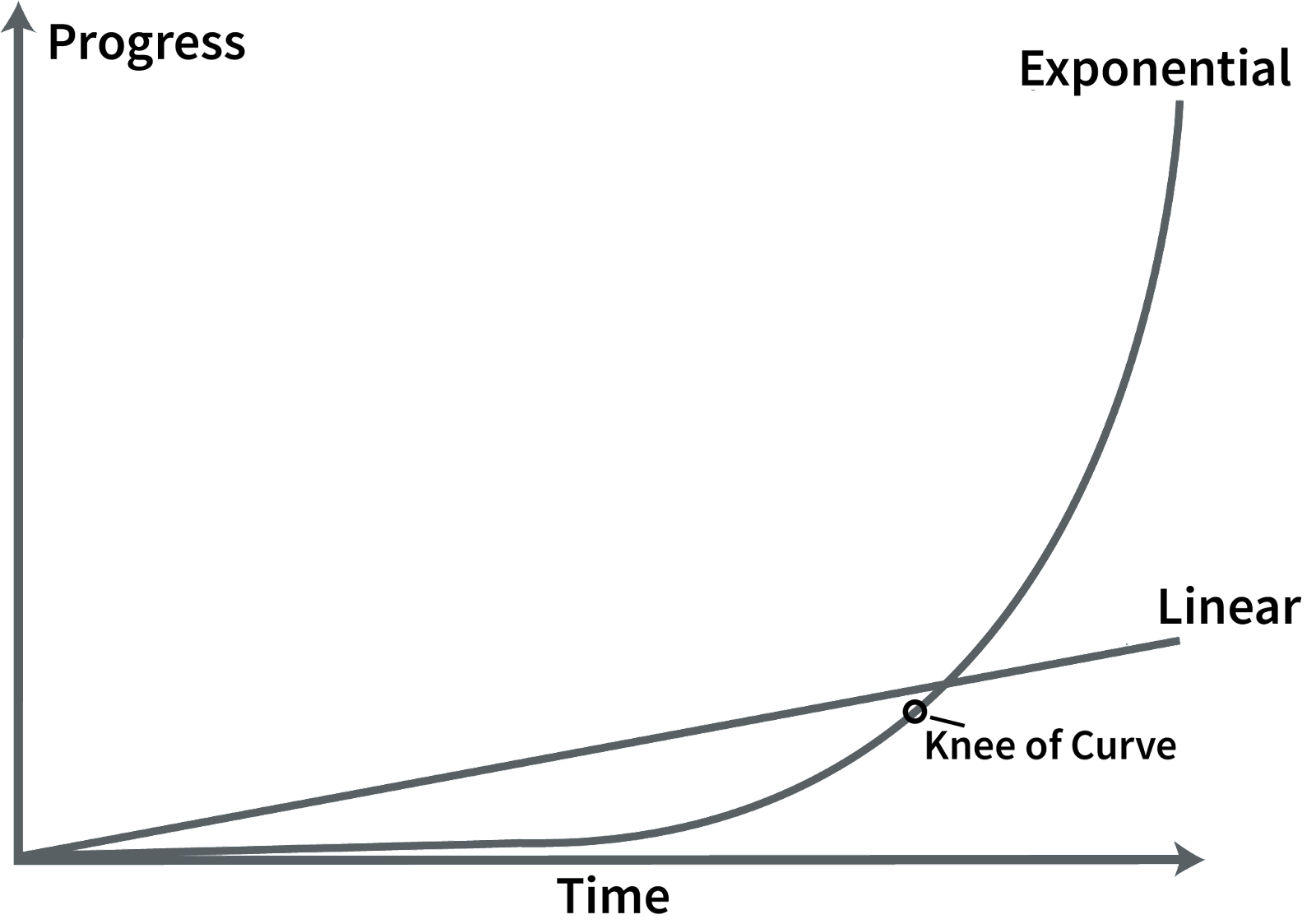
Our past is inaccessible, and the future is unknown. Yet we possess memories that we believe to be perceived events. There is a continuity to life in the present. For us, change and progress are incremental. But that does not apply to our creations. This type of change is best understood through visualization. Figure 1 illustrates how exponential growth feels slow until you break past the knee of the curve, at which point progress accelerates rapidly in frequency, scale, and degree. As a child of the mid-1980s, I share the generational perspective of knowing the world before the internet and being in it within the immediate present. The world is changing faster than ever before. Children born into the world today will never know anything beyond exponential growth. We are coming close to crossing that threshold and now must question who we will be when that moment arrives.
Moore’s Law is a trend where humanity is able to double the number of transistors on a microchip every two years. More transistors create more parallelism, allowing multiple things to happen simultaneously. The more tasks we can execute at the same time, the faster we are. Over the past forty years, this has been the driving force behind much of our technological progress, but that era is coming to an end. Physics, as we understand it today, is limiting us; our silicon-based transistors can’t get much smaller than they are now. Fortunately, researchers have discovered a great opportunity to increase speed through software, algorithms, and chip architectures. Code optimization to take advantage of chip hardware can maximize the benefits of parallelism, creating speeds up to sixty thousand times faster.11 Each new innovation in processing power opens new doors for previously unavailable or unimagined advancements.
Productively, exponential growth is the primary focus of present-day tech start-ups. Software is scalable, which means it can increase its functionality and capacity depending on user demands. Scalable technologies also typically have inverse ratios between their costs of operation and profitability; after a certain threshold, the cost of onboarding new users is negligible—it’s almost all profits. Organizational scalability also empowers a rapid monopolization in the productive vertical.
Inventor and futurist Ray Kurzweil has written several books exploring the concept of exponential growth, extending Moore’s Law to all technologies as well as biology. He maps out time periods between the evolution of more complex life forms.12 Starting from single-celled organisms, he demonstrates that the progress of complex life follows an exponential growth pattern. Similar to his findings on technology, the intervals between the emergence of new life forms become shorter with each milestone. In The Singularity Is Near, Kurzweil details the data behind human progress and how our major technological advancements follow an exponential growth curve, arguing that in the near future (2045), we should reach a technological singularity—a moment where we multiply our effective intelligence a billion-fold and merge with the intelligence we have created. From this point on, the future becomes difficult to determine. Kurzweil believes it will usher in an era of radical progress for humanity, where machines elevate our experiences beyond anything presently available. His vision of the future is optimistic and certainly possible—if the systems we organize ourselves with allow for it. If not, the benefits are likely to be available only to a small minority or not at all.
Exponential growth is a function of our universe, which also happens to be expanding exponentially.13 Our understanding of physics tells us that the universe’s rate of expansion should slow down over time because things are moving farther apart, which decreases the density of mass and the energy fueling expansion. Scientists have developed theories about dark energy, the latent energy existing in the vacuum of space. Dark energy expands in relation to the universe, so if the universe were to triple in size, so would the total amount of dark energy. This relationship between dark energy and the size of the universe creates the scenario where the larger the universe becomes, the faster it accelerates. Dark energy may or may not be the cause of this expansion. Human cosmology is a field in its infancy, forever limited by the moment in time we occupy—but it is widely accepted today. Just as we observe exponential growth at the cosmic scale, we also observe it in microorganisms.14 Exponential growth is very relevant to our experience of time within the immediate present.
We’ve explored how exponential growth occurs in the productive systems we build, in our collective technological progress, in the biological evolution of life, and within the cosmological expansion of our universe. So how does it apply to the individual time experience? Self-actualizing in the age of crisis requires an emergent leap in both individual and collective consciousness. Linear progress is not enough to avoid the crisis, so we must choose to become more than we are.
The most vital area of human expansion within our immediate present is imagination of the possible. Without it, we have no hope, no alternatives other than the very systems and beliefs driving us toward the crisis. Observing exponential growth in nature and technology shows us that the nature of change is changing, and we must adapt. Our exploration of alternatives is rooted in an extreme belief in individual and collective human capacity. We can progress exponentially in an alternative direction, but only if we choose to. We speed up our processes and progress while conserving the complexity of our creations. Even redirected exponential growth will seem incremental from the perspective of the human time experience. However, the degree and intensity at which change manifests will not. Exponential growth is part of our experience of the moment, an aspect of our universe we must quickly become more intimate with.
The Universe Has a History
To embrace your personal time experience as divine is no small task, but it is rooted in our present scientific knowledge. Time is real. It is not a product of the physical universe and did not emerge from the events of the big bang. All events occurring in the history of the universe imply change, and change within a moment requires time. The human experience is that of fractional observation, the perception and awareness of momentary realities forming the long event chains that make up our personal and shared experiences. As William Faulkner wrote in Requiem for a Nun, “The past is never dead. It’s not even past. All of us labor in webs spun long before we were born, webs of heredity and environment, of desire and consequence, of history and eternity.”
In the book, The Singular Universe and the Reality of Time, philosopher Roberto Mangabeira Unger and physicist Lee Smolin propose a reorganization of science and thought to help humanity transcend our present understanding of the universe and ourselves. Cosmology and physics have static sets of principles. These unchanging laws are the foundations that we build science upon, but here they identify conflict. Our scientific understandings do not support the idea of a static universe.
The Planck Epoch refers to the first moments of the big bang—the immediate present of creation and all that came from it. The laws of physics, seemingly immutable in our immediate present, were different in those moments. The universe was superheated and existed in unity; it was whole. As it cooled, the forces separated into the rules governing our reality and then into the states we now understand. There has never been a moment where the universe we inhabit has not been changing.
One direct conflict with this conclusion is that many twentieth-century theories work all the time and do not change. General relativity, quantum mechanics, quantum field theory, and the standard model of particle physics all have yet to fail an experimental test.15 So how does the individual embrace a universe of perpetual change when the core laws of our experience are so consistent? The answer is relevant to both our individual and systemic actualization.
As human beings, we tend to think of the world in systems. Thinking in this way helps us to cultivate, develop, and share knowledge with those around us. Organizing processes in a way that is both repeatable and reliable helps us learn and advance new techniques, continuously furthering human progression. It instills an almost mechanical perception of the universe; we project the success of local systems onto the totality of the universe. An error rooted in our experience of time leads us to incorrectly assign an element of naturalness to our creations. In doing so, we ascribe to our discoveries a past they never earned, methods of thinking that unintentionally create barriers to progress, giving malleable objects a rigid form that we hesitate to question once established.
Physicist Lee Smolin argues that our scientific institutions’ adherence to the fixed laws of the universe is stifling our progress. We assume that because our natural laws work perfectly in our stellar location, they apply elsewhere. For example, gravity might function differently throughout the universe. The binding of scientific research to unreliable funding sources enforces specific priorities in the scientific community. We fake progress instead of embracing ignorance. Our error is not attempting to make sense of the world but assuming that all of our observations must make sense. Smolin concludes that all cosmology should be approached as a study of independent subsystems within the universe, no two of which are alike.
In 2018, physicists began arguing that we are not living in the first universe.16 Before the big bang, there was a prior universe, and likely a near infinite cycle beyond that one. The team presented strong observational evidence of long-dead black holes in the cosmic microwave background. Universes are born and die one after another, and black holes can survive the expiration and exist in new universes after expansion. The discovery argues that traces of these black holes are visible in our data. In other words, we can observe black holes that have been dead for longer than our universe has existed.
Science tells us that before the universe, there was something. It is a stark contrast to the historical theories of creation, theological and other, that have so long dominated human consciousness. This is especially problematic for the prevalent religions of the moment because it disproves one of the most fundamental assumptions of our universe being created from nothing. Science can evolve, admit it was incorrect, and redirect its focus and energy. Our existing spiritual technologies do not have this luxury and are further discredited in their viability and framing of being. It is why attempting to self-actualize under these frameworks of meaning and value will always fail in the face of the crisis. Our efforts with this exploration are not intended to establish a religion but rather a nonreligious meaning and value technology founded on new principles transcending the time experience while remaining open to change in the future. Our knowledge of the universe as having a history fundamentally reshapes our understanding of nature and our place within it.
Understanding that the universe remakes itself opens up many new questions, for example, when and how the process began. At this stage in our time experience, we cannot accurately answer that question. For a universe to evolve, there must be something before it. Smolin believes that the new universe likely operates under laws influenced by the universe preceding it. The theory is that, like a human parent, a universe will pass traits of itself to its progeny. For example, a universe might come into being with slightly different degrees of nuclear forces or gravity. Scientific critics have called the concept untestable, but this assumes that all information is within humanity’s grasp. Incorrect. There are plenty of examples we might consider of conceptualizations we understand in theory but can never fully realize in experience.
Consider the mantis shrimp. These animals have up to five times more color-receptive cones as humans. Their vision draws from sixteen primary colors instead of the three available within human experience. Now try to imagine what the world would look like with sixteen colors. It is impossible because we do not know what we do not know. Therefore, we should not assume that because something is out of our grasp, it cannot be accurate. It seems equally likely that this succession of universes once had an origin point as it is to imagine that evolving universes are infinite without beginning or end. The human time experience always exists in relation to the moment; our lack of capacity to prove something has proven time and time again to be temporary. In the case of the universe, we may never know. Still, given that our experiences are finite, we must choose a direction. Self-actualization in the age of crisis embraces the knowledge of the universe as infinite transformation and seeks to align our individual philosophies and collective systems around these core concepts.
The universe having history means everything can change because nothing has ever not been changing. There are limitations within physical forms and our present time experience that resist this, so it’s difficult to embrace it if we only consider it from the present moment. However, the time experience is a web of event chains extending far back into history. Inhabiting an ever-changing universe forces us to consider that given enough information, technology, and cooperative effort, nothing would be beyond our ability to reshape. Unger argues that this includes reconsidering the universality of mathematics, a foundational element of our sciences often thought to be natural, and should now be considered a system removed from nature. Mathematics cannot have the final say in determining what is and is not within the universe because it is our creation and is always subject to the limitations of our time experience. Humanity harbors powers and capacities well beyond our imagination, and there is no pathway to self-actualization without first understanding this transcendent reality. Our inability to fully express this power in this moment doesn’t absolve us from applying the philosophy to our individual and systemic organization.
The combination of the changing nature of time and changes in our perception of universal history catalyze creation. Whenever necessary, we evaluate circumstances by considering the long event chains that brought us to the present moment. We must also understand that our imagination offers plenty of alternatives if we’re willing to explore. This thinking represents a substantial departure from present-day solutions to the crisis that intend to prolong the systems already dying so that a small few might benefit. An ever-evolving universe supports our embrace of higher time sense, focusing our awareness on the perpetual moment. It provides scientific support for our reimagination of ourselves and our systems in our efforts to transcend. We can always become something radically different from the present if we direct our focus and energy within the moment. This is true for both individuals and the collective.
That the universe has a history is a source of radical self-empowerment in our individual and collective journeys toward self-actualization. It teaches us that the most common historical narratives of power and divinity are false, that we are manifestations of an infinitely evolving universe whose power lies within us. Absolutely nothing in our world is removed from change, from our personal challenges to the systems that reinforce ways of thinking. The universe’s history of perpetual change diminishes all arguments for maintaining what is based on histories of practice. No system, technology, philosophy, or tradition is natural or necessary in this world. The age of crisis is upon us, but despair should never enter our minds. It is absolutely within our power to change our trajectory. We are extensions of a grand cosmic intelligence—ever expanding, ever-evolving, each of us expressing and receiving information from a unique vantage point.
The Changing Nature of Time
Reframing time as experience opens up new pathways toward understanding the crisis. We ride upon the crest of the wave of the past, always finding ourselves at the boundary of what is. Today, humanity struggles under the weight of our own creations. Our technological and cultural ascendency is outpacing the evolution of our legal and economic institutions, slowing progress and stifling creativity. This misalignment creates a tension that hinders our individual and collective capacity to become more. We organized society with laws and theories designed for moments of linear change when information streams were slow in progress and frequency. Now exponential growth is increasingly commonplace, and each of us is exposed to more information and more frequent change within the same daily rhythm cycles. Our perceiving this rapid acceleration of information is changing the nature of time for individual and collective humanity alike.
The changing nature of time is both easy and difficult to perceive. Easy because our technological creations have been freeing us from work for decades and many benefit from collective technological advancement. We can do more individually and collectively than previously possible.
Difficult because the legal frameworks governing our relationships with others and the distribution of advantage are rooted in a time experience of intentional and open discrimination of many for the benefit of the few. Until relatively recently, the human experience of time was considerably slower. Life was repetitive, consistent, and relatively cyclical for the vast majority whose focus and energy remained confined to labor for basic sustenance. Exponential technological progress was still occurring, but the length of moments between major leaps was large enough to leave the trend unnoticed.
The speed of change has been increasing all our lives, yet we continue to teach and practice methods of thinking and being that frame the world as it was instead of how it is. Systems that reinforce self-limitation hinder the individual from embracing the changing nature of time. The core human experience we all share is being an observer within an informational universe. All things within the universe are information. Each takes on a variety of forms and degrees that influence how we as individuals perceive it. We are a specific degree of conscious awareness, processing this information the best we can, given our limitations within the moment. Today we inhabit a universe where the speed of information is instant and our ability to leverage it is equally as quick. We are connected globally through our various devices and have built a foundation of collective consciousness that now seeks to release itself upon the world. This rapid explosion of progress in nearly all directions is as much an evolution of our creations as it is of ourselves.
Anatomically modern humans have been around for over two hundred thousand years.17 Throughout our history, our ideas of reality have altered dramatically. Because of our creations and circumstances beyond our control, change changes the way we perceive our time experience. Where we find ourselves within the moment shapes our reality, perspective, and values. Imagine if we could communicate with a nomadic human ancestor twenty-five thousand years ago. If we asked them what they desired, what might they have answered? A dry cave to rest in? A warm fire, great hunts, and a bountiful harvest? Back then, agriculture wasn’t commonplace, and the lack of surplus and storage kept needs and wants limited. Individuals born today might access thousands of possible directions. Whereas the individual twenty-five thousand years ago was locked into a fairly consistent lifestyle prioritizing survival, now it is possible to be more. Each direction we choose develops our specialization and imagination in new directions.
Communication technologies allow us to further explore the rapid expansion of the informational universes we inhabit. Text, email, video calls, and various social media platforms connect our population at instant speeds. It’s easy to forget that as recently as twenty years ago, the information we could access from others traveled significantly slower and was limited in content and context. Today, a three-minute video is approximately ten thousand times larger than the same information expressed through a text document. The farther we look back into our history, the more isolated and inaccessible knowledge becomes. Recent pandemics and the changing nature of work have forced us to be online more frequently. As a result, we are creating new information and spreading it throughout the universe daily. It’s estimated that we’ll produce ninety-seven zettabytes* of data in 2022, more than eighty times the number of observable stars in our universe.18 If these forecasts are accurate, they suggest an exponential growth in information creation. This rapid expansion of information is part of who we are at this moment, shaping our beliefs and behaviors incrementally over time.
There are many positive aspects of this transformation. We’re learning faster; creativity is booming; we communicate further and deeper and build relationships with others who would otherwise be out of reach. This expansion of communication and connection coincides with the spread of empathy proliferating throughout the universe. It drives our species closer together toward our inevitable unification but lacks the map we have yet to produce. It enables technological advancements that would seem godlike to ancient humanity, and we haven’t even scratched the surface of the most powerful system we’ll ever create—artificial intelligence. We can now do things in minutes that used to take days, weeks that used to take years, and years that would have taken generations. Humanity’s rapid progress is altering the time experience of being all around us, giving individuals access to more expansive and complex moments than ever before. A self-perpetuating cycle of discovery and creation, knowledge evolving and recreating itself despite the persistent resistance of what is.
So what happens when the time experience we occupy changes at a speed that exceeds our present abilities to adapt? The short answer is: we suffer. Mental health is a growing problem worldwide, with depression, suicidal thoughts, and suicide attempts among our youth increasing rapidly.19 Is it any surprise when they are persistently exposed to behavior-manipulating algorithms designed to draw focus to their insecurities? Our youth’s errors in judgment and moments of intense emotion and conflict are instantly spread far and wide and archived forever. The illusion of popularity and its relevance to our value is reinforced ad nauseam. More than any other group, youth worldwide exist within a time experience dominated by information streams intended to manipulate. The virtual town squares facilitated by present-day social media companies exist within rigid models of profiteering that view the individual as a variable to be manipulated rather than a whole being. Although our youth suffer the most injustice, they are not the only ones grappling with our circumstances. Those holding the reins of power have managed the changing nature of time so poorly that many are left without access and agency. For so long, our systems have shaped the individual to fit a mold that will never satisfy them. The result is confusion. We observe how information streams can reshape and reinforce value structures, even when these beliefs cause harm to their believers. Alongside the intentional disinformation, the changing nature of time also contributes to the spread of confusion and frustration within population groups. The exponential expansion of information isn’t to blame; the organizations transmitting the information are. It doesn’t have to be like this, but it is. So, we must recognize it for what it is within our journey toward self-actualization in the age of crisis.
Technology acts as a conduit for information expansion, empowering progress in nearly every direction. Earlier, we spoke of Kurzweil’s singularity, the merging of humans and their creations. In many ways, this is already happening. Our mobile devices are a part of us. They support various aspects of our lives and significantly extend our individual minds’ capacity, allowing us to do more in less time, in many ways expanding the moments available to us within a given cycle. In this, the changing nature of time is tangible to the individual, who can maximize their creative powers through their direction of focus and energy. This expansion of consciousness will continue to increase in its power and reach, and we will only ever access it in the now. Our perception of time is not something that will change; it has been changing and will continue to.
Throughout the text, we will explore philosophies and practices to apply the knowledge of the changing nature of time to our individual and collective lives. Central to this examination is the rejection of static ideologies of organization and being. The idea that any one thing or circumstance might be beyond transformation is false. Nothing is spared from the changing nature of time, for better or worse. The same may be said about logic that cites past failures as a reason to avoid present experimentation. All human progress begins with reimagining the possible, even if it means questioning our most closely held knowledge. Recently, scientists discovered a form of matter labeled time crystals that defy our present understanding of physics. Time crystals are a quantum system of particles that exist in a repetitive motion. Unlike standard crystals where the atoms are arranged periodically in space, the atoms in a time crystal are arranged periodically in both space and time. Previously it was understood that any change within nature always resulted in the spreading out of energy, typically transferred from one system to another. Where time crystals differ is their ability to change form without using energy.20 Imagine a snowflake that can switch from one unique configuration to another and then back again. Time crystals can cycle between configurations without losing or using energy; they exist beyond entropy. Although the discovery is still a long way from practical application, it could be the catalyst for a rapid acceleration of the power and use cases of quantum computing. A technology that once widespread will radically reshape the human time experience.
Consider also what we know to be true about the measurement of passing moments we label as time. The most advanced clocks we can presently construct are made up of large numbers of atoms lined up in one-dimensional optical lattices.21 We have built an atomic clock measuring the radiation emissions of strontium isotopes that is so precise in its measurement that out of every ten quintillion** ticks, only 3.5 would be out of sync. We now also understand that the maximum accuracy of a clock is directly related to how much disorder, or entropy, it creates every time it ticks. This happens because the more precise the instrument is at the atomic level, the more heat it generates by jostling the surrounding particles. Thus, the very act of measuring creates disorder within the universe.22
While the disruptions we cause are minimal, our ability to cause them deserves our attention. We must become more aware of how our observation of a phenomenon can alter the direction of our universe, similar to the famous double slit experiment that illuminates particle duality, where electrons exist as both matter and wave and change states when the individual attempts to measure them. Science continues to compile data that hints at our universe’s hyper-malleability in various directions. It is an interconnectedness imagined in past philosophies of meaning, a vision of being that now takes on new form and credence given our ability to replicate results in real time. The passing of moments has long been considered a separate phenomenon from the observing individual, yet we continue to discover information suggesting this is inaccurate. The changing nature of time extends beyond the speed of change as we experience it and into our relationship with the moment. We are scratching the surface of how thoughts, actions, observations, and creations ripple throughout the universe, highlighting that the changing nature of time is a trend growing in parallel with the changing nature of humanity.
Time is changing in parallel with information, expanding exponentially whether we choose to recognize it or not. Self-actualization in the age of crisis is a transcendent experience for individuals and the collective alike in that it reshapes our perception of the time experience. We reject the limitations of past understandings and their grasp on our imagination of the possible. We embrace the time experience as an immediate present, knowing that humanity crafts both future and past within the present. Armed with this knowledge, we seek to organize ourselves around it. The combination of individual and system into the larger self unlocks new aspects of our humanity and personal time experience. As we’ll explore, the systems we are surrounded by reinforce a time experience that resists the transformation of the individual and collective. We address this through our journey of systemic actualization. The changing nature of time calls on us to exert our most radical power as human beings, our ability to choose to be more than our circumstances allow.
Footnotes:
- One zettabyte equals 1,000,000,000,000,000,000,000 bytes. ** One Quintillion: 1,000,000,000,000,000,000
The Single Truth
The fact that universes evolve and are ever-changing reveals the single truth available to humanity. Change is the single truth; it is the only reliable and consistent happening in our universe. The single truth exposes the fragility of all other beliefs and dogmas that we hold to be real. It is the foundation on which we build the frameworks for self-actualization in the age of crisis and helps illuminate the relationship between time, information, and experience. The single truth is perhaps the most real concept that exists and empowers individuals and the collective to reimagine themselves and the latent power they hold. The German philosopher Immanuel Kant once asked what happens when we encounter absolute knowledge. Now is our moment to choose an answer.
Change is the single truth.
Our awareness of the single truth calls into question the frameworks supporting local and global society. Systems like law, economics, and spirituality resist change by design. Embracing change demands a radical realignment of our individual and shared values, which in turn are encoded into the systems we surround ourselves with. It calls on us to expand our vision of the possible to more deeply align with this universal constant. The idea that something cannot be done or can never work is an absolute falsehood and must be openly treated as such. This is true for all present and future scientific, political, economic, and spiritual understandings—so long as change keeps happening. Rejecting the omnipresence of change is at best a misunderstanding and at worst a deliberate lie. The word “impossible” must be understood as unachievable only within the frameworks of our current understandings and resources. Our inability to do or comprehend something now should not influence our beliefs of whether a thing can be done. The single truth teaches us that the denial of possibility is merely a projection of our own insecurities and ignorance; it has no factual bearing in a universe of complete and persistent change.
So how does the single truth of change impact scientific discovery and understanding? Consider our fixed position both as individuals and as a species on planet Earth. We understand that we exist in an informational universe. We build tools and systems to interpret and manipulate information within the world. We began to do this through an evolutionary process and have evolved into a purer form of creativity leveraging imagination. Information requires a receiver, but every receiver is a source of unique bias. Individually we inhabit a unique set of consciousness coordinates unavailable to anyone or anything else. We are similar in many ways, but we each occupy a unique perspective within the moment. Earth is the shared focal point of all of our total intelligence.
Our knowledge of the cosmos tells us we’re materially insignificant compared to the observable universe. At the same time, our existence is universally significant as a source of infinite imagination. Ideas become materially real through our direction of focus and energy. We develop scientific knowledge through repetitive experimentation and demonstration of outcomes against hypotheses. We expand our understanding by asking the right questions, and if our mathematical proofs are good enough, we create new laws. Yet all laws we create draw from human experimentation localized to Earth and our solar system. It’s incorrect to believe that validating a concept here on Earth has any relevance toward universal validation. Observing consistency in relationships here on Earth doesn’t mean this is true elsewhere in our galaxy, other galaxies, or the universe as a whole. To know something as truth always comes with an absoluteness of certainty. Yet science tells us that there has never been absoluteness in our universe. Our universe exists in a state of perpetual change, and we inhabit time experiences within the universe. Therefore all human knowledge is incomplete. It lacks permanence within the scope of what we already know to be the single truth.
Embracing this fact opens us up to approaching science and discovery in new ways. We question old truths and explore how they might be reshaped to fit new purposes. These philosophies are already taking hold of aspects of our scientific communities, but there is boundless possibility ahead. As we continue to redefine our understanding of individuals and systems, we reimagine what human time experience can be.
The single truth brings into question whether any of our systems can ever be considered natural or universal. It is often claimed that mathematics is the language of the universe, when in reality, it is a logic technology. Math is the practice of measuring interactions between quantities, structures, variables, and the change occurring between them. The idea of naturality draws from its usefulness and accuracy within the bias of humanity’s time experience. We understand math to be an incredibly accurate tool from our position within the universe, but an excellent artifact is still an artifact. Claiming mathematics as a universal or natural phenomenon gives it a power it does not deserve and distances it from the single truth. The core failing of mathematics is its inability to express the immediate present. If mathematical principles could express the immediate present, the universe as we perceive it could not exist because if the present were static enough to be measured, it would not be distinguishable from past and future.
Consider also that human mathematics has been developed around powers of ten—an unsurprising evolution, given our ten fingers and ten toes. Imagine the time experience of a yet unknown alien race whose planetary environment and biological makeup are significantly different from humanity’s. Under these circumstances, we would expect the evolution of their species and systems to differ greatly from ours. In this imagined future of contact, we can assume that the species also evolved logic technologies, but the symbols and context contained within would most likely be radically different: an entire civilization emerging on sets of scientific principles, understandings, and systems about the universe completely foreign to the collected works of humanity.
We might even speculate that truths understood by both parties might contradict each other. Perhaps ideas humans consider absolute and core to our perceptions might be proven incorrect or vice versa. In this instance, we unveil deeper understandings of our universe that could never be discovered from our present perspective. Ideas, concepts, and measurements would hold within them the possibility to be both true and false simultaneously—a break from our binary frameworks of reality. In an informational universe operating within the single truth of perpetual change, limitations of what is and what can be dissolve away. Although this example is an imagined future, the idea is enhanced given our understanding of quantum entanglement. Through experimentation, we have demonstrated that single photons (particles of light) can exist in multiple places at once, a discovery that is impossible under our standard laws of physics. The more we learn about the universe, the more we understand how little we know. The single truth aligns our time experience with new frameworks of meaning and understanding within our available scientific knowledge.
Self-actualization in the age of crisis is a process of embracing and embedding the single truth into individual experience. Acknowledging the single truth as our primary reality allows us to shed the dogmas of the past and their influence on our frameworks of thought. We recognize that our time experience is always bound to the moment; we are always grappling with constraints of where we are vs. where we seek to be. Yet, unlike our present circumstances, we never view the limitations of our circumstances as permanent or impossible to overcome. When an individual embraces the single truth, they imbue themselves with radical experimentalism. Doubts, desires, death, and dogmas give way to stillness in the moment and the clarity that comes alongside it. You are here, now. Nothing is beyond reach because everything is subject to change. When we shape our systems around the single truth, we empower ourselves to create change in alignment with the nature of our universe. We thus create a harmonizing effort to expand our ability to express ourselves in our chosen directions.
The single truth of change is sacred knowledge and should be treated as such. All human history is a story of our struggle to overcome great unknowns. We have created mythos, cults, religions, and philosophies to help us navigate our struggle with meaning—yet none have come close to providing the clarity we now possess. The single truth is the foundation of self-actualization in the age of crisis, the source from which we draw meaning and understanding. It highlights perpetual change as an assurance of progress past our darkest moments and challenges beyond our best. The single truth rightfully denies the distant deities of past millennia. We reject divinity as a form of higher self after death in favor of unleashing our powers here and now and awaken into the moment with knowledge of our power to direct the flow of change within the immediate present. It is an act of alignment with the universe itself, one that draws from our most advanced scientific understandings.
To embrace the single truth is to separate oneself from the arbitrary demands of existing spiritual technologies*. It is not an act of coercion that gives the option of absolute obedience or an eternal experience of suffering beyond death. The individual must choose to believe the single truth for their own sake. By embracing the single truth as real, good, and harmonious with our time experience, individuals define themselves through the direction of focus and energy in the moment. We become divine by developing a keener awareness of our powers of imagination and creation. Self-actualization is as much a practice as it is a system of meaning and value.
The single truth combines with the observable vastness of the universe to produce an infinite circumstance of possibilities in relation to individual experience. Nowhere in physical nature can we observe infinity outside of the mathematical equations that point toward consecutive universes, yet it exists within each of us in the form of imagination. Imagination is an observable phenomenon within the individual time experience that can only be defined in terms of itself. It is what it is. The only definition an individual can know is the one they create.
Cosmic vastness is contained within us, unmatched anywhere in nature except as the totality of universal experience. Our time experiences share the perpetual motion of all else. It is more than alignment; it is synchronicity. Our collective imaginations are the driving force in our total progression. They are also responsible for many systems of violence, cruelty, and greed. They teach us how to experience emotions, such as happiness and joy. Imagination empowers us to create ideas about what makes something good or bad, a concept that often changes through human experience. Our notions of power, value, and morality are directed by the systems we inhabit. In our immediate present, this means reinforcing society’s organization around the benefit of an extreme few. Structures of law and order are not designed to progress alongside the exponential growth of our universe. They are failing and people are suffering, and it’s getting worse. Now in the age of crisis, we must make a choice. These beliefs and frameworks have shaped our path to this moment, but no longer hold any power under the single truth.
The single truth also highlights a universal commonality that cannot be denied. Here and now, we exchange thoughts and ideas, generating new visions of what is possible. Present science has no definite views on the source of imagination, but theories exist. The challenge to overcome is how the brain can form unique concepts—events the individual has never observed or experienced—from understandings of existing objects. Take a moment and imagine an elephant wearing a green baseball cap while holding a bouquet of bright yellow sunflowers in its trunk. Likely, the majority of humanity has never personally witnessed this scenario, yet anyone with existing references to an elephant, a baseball cap, the color green, and sunflowers can conjure this image in their mind.
Why is that? Neurons in the human brain develop specific firing patterns where electrical impulses are released in response to specific information. Different objects trigger different sets of neural patterns to fire off, so when we see an elephant, different areas of the brain become more active than those when we observe sunflowers. Neural fibers network neurons together and act as conduits for information exchange. Neural fibers are wrapped in an insulating fatty substance called myelin. The more insulation, the faster the signals travel down our nerve fibers. Our prefrontal cortex evolved neural fibers that reach back into the rest of our brain and are surrounded by significantly thicker myelin layers than those in other areas of the brain. The result is that signals sent from our prefrontal cortex to other areas of our brain can travel at a speed more than one hundred times faster than nerve fibers with thin myelin layers. Current theories believe that this faster signal network allows for imagination. The rapid speed of information travel allows for the simultaneous merging of imagery.
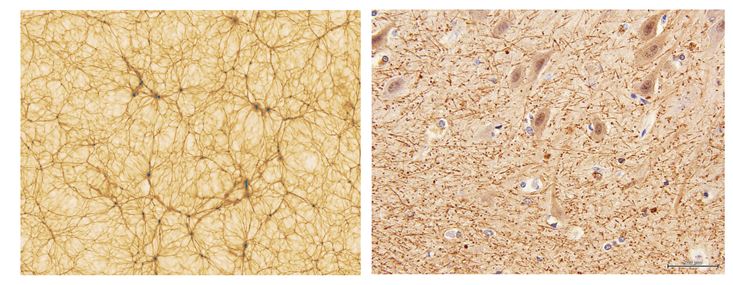
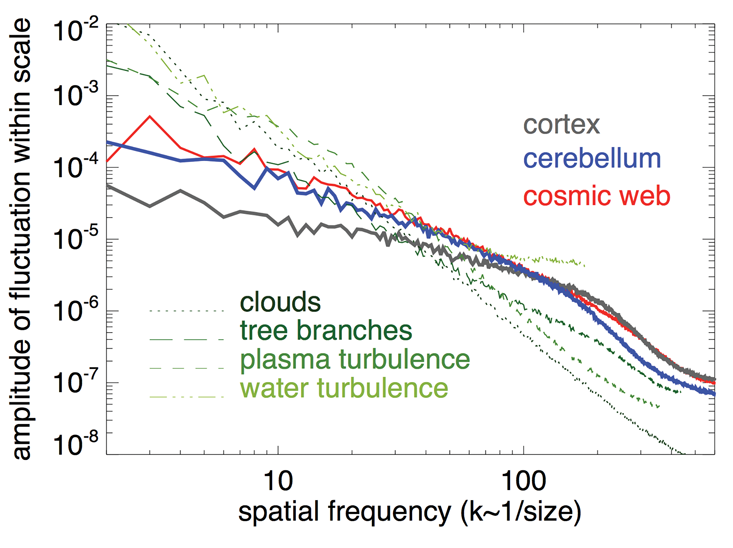
Consider also the complexity of the human brain in relation to the universe itself. Given our present understanding of the entirety of the universe, we know it to be roughly twenty-seven orders of magnitude** larger than the human brain. Despite this size difference, we now understand that the total number of neurons within an individual human brain is roughly the same as the number of galaxies we can presently observe in the universe. When we simulate the universe into an image and compare it to a scan of neurons within the brain, we see a striking similarity between the two (See Figure 2). At first, we may want to write this off as a projection—the individual sees what they desire to see. However, that is not the case here. Statistical analysis shows quantitative similarities between our neural networks and the cosmos. Knowing the numerical complexity of these systems is great, but it doesn’t shed light on the similarities between the brain and the universe. To understand this relationship, scientists calculated what would be the least amount of information necessary to build a computer program that can predict this relationship (See Figure 3). The results suggest that “the total number of neurons in the human brain falls in the same ballpark of the number of galaxies in the observable universe.”*** What we can learn from this information is that a factual relationship surrounds the totality of experience and change, the single truth. Mathematical proofs demonstrate that the entire universal cosmic web has more in common with the human brain than it does with the contents of any given galaxy. The same could be said for the individual human brain, which shares a greater similarity with the entire universe than it does an individual neuron. Now we connect the dots to observe how the dual infinities of change and imagination in a finite universe align with our scientific understandings of cosmology and neurology. Our available scientific theory and practice continue to reaffirm the necessity of embracing the single truth to align our experience of being with our understanding of nature.
The single truth is not necessarily incompatible with the traditional theist philosophies of the world. Technically, if an evolving universe is a creation—as a technological or biological simulation would be—then creationism is a viable argument. If the laws defining reality are constructs, then everything that springs from them is a product of intelligent design. Even in the scenario of evolutionary biology, the randomness that occurs in species mutation is subject to and defined by the frameworks governing time experience and space. At times, the moments we inhabit make it difficult to believe there could be intelligence guiding the process, but a simulated universe is a product of great effort and imagination. Anything the individual creates is a part of them by extension. This is as valid for a child’s artwork as it is for an engineer’s tool. However, it does conflict with traditional religious philosophies about the oversoul’s inaccessibility. The single truth brings the concept of god into a scope within reach of the individual. Creating is the ultimate power of a deity, and the single truth is the core of uniting humanity around its alignment with creation.
Observing the recursive nature of the universe, our imaginations, and our technological trajectories helps answer why we should immerse ourselves in the pursuit of a self-actualizing society. Connecting the dots of observable infinity through evolving universes, imagination, and our powers to create highlights the source of divinity we draw upon within the moment. Infinity is something that each individual possesses that exists nowhere except with the totality of universal experience. Where our present systems create narratives of independent actors adrift in a sea of chaos, we now know that our connection with the physical universe is beyond the material. Each individual represents a small slice of the infinite, unaware of the great link but participating in the process nonetheless. The individual time experience is that of the universe observing itself. Every happening since the initial moment of expansion of this universe—our big bang—results in this immediate present. The observer and the observed always represent the pinnacle of cosmological evolution and are a single sameness; without one, the other would cease to be. We perceive our time experiences as separate from external change because we lack the foundation of understanding to observe them as one happening. The single truth provides that foundation and brings a process of individual and systemic actualization.
Although the single truth may seem a far cry from many of the time experiences we inhabit now, it is not so surprising when we consider the intelligence surrounding us. Science demonstrates that humanity doesn’t hold exclusivity when it comes to imagination and communication. Plants communicate and animals imagine. Even though these phenomena are relatively new to our body of knowledge, they have been occurring for hundreds of thousands of years. Earth does not contain life; it is a living planetary network of information, sharing and evolving knowledge within a time experience. It’s not surprising that the earliest religious ceremonies worshiped nature, revering patterns of thought and change that we could recognize but not interpret. We can only ever be where we are, and history is full of moments where humanity redirected itself alongside new understandings of the world to transform its potential and capacity. Now is such a moment.
The emergence of the single truth brings the responsibility of embracing it. We must actively be aware of and share our knowledge of the universe’s perpetual state of change as the defining characteristic of our being. In an informational universe, beliefs have tremendous power in shaping individuals and societies, as evidenced by history. The frameworks presently defining us connect self and system using knowledge and information sets from time experiences long past. The single truth presents an alternative structure for thought and action that aligns collective knowledge with personal prophecy. It does not distance the individual from their present in the hope of some betterment beyond death. Instead, it connects them to the source of the divinity in the moment.
Our ability to embrace the full awareness of a moment is not a shortcut to alternative futures. Rather, it is an ever-present opportunity to realign our thoughts and actions. The single truth allows us to move forward into the future without fear. Where in the past we lacked the knowledge, now we only lack the courage. To embrace the single truth is to leave behind old narratives, ideas of truth and divinity crafted long ago that conflict with present understandings of the universe. For many, these beliefs are more than just tradition—they are identity. They are the aspects of ourselves that tie us to tradition and family units. But what is an identity in active misalignment with nature? Fear and anxiety. The idea of family is fairly static when considering blood relationships. Our sharing a walk toward expiration ensures that our legal and biological family structures will remain limited. As the single truth reveals, our webs of influence extend much farther. How does remaining faithful to a spiritual technology out of alignment with known reality help transform the individual? It cannot. It is an active deterrent in embracing the latent divinity within the momentary time experience. The narratives of salvation beyond death have conditioned us for millennia but offer no hope of a bigger life now. Self-actualization in the age of crisis is possible, but only if we are willing to create the change in ourselves and our systems necessary to manifest it.
The single truth requires no believers. It simply is. It is all of us, all of our experience, and all that will come to be. Until it is not. By definition, the single truth is perpetual transformation. There may come a time when we observe changes in the speed of universal expansion and change. Perhaps a rapid deceleration will follow our incoming acceleration. In that moment, the individual and collective will confront our present challenge anew, realigning their beliefs and actions with the known state of the universe. The single truth spares nothing from change, including itself. It is a belief that rejects dogma at the outset. It is true now, and that is the reason we must act. If in the future it is not true, it should be rejected. Change is the single truth. All else is temporary. I speak out loud to remind myself that I am limitless. I am long moments of something extending well beyond our individual existences. I am here. Now. Aware of being as both embodied individual and collective whole.
Footnotes:
- Refers to any religion serving to meet the spiritual needs of its practitioners. Technology because they are all creations of our own making.
** An order of magnitude is a power of ten. For example, if human brain size is assigned a value of “1” the size of the universe would be “1” with 27 zeros or 1,000,000,000,000,000,000,000,000,000
*** Vazza F., & Feletti A. (2017) The Strange Similarity of Neuron and Galaxy Networks Nautilus Physics https://nautil.us/the-strange-similarity-of-neuron-and-galaxy-networks-6379/
Oneness with the Relational Universe
Change as the single truth fills gaps in our understanding of being that current spiritual frameworks cannot. However, it is not enough to build a transcendent philosophy of meaning and value alone. The single truth illuminates our circumstance for what it is and clarifies to us the realities that we are and are not ultimately bound to. It also reveals the individual and collective oneness with the relational universe we share. Our experience of time as the totality of a single moment is an inseparable commonality we share with all other observing beings. When we embrace oneness with the relational universe, we acknowledge the deep connection we share with the world around us. We are both inseparable from the other and at the same time independent of them. The impacts of our actions ripple throughout the universe, just as the actions and event chains of others insert themselves into our personal experience. These circumstances play a significant role in defining the perspectives we adopt throughout our journey and are worthy of consideration in our development of transcendent philosophies of meaning and value. Oneness with the relational universe is real and inherent to being in a universe governed by the single truth.
Where the single truth helps us conceptualize the infinite nature of the universe, our expression of oneness with it provides a framework for identifying our individual divinity. Two sources of infinity are presently observable in nature: the perpetually evolving universe and the human imagination. In sharing this source of creative power with the totality, each of us is divine, equally as powerful as the gods and messengers in mythos past. The individual expresses their embodied infinity to direct the flow of information within the infinity that is our physical reality. This shared embodiment of the whole is a direct bridge between the internal and external human experiences. It identifies a fundamental basis for transcendence, the alignment of individuals with the single truth and the relational universe. Within now is the essence of infinity, our access to awareness of the totality of experience and our relation to it. The further we align individual and system around the expression of imagination, the more closely we embody the totality of being in the moment. In doing so, we align ourselves with nature and provide a foundation for human oneness unachievable with existing spiritual philosophies.
Being is the experience of time through relationships, interactions with others, and the world outside ourselves. The biological tools we use to make sense of the world are finite, so we rely on our infinite imaginations to construct frameworks for understanding. Until recently, information moved slowly, as did the individual time experience. Now, both grow exponentially but struggle to fully express themselves under the limiting beliefs and systems of the past. Our physical evolution limits our capacity to grasp change while also isolating us from an experience related to but ultimately disconnected from all others. The single truth shatters this illusion and empowers us to embrace our oneness with the relational universe. Happenings occurring outside of the individual are an inseparable part of them; they are the individual as much as the individual is themself. Everything we think, say, and do exists in context to our circumstances. To know and embrace this reinforces the foundation for our journey toward self-actualization in the age of crisis.
The idea that we exist in a relational universe is not new, but it’s not something the majority of humanity practices.* According to early texts, Buddha developed the law of dependent origination, Paṭicca Samuppāda. It states that each event comes out of another, arising from prior happenings. We are constantly grappling with the consequences of prior decisions in the immediate present, a process that we perpetuate indefinitely due to our lack of awareness. Confucianism arose in China around 500 BCE as a spiritual technology emphasizing the importance of the family and social harmony—a philosophy rooted in the idea that humans are fundamentally good, able to improve, able to learn, and can become greater through individual and collective effort. It is wasteful practice to focus on life beyond the present when the ultimate respect an individual can pay to the godhead is the expression of their inner divinity through love and focus. The idea of valuing our relationships with others as a supreme good is a recognition of our common humanity and instills purpose into the moments we inhabit. The philosopher Alan Watts said, “You can’t have this without that. You can’t have here without having there.” The space and the intervals between experiences separate one happening from another.
Viewing individual experience as inseparable from external happenings rejects frameworks of meaning and value derived from past mythos. Our social and spiritual frameworks have long reinforced the idea of individual exceptionalism. Each exists as an independent actor responsible only for themselves and, to a lesser extent, their families. We worship the individual who rises above circumstance to craft a destiny for themselves while shunning those of equal potential but lacking access and agency. We idolize success stories carefully curated for our viewing pleasure as brief escapes from the drudgery inherent to survival for the many. We are blind to the fact that these narratives serve as tools to justify the extreme inequity so common throughout the world. Our present social, legal, and economic systems are designed around misunderstandings of Newtonian physics and Darwinian evolution. We equate survival to a pure form of competitive event chains where choice is the sole determining factor of prosperity. Those unable to adapt are weak links destined to be filtered out by nature’s great process—humanity perfected through competitive ideals. Programmed ideas of value and wealth spread through religious and political institutions, championed by a majority who suffocate under the weight of their own dogmas. Self-actualization in the age of crisis is a process of embracing our oneness with the relational universe. Through this practice, we confront existing narratives as falsehoods.
In an informational universe, all experiences imprint upon us. The individual is always interacting with systems that encourage specific ways of thinking about the world. All life occupies a unique conscious coordinate, perceiving inputs and directing energy from a place no others can. We are each subject to the fact that the space we inhabit and the values we believe are inseparable. If any one of us were born in a different place, moment, or within other frameworks of personal access and agency, the developmental direction of our character and consciousness would be different. All of our creations imprint upon us specific ways of thinking and being bound to the moment of their creation. Overcoming the age of crisis begins with recognizing this relationship. Our creations are always bound to the time experience of their birth and will forever reinforce the past visions of the good they were intended to support. Here we confront the fallacy of the individual’s independence from their environment. Presently our struggle is overcoming networks of organizational technologies encouraging a form of life inadequate to overcome the crisis. It is accurate that choice within the immediate present plays an outsized role in shaping individual destiny, but different individuals always have access to different choices based on the event chains defining their history. Can someone born and raised in an environment of material insecurity, emotional stress, and lack of love ever conceptualize the world in the same way as a secure, stable, and loved individual? No, they cannot. We could create many examples, swapping adjectives, and the answer would always be the same.
Our oneness with the information relationships surrounding us is visible in every society. The systems controlling information within a society shape the behaviors and beliefs of its participants. They create the frameworks of interaction with others, rules for a game we’re unaware we’re playing, and behaviors that reinforce themselves every time we act them out. If the total information an individual receives in their time experience denies or omits the knowledge necessary to develop their personal capacity, then options others may understand as real become nonexistent. Behavioral sciences explain how formative the experiences of youth are for the individual. In these time experiences, we craft worldviews—for better or worse—that will stay with us for much of our lives. We can illustrate this by imagining that every individual is born with a personal toolbox. From birth till death, they accumulate knowledge through observation, informational inputs that become tools added to the toolbox. When a problem requires solving, they pull from the available knowledge tools. Each choice initiates event chains that continue to expand throughout the relational universe. If the individual time experience is one where problems most commonly appear as nails, they will develop many hammers. So, what happens when that person faces a challenge requiring a saw? They are ill-equipped because no points within their journey added the concept of a saw to their toolbox. We do not know what we do not know. Therefore, we must reject the dogma of personal choice as the primary determiner over our fates. Instead we should acknowledge the interwoven experience of individual and system as a single self, manifest in the moment. Our creations are just as much a part of us as our individual egos.
Ignorance of our oneness with the relational universe can often warp our personal perspectives to prioritize meaning and values in opposition to those encouraged by the single truth. My partner and I once joined a couple for dinner who self-identified as staunch individualists. In the immediate present, they enjoy material abundance, but both had their independent struggles in the past. That evening the conversation shifted toward a discussion about the relational universe and how reimagining the systems surrounding humanity would redefine us. Imagine my surprise when my friend shared his perspective that we should abolish all public institutions. When I questioned the logic of stripping away the very public systems that equipped him with the tools to transcend his personal circumstances, I was met with dismissal. He said he earned his success through sheer willpower. He insisted that the trajectory of his life would have been the same if he did not have access to public schooling, roads, and a wide variety of other social welfare systems. Now in a position of means, his perspective prioritized eliminating the funding of education systems so that he might have slightly more capital. Putting aside the inconsistencies of believing that any individual’s life trajectory would be the same despite rewriting eighteen years of experience, it is an anecdotal example of how personal circumstances shape perception. Our operating within systems that fetishize wealth, power, and rabid individualism develop a form of humanity that denies our oneness with the relational universe. They separate us from and subjugate us to our own creations, giving reverence to an order of life of our own making while denying the possibility of alternatives. Self-actualization in the age of crisis is the process and practice of deprogramming ourselves from the ideals projected onto us by the institutions surrounding us. It is a denial of the past’s dominion over the present. We embrace new values that will support defining new systems.
It seems peculiar that we inhabit a relational universe but find so many ways to deny its influence on ourselves and others, but it’s not difficult to understand why. Our immediate present is filled with laws, systems, and social norms derived from ideologies deeply rooted in conquest and dominion. History’s most recognizable names are often those whose primary influence on the world consists of violence and death. Our popular culture fetishizes soldiers and war through our games, entertainment, and politics. These systems craft narratives of strength and individuality that defy logic and contradict reality. Humanity’s greatest achievements have been the product of mindful cooperation with others.
Our scientific understanding also supports that individuals’ information streams define their values.23,24 The relational universe extends beyond frameworks of imagination; the consumption of identical information streams between two individuals creates physical events like the synchronization of heart rates.25 The connection between how our perceptions of the world influence our being highlights our oneness with the totality of experience. There is a direct correlation between our informational relationships and who we are as individuals. Considering our oneness with the relational universe alongside the single truth helps us understand the keys to unlocking humanity’s latent potential.
When we consider the influence of systems on the individual, there is no better example than our bodies of law. All laws are forms of measurement. They provide a static image of what interactions with others and objects are supposed to look like, giving us a relational understanding of happenings—not unlike a mathematical equation. Society judges adherence to laws by comparing the actions of an individual or organization against the standards we create. General codes of conduct provide frameworks of behavior that we internalize as right and wrong. Laws impact individual behavior by creating the context by which we process our observations. So how do we reconcile the power of institutions to shape reality when they promote inequity through the nature of their design?
Many of the laws presently governing us draw heavily from spiritual philosophies dictating the conduct of life that is driving us closer to crisis. These roots give our creations a sense of permanence they do not deserve. The ethos is further reinforced with a pseudo-religious dogma regarding the sanctity of laws and false narratives about equality of justice. It doesn’t take a legal scholar to understand that the people creating the laws across the globe are those with the most wealth and power. Unsurprisingly, our laws and the systems they guide disproportionately favor the wealthy and powerful. The idea that an overwhelming majority of individuals should acknowledge, obey, and support laws that distribute unequal justice has long been part of global social programming, typically reinforced through the state’s monopoly on violence. Consider also the concept of financial penalties as a means of justice for breaking the law. If the penalty for a crime is a fixed dollar amount, then that law only exists to punish poor people. The blatant corruption in high finance further reinforces this example. When investors overextend themselves, the costs of their failures are socialized through government bailouts, but the gains remain in the hands of the few. When we see a corporation paying hundreds of millions in fines for breaking the law, it is a ruse. These numbers seem astronomical to the average individual but are small fractions of these corporations’ ill-gotten profits. It is a mockery to imbue a sense of supernaturality into any human institution that intentionally shapes different time experiences for the wealthy and the poor. Legal organization is a single example that highlights how the systems we inhabit enforce specific ways of living for different groups. We find natural divinity only within the immediate present, available to all, and expressed through our ability to create change that better aligns our species with the collective whole.
There are no separate events in nature; everything exists in a single state of perpetual motion. Within every observable moment, things have specific and unique places at all scales, just as you and I occupy a space now that none other can enter. Our independent perspective is one of billions, all inhabiting a fixed position within and alongside the universe in a given moment. Every happening directly relates to other happenings, expressing itself as a single fluid time experience in the moment. By conceptualizing individual success through an adversarial lens, we deny our connection to the larger whole. The single truth and our present scientific understanding paint a picture of reality that sits in stark contrast to the narratives of being prioritizing hyper individuality, but these values are embedded in the systems surrounding us. The relational universe positions the individual as an independent node within a larger network of intelligence that they cannot access. It is similar to the experience of bacteria living inside a human body. We play a role but are unaware of our larger significance. However, we are different because we possess the capacity to leverage our infinite imaginations to shape the universe in our own image. Our conditioning does more than exacerbate otherness. It also disconnects us from totality. We are born into cultures reinforcing the idea that what exists outside of our perspective is foreign and adversarial, something to be overcome. In truth, it is directly connected. Everything outside is also inside; we are reflections of one another. When we explore the injustices and inadequacies of our present global and local organization, we must also consider how these circumstances diminish us as human beings. Embracing our oneness with the relational universe aligns us with all happenings past and present through the pursuit of individual actualization, which in turn empowers systemic actualization by decoupling social organization from a philosophy of rabid individualism.
Oneness with the relational universe isn’t purely spiritual philosophy; it is the material reality of existence. Quantum physics has brought about the theory of unified and quantum fields. The most foundational level of our physical reality is the quantum field from which all is created. It can be observed but not predicted. Underlying this quantum field is the unified field that exists in a singular state of perfect equilibrium. Events in the quantum field occur through fluctuations from the underlying unified field. The unified field can best be described as a single state of pure potential, which similarly describes our application of the single truth. There is beautiful poetry to the knowledge that the smallest thing humanity can observe is also the largest.
We know that there is no such thing as a zero-energy state in our present universe. Even in the vacuum of space, a quantum field is gently vibrating, and sometimes these vibrations produce enough energy to create sets of virtual particles and antiparticles that appear from “nothing” in our physical universe.26 When we talk of time being a wave state as a literal interpretation—all beings within our relational universe emerge from a wave of possibility. Even more intriguing, quantum field theory suggests that these happenings only occur when not being observed. Our present understanding tells us that creation is abundant in the physical universe, just as it is within our personal experience. Individuals are an extension of a universe, existing as a wave state of creative possibility, each containing an aspect of infinity within our imaginations. Therefore, it is likely that if we can transcend the crisis, humanity will eventually advance to a time experience of understanding where we may freely manipulate this wave state of possibility. Oneness with the relational universe is a philosophy that nature has shared with us for millennia, but our present conditioning has blinded us to this reality. Alongside the single truth, oneness with the relational universe completes the unified spiritual philosophy necessary for human transcendence. Our shared being is both inside and out. Self-actualization in the age of crisis is the process of changing our nature. We reject the narratives and beliefs that separate us from the infinite and reclaim our totality as one.
To be one with the relational universe is to embrace our experience of being as time. We are the moments we inhabit. We use the language of time experience to describe the individual’s awareness of and connection to the immediate present. Connecting the individual experience with the immediate present imbues humanity with a divinity inaccessible through the dominant spiritual institutions of the present. It also brings focus to the extreme varieties of time experience available to humanity in our immediate present. The disparities of material stability among collective humanity are so great that individuals occupy extremely different realms of possibility and thought. Primarily determined by where we are born, these perceptions are formed and reinforced through our foundational experiences and shape how we approach the universe. They seem absolute because we believe the time experience to be a totality of past and present intermingling in the now.
Living in different time experiences forms our understanding of what is and is not. Oneness and the relational universe teach us that diverse and conflicting perceptions of reality are no less authentic to the observers inhabiting them. The varying degrees of individual access and agency within time experiences place artificial limitations on individual imagination. If someone can’t consider an option because their experiences offer no frame of reference in that moment, then that option does not exist within their time experience. It’s as if it is not real because no possible combination of their event chains could produce an alternative to what they presently perceive. This example applies to everyone. Every individual inhabits a unique set of conscious coordinates within this universe. None of us can know everything in all moments because an inherent aspect of being human is uncertainty.
It is commonly argued that hierarchies are natural and necessary, but we know them to be recent inventions in relation to the total time experience of our species. Nomadic humanity was highly egalitarian, relying on cooperation and collaboration to grow and prosper. The advent of agriculture brought with it the opportunity for surplus. When resources surpass needs, specialization arises, and members take on responsibilities outside of the production of necessities. Throughout history, abundance has typically been highly concentrated, the majority of benefits from collective progress supporting the few and excluding the many. Authoritative structures create perspectives of hierarchy that seem inescapable. It was not that long ago when the human experience lived under a narrative of the divine right of kings. Living in the age of crisis creates a similar sense of dread in many of us; the institutions and people governing society continue to proactively worsen our problems. Our systems of change have been captured by an extreme minority, denying the collective a voice in its destiny. They reinforce the priority of the few over the majority in a different direction but to a greater degree. The single truth tells us that even these moments lack permanence. Hierarchies misalign with the natural democracy of the universe. As everything exists in a relationship with all others, each act in accordance with all else. Alan Watts went as far as to call the universe a democracy, and he wasn’t wrong. Consider measuring the direction of movement of an object in empty space. We cannot tell if a single object is moving without something to compare it to. We can tell if two objects are moving toward or away from each other, but the observer is not aware of which of the two objects is moving—whichever one they focus on seems to become the static object. Only when we observe at least three objects moving through space can we determine which object is moving in relation to the others. This phenomenon of observation also applies to our individual experiences. Our beliefs about ourselves always form in relation to others. We define individual meaning, value, and love by observing what exists outside of us instead of creating it from within. We develop personal value through comparison because the systems surrounding us imprint the idea of a zero-sum universe onto us. Progress directly relates to overcoming others; for winners to exist, there must always be losers. Democracy is inherent within the relational universe, an inescapable aspect of being that we have ignored in past constructions of social and legal frameworks. Self-actualization incorporates our understanding of the democratic universe into our personal practice and shared process.
Believing that our individual time experience reflects the universe surrounding us reframes our understanding of the age of crisis and our opportunities for transcendence. To embrace our oneness with our relational universe is to embody life at the edge of meaning. The subjective nature of individual time experience highlights why self-actualization in the age of crisis is a journey toward aligning individual and system. We inhabit a perpetual relationship with the outside and others, a single experience of being. With this in mind, we recognize that our present global organization and systems reinforce separation and are therefore inadequate in the reimagination of human divinity. Through individual practice and collective processes, we can reshape ourselves and the world around us. We enhance and empower the individual by crafting a world that maximizes their opportunity to leverage imagination and creation in the directions of their choice. In doing so, we free ourselves and our concepts of value and meaning from the binds of a past we had no say in choosing.
Footnotes:
- Religious Composition by Country, 2010-2050 Pew Research Center April 2, 2015, https://www.pewresearch.org/religion/2015/04/02/religious-projection-table/
Birth Lottery and Event Chains
We’ve established our oneness with the relational universe and how all human beings operate within the frameworks of the totality of their experience within the moment. Now we will focus on the personal impact these circumstances have on the individual to explore how birth lottery and event chains completely out of our control drastically influence our individual access and agency within the world. We’ll place special attention on why organizing ourselves in ways that reinforce these impacts is far from ideal. Everything within the moments we inhabit perpetually imprints on us to shape our understandings and beliefs. Birth lottery is a term to describe the universe surrounding us as we enter the world. Every child enters the world with a unique set of circumstances, born in a specific place, to individuals whose intent and effort are to be determined. Birth lottery incorporates all factors of our initial experiences because while each of us came to be within a unique set of circumstances, we all share the extreme vulnerability of being young. Factors ranging from our personal health, family wealth, and the event chains that shaped the history of our parents ensure that each of us begins life within different frameworks of reality.
It is both accurate and incorrect to claim that birth lottery dictates individual capacity—accurate because the resources you are born into have a significant impact on individual agency and access to opportunity and resources, and incorrect because all individuals are more than the systems surrounding them. Our most formative years are places of extreme vulnerability that many of us emerge from with various forms of trauma and informational frameworks for processing the world. Birth thrusts us into a specific position within the universe that we have no say in choosing, one that plays an outsized role in the trajectory of our lives. Considering the impacts of birth lottery and event chains on individual access and agency in the world, we turn our focus toward transcending the inescapability of randomness, reimagining individual experience in such a way that each possesses the capacity to escape the circumstances of their birth and express themselves within the universe.
We recognize that the most defining moment of life is birth for various reasons. For the individual, birth is a random event that brings with it frameworks forever influencing our ways of understanding the universe around us. Systems we had no say in crafting immediately take hold of our experience, defining what is and is not. Variables such as geographic location, parental wealth and attention, group spiritual philosophies, and specific laws immediately constrict the individual’s experimental agency. As a collective, we still struggle with past frameworks of birth lottery as a means of self-organization, a way of designating power and order in a world of fundamental unknowns that no longer burden us. Individual actualization demands that we grow beyond the power and influence of birth lottery on the human experience. To do that, we explore why it plays such an outsized role in present society and what we can do about it.
The mythologist Joseph Campbell lectured about how societies have historically created specific, limited types of human beings. Behaviors and bodies are molded to fit the needs of society, identifying the individual as a member of a particular group. For example, the needs of a primitive hunting culture would be different from those of a primitive agricultural society. Each provides different ways of thinking and acting within the universe according to the moment. The problem of being constrained to the time experience of our birth is not new. Over time, societies have changed how they integrate the individual, but the core problem of opportunity being birth-dependent has yet to be resolved. Now we find ourselves in a moment where the constraints of linear time experiences are loosening. Today we possess the capacity to reshape the arrangements supporting birth lottery as the primary determiner of individual expression, but only if we choose to do so.
Placing value on the birth lottery is a legal and social technology extending as far back into our history as place-based farmers. It is a form of social organization that defines individual capacity and worth by randomness, citing a divinity that none ever had the right to claim in order to infuse a false legitimacy into the ruling powers. It was thought that by assigning the position of supreme leader to an individual yet to be born, humanity paid reverence to the gods guiding our lives.
Today the concept is intertwined with nearly all of our systems, each of which has evolved under frameworks of birth lottery as a legitimate way to organize and distribute the benefits of living within societies. It doesn’t have to be this way, but it has been for a long time, so it seems natural. Individual actualization requires that we move away from birth lottery as a self-organization system. We accomplish this by rejecting randomness as the primary determining factor for individual access and agency within the world. Our shared journey toward systemic actualization is the process of reorganizing ourselves so that the randomness of our birth plays little to no role in our ability to change the direction of our lives.
We can easily imagine how someone born into extreme poverty will experience a radically different universe than someone born into wealth, and several studies support the concept as fact. For example, a 2019 study reviewing the long-term impacts of being born into poverty in the United States cataloged the effects of parents and approximately 230,000 children who lived in Chicago in the 1980s and 1990s, using indicators like exposure to high levels of lead, violence, and incarceration as key predictors of children’s later success. The results found correlations between male children growing up in harsh environments, increased adult incarceration rates, and lower earnings.
For young girls, exposure to harsh childhood environments accurately predicted higher teen pregnancy rates.27 Black women make, on average, sixty-four cents on every dollar made by white men. This translates to Black women being paid 34,000 dollars a year compared to 53,000 dollars for white men.28 Social mobility continues to decline across generations, down 20 percent over the past thirty years.29 It is now more likely that people will remain in their parents’ economic class rather than progress. This variance in experience directly results from how we organize the laws and systems governing national and global society. Thus, we further establish the case for the concept of self to be separated into individual and system.
A nine-year study by the Center for Disease Control found that Black, American Indian, and Alaska Native women are two to three times more likely to die from pregnancy-related causes than White women.30 The trauma of maternal deaths during pregnancy extends globally, with 94 percent of incidents occurring in low- and lower-middle-income countries.31 Consider also the impacts of poverty on individual health during critical development stages. Malnutrition accounts for almost half of the deaths of children less than five years old around the world. Poor nutrition in the first one thousand days of a child’s life can also lead to stunted growth, which is associated with impaired cognitive ability and reduced school and work performance.32 Throughout the world, birth lottery determines the quality of education an individual receives. We have organized ourselves to actively equip people with different analytical skill sets depending on where they are born. In doing so, we squander creative genius and sow seeds of disempowerment. These examples demonstrate how birth lottery acts as a catalyst for perpetual disadvantage, driving individuals into experiences that erode their humanity at each step.
Beyond personal circumstances, our birth lottery positions us within specific sets of institutions that dictate the conduct of life. Systemic oppression and violence disproportionately impact poor and local minorities. Throughout history, millions have been born into societies where laws were developed by one group to actively oppress another imagined to be less human. Our systems encourage this to a degree where past populations of oppressed people are now active oppressors; the cycle of violence and dehumanization continues without introspection. Widespread individual actualization cannot exist in a universe where access and agency are distributed randomly at birth to a small minority of the total population, and no amount of outliers will ever change that. Individual and collective transcendence requires us to embrace the inherent radical power of prophecy contained within every new life. There are no others beyond a differentiation of interests and circumstance, no justifiable reasons to hate or oppress another because of the random event chains influencing their being. Those embracing otherness as a means of personal gain do so in stark contrast with the nature of our universe, reinforcing beliefs and behaviors driving us toward the crisis. Understanding this fact gives us the power to radically redirect ourselves and our systems.
Systems supporting birth lottery as the primary influencer of individual access and agency reinforce a radical ignorance within our collective population. However, it would be incorrect to assume that all participants embrace these philosophies willingly. Consider the individual embodying and promoting a culture of hatred. The majority rightfully reviles them, but what event chains wove the webs tapping them into a time experience lacking the capacity to imagine alternatives? Individual actualization is a process of radical empathy, recognizing that even the vilest individual entered our shared universe with the same infinite potential as the rest of us. While the event chains composing the universal web of the individual may produce revolting results, the organization of society must never deny their capacity to return to the fold under the right institutional innovations. To believe that we all can be more than we are is a core tenant of individual actualization that we must apply to ourselves and others. We are not ignorant of the fact that the individual’s transformation must be a personal choice and that some will choose to remain on trajectories separating themselves from the single truth and our oneness with the relational universe. At the same time, we must provide those willing to embrace the single truth and work toward self-actualization in the age of crisis the opportunity to do so. Nothing is beyond change, especially the individual human embodying an infinite imagination.
What of those born into means? Individuals born into a universe free of material struggle begin their journey standing on a floor much higher than those with material struggle, creating pathways for experimental imagination and creativity unavailable to others. Our ability to fully express ourselves depends on a certain base level of security, which is a major difference in the development of individual capacity. For those born into a world without concern for material security, birth lottery often creates different barriers to individual actualization. For many, there is the willful denial of the reality of our circumstances. Whether through the convenient limiting of personal power through self-imposed inaction or through the embrace of personal circumstances as a result of direct effort and ingenuity, the individual embraces a narrative conveniently reinforced by the inequitable institutions to remove themselves from their connection to the whole. In doing so, they attempt to isolate themselves from nature and our oneness with the relational universe. They may believe that their momentary security will extend into the crisis or conceptualize their personal family unit as somehow removed from the whole. Our systems further support this cognitive dissonance through dynastic wealth transfers, calcifying beliefs in the legitimacy and fairness of the systems that be. It is not enough to recognize the need for action or support change with idle words; the crisis requires all of us to become changemakers. To abstain is an act of willful ignorance, a denial of our inherent interconnectedness in a relational universe, and a failure to cultivate the empathic powers that define human beings. How can a person who rejects reality ever become one with it? They cannot.
Consider also the fundamentalist theist, whose history and community may insulate them from the perils of life others struggle with. They argue that we live in a deterministic universe because their god architected it; therefore, there is nothing to be done about birth lottery. Those who struggle and suffer because of the surroundings of their birth are meant to be exactly where they are. It is a view in direct contradiction with many of the humanistic lessons found in the ancient texts, but one conveniently recalled whenever questions arise about the power structures inherent in monotheistic religions. In truth, there is no conflict between reorganizing the world away from randomness and believing in a universal intelligence. Our historical spiritual technologies have a well-documented history of changing their philosophies to meet the needs of the moment.
There are many circumstances and events within our known universe where accepting things as they are is valid and reasonable, but birth lottery is not one of them. We cannot rewrite the history bringing us to this moment, but we can change our past by acting within the present. We must begin by recognizing the right of self and family preservation while simultaneously acknowledging our oneness with the other and the inherent responsibility this places upon us as individuals. It is intellectually and spiritually lazy to prioritize self-preservation in a moment of collective crisis. The most direct path to individual security and prosperity is through the elevation of the collective. Only then do we maximize our capacity for experimental imagination and innovation toward a shared vision of the good.
Today our systems embrace birth lottery as the highest form of soulcraft. It is a way of organizing ourselves that draws deeply from historical superstitions to support significant disenfranchisement for the majority. Self-actualization is the process of purpose-driven creation, intent manifesting through individual and collective efforts to be more than we are. To reject the grasp that birth lottery possesses over individual access and agency is to open ourselves up to a universe of genuine equality of opportunity, laying the foundation for possibilities of individual and systemic actualization presently unavailable. The elimination of birth lottery as the determiner of human fate is and should be considered the north star of the reforms necessary to reshape the world and transcend the age of crisis.
Points of Reflection: Chapter 0
-
The speed at which information is expanding is increasing. This significantly impacts the human time experience.
-
Change is the single truth.
-
Everything exists in relation to all else within the moment. There is no separation between individual, others, and the universe we inhabit, despite what our limitations may suggest.
-
Human experience is that of the fractional observer within an informational universe.
-
Our most advanced science suggests that universes are successive, a process that is essentially infinite from the human perspective.
-
There are two observable infinities within the universe: the universe itself and human imagination. The alignment of these two represents human divinity within the moment.
-
The inheritance of a specific type of history limits human capacity to transform, but only because we choose to allow it to do so.
-
Our creations reinforce birth lottery as the most crucial moment in human existence. This is an inadequate framework to meet the needs of the moment.