Chapter 2 — Individual Actualization
A Short Guide to Active Soulcraft
-
Begin with the end in mind. Who are you becoming, and what steps are necessary to take you there?
-
Document your plans and pathways.
-
Set milestones, not timelines.
-
Embrace discomfort. Every master was once a novice. The lessons one learns when they lack collective context are those that inspire innovation.
-
The practice always occurs now. When you avoid responsibility to yourself, you choose to move away from the directions you desire.
-
Focus on something that brings you joy, piques your curiosity, or inspires your action.
-
Recognize that your habits shape you but do not ultimately define you.
Applying Modern Shamanism
-
Develop small rituals that ground you to the moment and elevate your awareness.
-
Practice pausing with the moment. Five breaths is a great exercise to support this.
-
Imagine more. Visualization sets anchors that pull us toward known futures of our own creation.
-
Make time to consider the single truth and the relational universe from your personal perspective. How might you deepen your connection with it?
-
High ritual is a sacred right of our practice intended to deepen individual connection with nature. Engage in the journey at your own risk.
-
As your awareness of the relational universe develops, dedicate focus and energy to considering the totality of your moments.
Authentic Imposter
In exploring the age of crisis, we explored doubt and its impacts on the individual. Now we turn our focus to how our knowledge of the single truth changes our approach to grappling with doubt in our daily lives. We focus on developing practice and habits to combat doubt’s ability to shift us away from pursuing the directions our imagination demands. The title of this section draws from the everyday struggle many of us have grappled with: imposter syndrome. Impostor syndrome happens when an individual doubts their skills, talents, or accomplishments and fears being known for their ineptitude.^28^ It refers to a lack of self-belief and a fear of exposure—that one day the curtain will be pulled back and our weakness and lacking will be visible to all. Feeling like an imposter is a psychological phenomenon that typically defies logic or history, an imprint from a lifetime of interactions within systems prioritizing otherness and competition as a means of measurement. Feeling like an imposter is incredibly isolating because it is a lessening of ourselves in comparison to others. The single truth and the relational universe teach us new foundations for how we should perceive ourselves and our efforts in an ever-changing universe. We become more human not by avoiding or denying our insecurities, but by reimagining them within our new structures of meaning.
In 2019 I was invited to participate in a disability leadership development retreat for my work on developing a free and open election campaign platform to support access to the process of local governance. It was an inspiring event full of changemakers impacting the disability space. Our final evening at the campgrounds ended with a large campfire where the participants spent time getting to know one another on a personal level. The space was ample, encouraging several small group conversations to form. In my huddle, we were discussing building organizations when a young pioneer researching social media addiction leaned over to me. “How do I get over feeling like an imposter?” he asked. My reply was quick but came as a shock to the group. “Everyone here is an imposter. Me most of all.” I did not say this about so many high-achieving individuals lightly, nor as an insult to anyone in the group. Instead, I was recognizing how the crisis of doubt infuses the individual with deep insecurity. As a result, we experience unease about our personal capacity, ability, and will to create what we envision. This is especially true when challenging ourselves, taking on tasks that make us bigger than we are.
In a relational universe, our existence is constantly exposed to happenings outside of our vessel, so it’s unsurprising that we compare ourselves to others. The feeling of being an imposter is experiencing information through emotion, drawing from the space between who we are and who we are becoming. The single truth of perpetual change ensures that there are always unimaginable unknowns in whatever directions we choose. We don’t know what we don’t know, and that makes us nervous and uncomfortable. It is a biological learning from a time experience long ago when our survival depended on not being killed and eaten by a variety of predatory animals. We will never remove unknowns from the experience of being human, but we can reimagine how we digest and act upon this information. Systemic actualization provides tools to remove fear from human experience, but not until the individual embraces that the lack of knowledge does not equate to a lack of worth. It is a state of being that we all occupy, one we experience in many different directions throughout our lives—sometimes by choice, oftentimes out of our control. At the core of the human time experience is our absorbing and projecting of information. There is nothing the individual cannot learn and do well, given enough time. The feeling that we do not belong, that we are imposters, is nothing more than awareness of what we do not know. As we’ll explore, it is something to embrace and celebrate in our journey toward becoming more than we are.
Recognizing our imposter syndrome as an authentic aspect of who we are in this moment is the first step toward letting it go. The process of becoming more does not lessen us; it is expansive. Yes, there will be people within any given moment that will know more and be better at the things you are working on. However, we should never forget that our individual time experience contains a uniqueness that no one else possesses. Our personal event chains always hold the possibility of connecting dots others may miss, especially when we are aware of the immediate present and our objectives within it. Doubt is merely a framing of information, and even though our systems encourage us to feel one way or another, we are ultimately the architects. I have long taken solace in the knowledge that humanity shares a general confusion. It is knowledge that has served me well in aspects of life ranging from dating to productive work. It was a conclusion I reached during my summers working while attending university. Like many novices, I naively believed that individuals’ professional resourcefulness and imagination would translate into character and wisdom. As I became further acquainted with my peers and occupational superiors, my illusions were rapidly dispelled, a trend that has continued in every venture I have undertaken since.
Everyone was just as clueless as I was. The only difference was that others had the lived experience to better navigate unknown waters. Their expertise did not elevate their humanity above mine, and I often observed those with power and knowledge behaving in ways that seemed more about feeding their own egos than elevating purpose. How many of us have experienced an environment where leaders were aggressive or belligerent? If you want to understand an individual’s insecurity, give them a moderate amount of power and status and observe how they treat others. My experience has led to many observations of people attempting to overcompensate their insecurities through aggression and exclusion. Pay them no mind and offer them no more energy than necessary. In your personal life, avoid them. At work, breathe deep and understand that their criticisms are not a reflection of your character or worth. Aggression toward those who lack knowledge and experience is an attempt to dominate. A projection of insecurity and weakness is apparent to all except the aggressor. These are the inauthentic imposters, pretending to be separate and removed from what is. They pretend to possess knowledge and awareness that is somehow out of reach of the other.
When we embrace the authenticity of our ignorance, we also acknowledge that we share this struggle with others. In moments of conflict, the self-actualizer opens themselves up as a resource, paying little attention to past errors beyond the discovery of root causes to share lessons for the future. The gaps in knowledge and experience are inherent and ever-present in a universe governed by the single truth. To approach them with anger or frustration is to fundamentally misunderstand our time experience.
Consider how even our moments of success are never enough. In my twenties, I founded a retail and e-commerce business focusing on building a home beer- and wine-making community. It was a passion project and an effort to build something of my own. My partner and I took a 30,000-dollar investment, ordered some materials, rented and furnished a small warehouse, and began our journey. Over the next eight years, we built and supported incredible communities at the local and national levels. In total, we employed seven team members outside of ourselves, operated two retail warehouses, and generated about six million dollars in revenue through our direct channels and partnerships with big box retailers. We were shipping to every state in the United States and internationally. After eight years of operations, my partner and I decided to move our lives in different directions.
Being thirty-four was a much different time experience than being twenty-six. We had families now, and it was time to part ways. Fortunately, we were able to arrange a sale with a community member who—at the time of this writing—is still operating the business. For some time, I struggled to determine whether my efforts were successful, especially within the context of the financial outcomes. When I founded the organization, my only focus was on building something great. Then, in my mid-thirties I wondered if I should have been spending my efforts on something more lucrative. One of the struggles with overcoming doubt is that it takes many forms, and when we evaluate ourselves and our progress, we often do it from the values of others instead of our own. That my capital and material gains would have been better off on an alternative path was, at times, a source of shame. Business, after all, is about making money, and the ultimate measure of a successful venture is quantified by net revenues—monies retained after expenses. I struggled with this question for some time, but I ultimately concluded that it was worth every moment of my focus and energy.
To prioritize profit over the incredible friendships I made, the wide breadth of expertise I gained, and the countless lessons I learned was a diminishment of my humanity. But I, like everyone else, have been exposed to a single economic system that reinforces specific types of belief and behavior—systems of economics, law, and entertainment that tell us what we should and should not value. They paint a clear picture of who is and is not successful, a vision of humanity that only serves to perpetuate itself. It’s no wonder that the grass always seems greener. While this particular story is unique to my journey, the theme is one we share collectively. We inherit meaning systems by being born at a specific moment, in a specific place, to specific people. Within these relationship frameworks, we are made to feel as if there are right and wrong paths to follow, but that is simply untrue. The only valid measures of success are the ones we create for ourselves. Am I closer to the creation of my vision today than I was yesterday? If yes, great! If not, I will be better tomorrow.
We become authentic imposters by detaching our personal value and worth from our circumstances. It is a fact we must revisit time and time again to create the habits necessary for overcoming our crisis of doubt. Individual happiness should not be tied to a moment because the relational universe teaches us that we are the totality of happenings, extending from our individual perspective to the vast cosmos. It is a difficult habit to practice because so much of our surroundings tell us not to. The infinity contained within each individual cannot be judged by a single moment, no matter how great or miserable it may be.
When we direct our focus and energy toward the past, we strengthen the grasp of history on our immediate present. Our fear of the past, or lack of it, in relation to a specific focus, will dictate our future. When we fear our past, we manifest a self-fulfilling prophecy. Dwelling on the past within our immediate present influences our thoughts, behaviors, and actions to generate the outcomes we hoped to avoid. The single truth teaches us that the past has no sway on the future; only the present does. Different moments will impact our perceptions in varying degrees, but contained within that same certainty is our ability to let those moments go. Embracing our authentic imposter brings an understanding that each moment of awareness contains a reset button. We cannot change the past moments that brought us to our immediate present, but we can redirect ourselves away from the trajectories we inherit toward visions of our own crafting at any time. To do this, we need to be able to summon an awareness of the moment by developing the necessary habits and practices.
Our power to break the past’s grasp on our future stems from choosing not to engage with the self-harmful practice of focusing on what we are not. This is easier said than done, especially in times of distress, but it is completely within our reach. The single truth tells us there are only two states within the individual time experience: what we are and what we are becoming. We are never what we are not until we decide to make it so. The process of becoming is a result of directing our energy and focus. Therefore, when we focus on aspects of our circumstances that make us feel less-than, we give these aspects of ourselves a realness they otherwise lack. Of course, not all self-reflection is bad. Becoming better by constantly learning from our mistakes is a standard practice of all self-actualizers. We are rejecting associating our personal worth to any moment, positive or negative. Value derives from philosophies of meaning that shape our perspectives. Happenings only change our place in relation to the universe. While we typically intend our efforts to draw us closer to the outcomes we desire, at times we find ourselves farther away from accomplishing our objectives than before we started—at least it seems that way through the lens of our linear time experience. Given that we all share a birth into networks of systems rooted in competition, it is unsurprising that we draw value and worth in relation to the outcomes of our efforts. Know that this conditioning is not natural nor permanent. Each of us possesses the power to detach our self-worth from our circumstances. Through the lens of the truth, we recognize the practice of intertwining personal value to the outcomes contained within a specific moment for what they are: directing energy and focus on self-harm.
Within our relational universe, the ideal reality is one where the individual can fully commit their focus and energy to the direction of their desire. We can imagine our time experience as a long fuse laid out straight. In this scenario, our birth begins our slow burn toward nothingness. Each moment that passes contains infinity, immense energy released within the spark. When we are aware of the value of our time experience at the momentary level, we recognize that focusing on what we are not—the imposter—is an active choice. We choose to make those moments a part of our experience. Moments of anxiety and self-immolation create insecurity. As explored earlier, I am just as guilty of expressing the imposter as any other; I imagine more so than most. It can be hard to recognize in the moment, which is why we practice awareness in several forms. Our authentic self is the one we have complete agency to define. It has long been established that no human should ever seek to proactively harm themselves or another. Why then do we self-loathe? Again, we turn to the single truth and the relational universe. We are this way because the systems governing our interactions within society make us this way.
Have you noticed that you consume more when you are stressed? It might be food,^29^ drugs,^30^ or entertainment—the list could be an entire book in itself. How often does this stress consumption turn to guilt or regret? Every moment of awareness is one of potentially infinite directions. Our divine powers of creation are not limited to the creation of positivity. As we have observed throughout history, many have leveraged their imaginative infinity to harm and destroy. Stress is a trait we share as a collective that has been preyed upon for over a century. Our media projects a narrow image of humanity while omitting many others. Our news is owned by conglomerates who intentionally sow discord for profit. The advertising and marketing industries exist to make us feel like we are always missing something. The majority of the information produced exists to elicit fears, wants, and confusion. How can we feel wholeness within our moment when everything built around us is designed to exploit? It is not easy, but it can be done if we reframe our understanding of meaning and value.
So how do we translate removing self-worth from circumstance into actionable practice within our journey of individual actualization? Moments of self-harm, whether they be mental or physical, are dangerous time experiences, so our best defense is to avoid them. Embracing our journeys as authentic imposters doesn’t make the individual immune or separate from the event chains defining their history, but it does infuse a detachment from the outcomes of said past. The individual possesses an absolute certainty of their ability to redirect their focus and energy within the moment. It’s not an excuse to be ambivalent toward our choices and impact on others, but an understanding that despite our past failings, we are more than the combination of our history paints us to be. Most importantly, being an authentic imposter is an act of deep empathy. To be one, we must extend the same to others. We must recognize and affirm that none are limited to the sum of their circumstances, so long as they choose alternatives.
Awareness
Awareness as a core value is the practice of elevating our perception within and of the totality of experience. It is the expression of being that results from embracing our reimagined core values, small rituals, and soulcraft within the moment, a time experience of ideal focus in the directions of our choosing and an elevated sense of connectivity to the universe surrounding us. It is both a physical and spiritual experience. When inhabiting a time experience of high awareness, the individual perceives more information than they previously thought possible. They become more effective and precise in their chosen directions, empowered by heightened sensitivity to the internal and external infinities they observe. Our embodiment of awareness as a core value is rooted in our vision of a greater humanity. We embrace awareness as a core value to expand our understanding of the limitless potential latent in each individual. We recognize we are more than the systems surrounding us allow us to be and embrace the unification of system and self to heart as a spiritual quest guided by our understanding of the relational universe. We practice awareness to develop a form of humanity that empowers each to align themselves with the single truth.
Awareness develops alongside the practice of our core values and our embrace of the single truth and the relational universe. It is especially intertwined with our expressions of enthusiasm and minimalism. Our enthusiastic approach to engaging with others and the universe continuously makes us greater. We learn more, do more, and become more in our chosen directions, providing deeper and ever-expanding awareness. As we expand the scope of our knowledge, we form connections between various event chains that develop into unique time experiences of compounding awareness, available only to the individual. The highest forms of awareness empower the individual to separate their ego and being from the circumstances and vessels they inhabit. The experience of peak awareness is difficult if not impossible to retain indefinitely within the immediate present, but the more committed we are to its practice, the better we become at identifying ourselves as separate from circumstances. Our reduction of the unnecessary and unwanted through minimalism sharpens our focus on what matters, heightening our awareness and strengthening our power to direct the flow of our time experience. When the individual unburdens themselves from the unnecessary, they develop a precise form of awareness that can better resist distraction. Awareness as a core value is the persistent cultivation of our engagement with and choice to direct the moment.
Developing awareness has many practical benefits that extend through various aspects of our lives. It deepens the connection between the individual, others, and nature. In combination with relation, it permeates the individual’s understanding of the world and infuses harmony into daily experience that is otherwise unavailable. We become less subject to confusion and frustration and more in tune with our powers of redirection within the moment. Awareness is a powerful perspective in evaluating circumstances and others and helps develop a broader perspective toward planning and executing our vision. Alongside flexibility, awareness enhances our embrace of equity and the latent divinity within the other. Through its practice, we become more whole with the totality of experience. Our embrace of awareness as a core value and commitment to the practices and habits necessary to develop it help extend our fractional perspective ever so slightly. In doing so, we develop a mechanism for compounding the expansion of our humanity.
Individuals may develop and strengthen their awareness through rituals and practices. Additionally, dedicating focus and energy to introspection helps us cultivate visions of ourselves in our most aware states. Examining past happenings is a process we’re all familiar with; however, there is something to be said for the context of our reflection. It is valuable to examine the trajectories bringing us to the immediate present from an objective standpoint. Our intention is to discover lessons we may have overlooked in the moment and evaluate our behaviors in relation to the ideals we envision. It is purely information and not at all intended to descend into pointless self-judgment or frustration. To dwell on a past that no longer exists and is completely out of reach is a waste of energy and focus. It does nothing to bolster awareness and moves us farther away from alignment with the single truth. Focusing on future circumstances is the act of visualization, a small ritual we will explore further in the text. It is a way of providing context to future moments that have not yet occurred and may never occur. We bring awareness to the future by creating anchor moments that draw us toward them. While it’s difficult to quantify awareness, we progress by embracing and consistently practicing core values in alignment with the single truth and the relational universe.
Cannabis, Sin, and the Joy of Novelty
Modern shamanism, as a practice within our journey toward individual actualization, incorporates several aspects of nature into our rituals and beliefs. We draw from our understanding of humans’ symbiotic relationship with the universe and their environments. From the water and food we consume to the rare minerals that power our supercomputers, nature supplies us with the resources necessary to thrive and create. It was true when human time experience was limited to nomadic hunting and foraging and will be true when our species is harvesting stars and gas giants for resources we haven’t yet discovered. Beyond the means necessary for survival and progress, nature provides us with novelty. From the beans that make our morning brews to the yeast that ferments our sugar waters into beer and wine, humanity has always found a way to enjoy small pleasures with nature’s assistance. In our efforts to align ourselves with the single truth, we recognize the joy of novelty as an aspect of individual spirituality.
Cannabis is one of nature’s most miraculous bounties. It relieves physical pain, aids and intensifies our spiritual practice, and helps us enjoy novelty in the moment through states of deep relaxation. We understand that cannabis use in spiritual rituals is at least 2,500 years old, dating back to funeral rituals in China during 500 BCE.^44^ The earliest evidence of cannabis consumption in India dates back to around 2000 BCE,^45^ and the Vedas call cannabis a source of happiness, a joy-giver, and a liberator that was compassionately given to humans to help us attain delight and lose fear.^46^ It’s not too difficult to imagine that although our evidence of ancient use is limited, the practice was likely widespread amongst any with access. Our historical connection with cannabis in ritual highlights its proper classification as a sacred plant. Cannabis aids in our practice of modern shamanism by augmenting our small and high rituals and helping us engage in the enjoyment of novelty.
Smoking or ingesting cannabis and practicing meditation can lead to a visionary experience, especially for the veteran practitioner. When entering a deep meditation, marijuana encourages hallucinations that are less intense than high ritual mushroom ingestion but greater than standard meditative practice. They come in many forms and, like the mushroom, seem to be communicating at times. Unlike the overwhelming experience of high ritual, augmenting meditation with cannabis results in distant hallucinations—visible but out of reach. In my personal journey, I have experienced cannabis-induced hallucinations that come in the form of layers of depth and dimension to my standard visual perception, as if shapes and imagery were superimposed over my standard field of view of darkness within the meditative state. Cannabis also can unlock audio hallucinations that, from my experience, can best be described as the sound of vibrations pulsing up and down—a rhythmic pattern of sound and silence. Cannabis as an aid to this small ritual assumes the ability to focus and concentrate on your breath which is developed through practice. I would not personally recommend cannabis-enhanced meditation to the novice but would not fault them for experimenting. Be aware that different strains of cannabis impact the individual in different ways, and in my personal practice I have found that some strains make reaching meditative states that transcend the physical very difficult. We become too busy thinking about everything at once. Where meditation is the primary small ritual for the individual, the addition of cannabis is exploratory and lacks priority.
Earlier I shared my small ritual of practicing yoga, which at times I enjoy under the influence of cannabis. It allows for a deeper meditative practice. I find that each pose feels spiritually different in a way I have yet to experience during standard practice, especially when practicing a slow flow with extended position holds. When using cannabis to enhance aspects of your journey, be mindful of your commitment to restraint, relation, and awareness. There is nothing wrong with enjoying nature’s bounty. You should not feel guilty; there is no higher power judging you. Cannabis, like all else, is simply a form of information we interact with as observers. It is as much a part of our experience as any other plant we eat or use for industrial production. It is simply one that has many medicinal and spiritual benefits.
There is also evidence to suggest that cannabis should be avoided by anyone under the age of twenty-one, as the brain is still developing. Youth marijuana consumption strongly correlates to the development of fewer neural pathways in specific brain regions such as the precuneus, where we draw alertness and awareness from, and the fimbria, which is responsible for learning and memory.^47^ I have my doubts about reason’s ability to triumph over the experimental urges of youth, but we should have candid conversations about cannabis’ impacts. When we demystify the cannabis experience through decriminalization and awareness, we diminish its allure.
Part of embracing cannabis and the joy of novelty is overcoming the stigmas of discussing personal drug use with our children. Whether our use is medical or recreational, it serves a valuable purpose. A culture of hypocrisy is significantly more damaging to our youth than the transmission of knowledge. The idea that children should not be exposed to the knowledge of small and high ritual drug use only mystifies the experience, allowing for the influence of others who may not have their best intentions in mind. With this being said, small rituals are no excuse to be absent of responsibility to ourselves and others. Cannabis can be addicting, especially through the lens of novelty. The individual must exercise their core value of restraint to ensure they do not engage in self-harm.
Sin is the act of engaging with others and the universe in ways that do not align with our core values. There is no such thing as original sin or birth sin, as humanity is born into this world without burden. Such an idea only serves to bind the individual to a specific, predefined path of belief and perspective. Original sin is a convenient religious tool for political and economic dominion but holds no value or place in our shared journeys toward self-actualization in the age of crisis.
Like all other words, sin is a context of our own creation. We associate the word sin with some external judgment from an omnipotent being, but this concept is a relic of a human time experience lacking our present knowledge. In the future, we may decide to replace rather than redefine the word, but for the sake of exploration, we examine it as is. As the single truth ensures that we are only ever here now, sinning is, in many ways, forgetfulness. We either forget about our core values entirely through some form of stupor, or we are aware that our future actions will break from our core values and act anyway—forgetting why we chose to align ourselves with the single truth and the relational universe in the first place. We know sin best after the act because only then can we reflect on how it makes us feel compared to the person we believe ourselves to be. More often than not, it’s not a positive feeling. We must separate sin from guilt by reimagining it within the single truth. While the individual time experience is embodied infinity, we, as observers, are still bound to our humanity.
We are fallible beings who never possess perfect information and, therefore, always lack the capacity to make the ideal decision. At times, our emotions and the neurochemicals they coincide with rapidly shift our perceptions of the universe and bring about a more impulsive and instinctual state of being. Sin is, therefore, a part of us, aspects of our past that make us whole within the immediate present. We cannot escape the misalignments of our past, but we can avoid fetishizing them. Just as we seek to eliminate expectations of our outcomes, we abandon the falsehood that we are beyond error.
We abandon the guilt associated with sin in favor of a renewed commitment to being more in our chosen directions. Both require the same amount of focus and energy, so why choose to be better? At times we may not be able to simply reject guilt, especially if our sin breaks our commitments to others. Although these circumstances certainly illuminate a serious misalignment with our core values of restraint and courage, they do not transform us into static beings existing permanently within these states. Recognizing sin is a self-taught lesson in what we do not want to be. What matters most is the direction of our focus and energy within the immediate present.
But what of the individual who uses our rejection of guilt as a justification for sin? They were never genuine about embracing the single truth and the relational universe in the first place. The single truth tells us to approach others with a focus and energy free from the prejudices of our immediate perceptions, but the individual still retains the responsibility of breaking connections with bad actors. The journey toward individual and collective actualization will be long and hard fought. The individual should not concern themselves with those who willingly abandon their relation to the other in favor of temporary and fleeting progress.
Novelty has been known to us well before the observing time experience ever inhabited human form. Humans have observed play in mammals, birds, reptiles, fish, and some amphibians.^48 ^Humanity has been observing consciousness, in its many forms, for hundreds of thousands of years before the establishment of our present social orders. Joy and novelty are part of nature. We discover something interesting and pursue it. In doing so, we create time experiences of joy that expand our humanity and love. Therefore, spiritual practices that exclude or demonize the pursuit of joy are not worth our attention.
The single truth ensures us that our experience simply is. Therefore, it is only within the immediate present that we ever recognize the totality and richness of being. The greatest joys we can experience occur only within the moment, and we should embrace them. Have you ever felt guilty about enjoying novelty? You aren’t alone. The joy of novelty has been tempered for centuries thanks to religious, political, and corporate propaganda. Today our information streams are full of information supporting the cult of hyper-productivity. For-profit media churns out stories about billionaires and their one-hundred-hour work weeks, constantly reinforcing that it was hard work and focus that brought their fortunes—conveniently leaving out luck and network. It’s a necessary information regime for propping up economic systems that prioritize competitive consumption but are diminishing to the individual spirit.
This is not a critique of those willing to immerse themselves in their passions, simply a recognition that the standard for individual value should not be judged solely by our productivity and participation. One of the unspoken secrets of the success of highly technical labor today is how much time is spent creating systems and processes to automate tasks and reduce workloads. Many share a common disdain for working on things they find unworthy of focus and energy. More often than not, they only serve to heighten our awareness of what we would rather be doing. The joy of novelty is innate within our being, but the systems surrounding us have made it difficult to embrace it to its fullest.
In knowing novelty as an aspect of transcendent humanity, we can connect the dots between creation and joy. The elevation of novelty as an experience to be embraced without guilt or fear of judgment encourages the individual to wholly embody enthusiasm in their life. Instead of compartmentalizing our joys as separate and unrelated to our work, we seek to combine the two into a single experience. In time experiences past, the individual had no alternative but to accept the occupations prescribed by the collective social order. Within our immediate present, the changing nature of work allows for plentiful opportunities to weave productivity and passion into a single thread. To do so is one of the greatest expressions of divinity within the moment.
Individual actualization as a process of alignment with the single truth is, by definition, a reimagination of the self. Although many aspects of this journey are important, perhaps none are more important than the embrace of the joy of novelty within our time experience. We temper our enthusiasm with restraint so that our pursuit of novelty does not transform into obsessive excess. We reject the notions of sin reinforced by spiritual technologies out of alignment with the single truth and the relational universe. As the individual develops their practice of active soulcraft and small ritual, they begin to understand novelty in a new light. By crafting personal visions of joy, the individual sets the theme of their journey and guides their embrace of the good. The individual deserves novelty and joy within their time experience for no other reason than their inhabiting of the now. Exercise your divinity within the moment and have fun doing it.
Cooperation and Competition
The cornerstone of individual actualization is cooperation. From it, all other aspects draw support. The individual who can unleash their latent potential within their time experience has access to the resources necessary to possess agency within the world. Our understanding of the relational universe and single truth illuminate the idea of personal freedom as intertwined with collective freedom. The more we can accomplish together, the greater we become individually. Our struggle to fully express cooperation in our being and efforts stems from the fact that many of the systems governing our relationships encourage inequity by design. Systemic actualization requires participants who operate with extreme trust and confidence in others to flourish, so how do we overcome the conflict of who we must become and what our present systems encourage?
The embedding of competition and self-assertion as the primary pathways to progress into our educational, economic, and legal frameworks creates barriers to connecting with each other. In every new relationship we seek, there is risk. We risk that others might diminish us, deceive us, or bring us emotional or physical harm. We cannot approach others with the total openness we would prefer because we have been taught—and have personally experienced—that others will take advantage of us if given the opportunity. Part of this draws from a long history of tribalism, but much of it is our own doing. The prioritization of competition as a means of learning and earning has changed our fundamental alignment with nature. It is well understood that nomadic humanity was primarily egalitarian,^17^ with men and women both contributing and sharing near equal power and responsibility.^18^
Paleoanthropologists believe that resistance to being dominated was a key factor driving the evolutionary emergence of human consciousness: language, kinship, and social organization.^19-21^ Yet, if we were to listen to the vocal supporters of our present arrangements, we might believe that human history is a narrative of aggressive struggle against one another. It has been nothing of the sort. Our greatest achievements as a species have always resulted from cooperation, aligning our individual wants with a collective greater good. Building the beliefs, practices, and systems that support the development of our cooperative powers begins with understanding that it is both natural and necessary for human beings to favor cooperation over competition.
Embracing cooperation as a fundamental basis for the development of individuals and systems spreads throughout various aspects of the human time experience. Therefore, we consider cooperation from a variety of perspectives. We understand that the transformation will occur in different directions simultaneously and know that the advancement of cooperation within specific verticals of our lives may depend on elevating others. It begins with the individual who, through developing their own cooperative ethos and powers, infuses the ideal into all they do. Our work, the development of new systems and the challenging of old, our interactions with others, and the expression of our infinite imagination in creative experimentation are all influenced by our perspectives on the value of cooperation within society.
There is a symbiotic relationship between cooperative individuals and cooperative systems. Each empowers the other to succeed, eventually developing a momentum that energizes a culture of perpetual progress. The more rapidly we develop a highly cooperative ethos, the faster we unleash the power of individual and collective alike. The individual’s wholeness and the systems surrounding them do not have to be a dystopian nightmare. Our moments of immense wealth and extreme inequality happen because those with the power to create laws have made it so. We must shed the dominion ethos. We cannot immediately escape these systems, but we can radically redirect ourselves. Our work is to shift our focus from the path of least resistance—what is—to the work of becoming what will be.
Cooperative Competition
Transcendence struggles with an ideological impasse between individuals seeking higher forms of humanity through the development of cooperative systems and those believing that our present systems rooted in competition are ideal. The inherent advantages argued for either arrangement often reflect individual preference within the moment, but a dogmatic approach to either fails to develop validity because of their belief that we must have one or the other. We already understand that values and systems that encourage cooperation and competition are not mutually exclusive. Embracing cooperation as the foundation of transcendent spiritual philosophy isn’t an attempt to eliminate competition, but it is a reassessment of its value in governing our relationships through law and system. This view is incorrect and a misunderstanding of the relational universe we inhabit. Developing cooperative systems in alignment with the single truth allows for the expansion of competitive systems of outcomes and merit while at the same time ensuring pathways of security and agency for those who prefer alternative frameworks of being. Here we explore why radical cooperation is the most effective method of encouraging individual and collective development while noting how competition can play a role in society that doesn’t trap the individual within the frameworks of access and agency they were born into.
Before we dive into framing the meaning we give to competition in a cooperative society, it’s best to define what our objectives are not. Self-actualization in the age of crisis is not a quest for equality of outcomes. Organizing our systems to produce equal outcomes for individuals is out of alignment with the single truth. In a universe of perpetual change, whatever is understood as equal within the immediate present will certainly not be considered equal in future time experiences. The provision of equality of outcomes through systems requires all aspects of the structure to perform according to predictions. It places the security of those inhabiting the system at significant risk of cascading failures due to technological or process disruption from within the organization and outside of it. Equality of outcomes contradicts core elements of individual actualization such as the active soulcraft of developing habits and practices that create intrapersonal meaning.
No system we create will be able to adequately compensate for the disparity in outputs between the novice and the master; nor should it. To claim a vision of humanity without distinction between those willing to make the sacrifices necessary to achieve expertise and those who have not yet committed is willful ignorance that attempts to resist the relational universe. Hierarchies of competency will continue to exist because they are simply an expression of long event chains of focus and energy directed toward a single direction. With that said, our present arrangements do not support equity in the development of competency as they actively exclude groups from access and agency within the world. Our recognition that each exists in unique conscious coordinates within a shared, perpetual, and immediate present provides an understanding of the radical uniqueness of all. Equality of outcomes for the collective is unfeasible because it dismisses our ongoing journey of individual actualization. Politically, crafting a world of absolute outcomes creates information ecosystems that reduce imagination and experimentation. It also restricts our ability to explore alternative methods of working and living, placing arbitrary restrictions on infinite human potential. With all of this said, we should note that the rejection of equality of outcomes is not in any way contradictory to creating a higher floor of cooperative social protections—quite the opposite. The most basic need of individual actualization is security. Security is not an outcome of our efforts; it is a precursor to the imaginative action that cooperative competition inspires. Genuine cooperative competition within society requires that all who wish to participate have the opportunity and access necessary to do so. Anything less is just varying degrees of competitive hierarchies that limit our individual and collective potential.
Leveraging the power of political technologies such as the city, state, and nation to develop secure and fearless individuals also requires us to reconsider our process for rewarding innovation. Specifically, how do we judge the best outcomes put forth by individuals and groups in a society where all possess the freedom, access, and agency to innovate? In a systemically actualized society, competition within markets of exchange becomes fiercer than any present arrangements. We organize ourselves so that failing in our attempts to experiment and innovate does not risk individual security and well-being. If individuals or groups experiment and fail, there is little if any risk to their personhood and therefore they possess the ability to try again in a new direction as quickly as possible.
This de-risking of our experimentalism creates contests of ideas where the primary criterion for evaluating new solutions is the best possible alignment with the needs and vision of the moment. As more individuals align themselves with the single truth and shape systems accordingly, the seemingly insurmountable hurdle of colonialism we have inherited will erode at scale. Although many innovations arise that improve established practices and procedures, advancements on the horizon will require us to reimagine the operations of entire verticals. Given the inevitability of rapid and frequent sector disruption, we must also consider how to best navigate the justification of what we embrace and what we reject. To do this, we must ignore the promoters and dogmas of the free markets that claim salvation in the systems drawing us to crisis. How can a global system where 99 percent of global wealth belongs to 1 percent of its population^26^ ever serve collective humanity? It cannot. Nothing just can come of a system where so few dictate the direction of so many. Today there exists no truly free markets. Cooperative competition changes this for the benefit of all.
Now we consider how cooperative competition fills gaps in our systems of progress more effectively than our present arrangements. Earlier we explored how the expansion of public ownership of specific verticals helps raise the human condition for all. Embedding this form of cooperative arrangement into society is not an attempt to dictate what flourishes and what doesn’t. With a higher floor of unalienable social protections, state and global verticals can approach supporting productive possibilities with a higher degree of indifference. Personal connections and networks become less valuable than the merit and scope of the experimentation. Contrast that to our immediate present, where the influence of the private sector on political decision-making strongly supports the maintenance of the status quo over disruptive innovation. From 2010 to 2020, corporate lobbyists spent 36,890,000,000 dollars^27^ on encouraging (bribing) United States political actors. When individual security is intertwined with productive occupation, those controlling existing productive verticals possess the power to dictate what does not progress in collective society. For example, in the same decade the fossil fuel industry spent 1,467,730,000 dollars lobbying Congress in favor of policies protecting existing energy extraction and lobbying against investment in new green energy alternatives. The politico attempts to justify the purchase of their vote through excuses and false narratives such as protecting jobs or national industry, conveniently ignoring the considerable damage being done. They fail to imagine alternatives because it is personally lucrative to embrace the path of least resistance.
This example highlights a logic spread throughout present-day democracies. We struggle to become more under the weight of what is. Societies embracing cooperative competition differ in their ability to approach emerging technologies unrestricted by those seeking to maintain personal power at the expense of collective progress. Governments open themselves up to actively filling access gaps unaddressed by the private and social sectors. They extend credit, technology, knowledge, and talent under frameworks of law that force a more agnostic and equitable approach to supporting innovation. Infusing the ethos of cooperative competition into our systems creates new pathways to opportunity that rejects the two most popular national models of economic governance available today, the top-down imposition of economic direction imposed by China and the laissez-faire regulation of businesses popular in the United States. When we organize the state to support higher degrees of cooperative competition, we do so in a decentralized and pluralistic way, encouraging participation and experimentation within a wide variety of productive verticals of society.
In 2019, I ran for State Assembly in my home state of New Jersey. A central theme in my campaign platform was infusing state and local institutions with knowledge economy principles and practice. This included frameworks of statewide system development designed to help small- and medium-sized businesses infuse a more cooperative form of competition in their practices and insulate themselves from present and future disruptions. The plan included creating the platforms and pathways necessary to pool resources, people, and ideas while still competing on overall value delivery and service. Consider the following example. Within a five-mile radius of my residence at the time were fifteen pizza shops, each operating independently. Imagine an easy-to-use purchasing collaboration platform where these shops could pool resources to purchase basic ingredients such as sauces, flour, yeast, cheese, and more as a single unit. Each participating shop now leverages the bargaining power of all fifteen in negotiating price points for their standard material costs, the net benefits of which are passed back to the owners who would now enjoy lower operating costs, freeing cash for staff and experimental growth. Their determining factor of favoritism would still be who makes the best pizza, but each would benefit from more liquidity, which could be shared amongst owners and the team.
This type of cooperative exercise leverages the power of the state to organize individuals and groups in ways that are unlikely to occur through the standard operational and competitive frameworks present today. Drawing from our understanding of inhabiting an informational universe experienced through relationships, we focus on creating strategic opportunities for cooperation within competitive models to encourage innovation. The example above also illustrates what we mean when defining our approach as agnostic to the individual. Systems create collective benefit for all who participate but do nothing to save those whose total value offerings are not enough to generate sustainability. Proactive cooperative models replace reactive bailouts as the primary philosophy of state economic support.
Cooperative arrangements like the previous example lay the foundation for greater degrees of innovation in how our government technologies can support individual experimentation. As we become more open to building systems around the values of cooperative competition, we can begin to expand our experimentalism into foundational laws such as property and contract. We can visualize this through the following example. In the United States today, healthcare and video games operate under the same foundational rules. Technologies and processes are all confined to identical intellectual property laws. Creators own these innovations for extended time periods and no others have access, even in the case of health care, where the majority of innovation begins through the public funding of university research initiatives. This model of operation contains several flaws. When innovation is confined within sectors, it always leads to extreme concentrations of wealth and power within those industries.
Those organizations or groups with the most capital can leverage their liquidity to continuously invest in innovation, while the majority of competitors lack these opportunities. As a result, a single organization establishes a virtual monopoly and becomes the de facto influencer of policy changes surrounding the vertical. Once this monopoly is established, the focus turns from expansive innovation to financialization, and our best companies become rent seekers as they mature. Considering the video game industry, we may say this is an acceptable model. Entertainment is so varied and dependent on individual imagination that even a small independent studio can produce a product that achieves viral popularity. The question then becomes, does it make sense to apply the same theory of legal governance to our medical industries as we do for entertainment? If our primary concern is humanity’s collective well-being and progress, the answer is no.
The alternative is to rewrite property and contract laws to be vertical-specific, redefining access to resources and technology based on the direction of our focus and energy. How we frame this sharing of resources is flexible and can be determined by various stakeholders within the verticals to ensure that groups have opportunities to dissent from the dominant opinion. For example, we may choose to reimagine the meaning of ownership in medical verticals by eliminating technology and process patents. For both the individual and the collective, the highest possible benefit from our shared creativity is advancing our medical capabilities in all directions. Therefore, a redefinition of property specifically for these advancements furthers our shared agenda of creating a more transcendent humanity. We address the common rebuttal about the private capital that supports private drug developments post-research through several alternatives. In the case of a clear innovator, we might award limited-time exclusive manufacturing contracts to ensure that their costs are recouped. Alternatively, societies may decide that the costs of supporting said development should be socialized alongside access, whether paid retrospectively after successful completion or proactively to trusted groups and organizations. This approach also helps the experimental group of researchers and scientists avoid the drug and health monoliths dominating our present landscape. The mechanics of how we specify access are not as relevant as the theme of transition. We seek to give more people access to markets and resources and the capacity to innovate. The first step toward manifesting this vision is our individual alignment around the belief that cooperative competition lays a foundation for experimental progress presently unavailable within our inherited systems of social and economic organization.
When we surround ourselves with systems that encourage cooperative competition in alignment with the single truth, we open the door to possibilities presently unavailable to us. This embrace of a more flexible philosophy surrounding our laws and the lifestyles they reinforce lays the foundation for a reorganization of systems that support broader experimentation across all sectors of society. Earlier, we explored how radical cooperation is the most direct path toward individual freedoms. The evolution of human spirituality from frameworks prioritizing competitive hierarchies to cooperation-centric models allows for deviations from the popular modes of living. Individual actualization brings with it the understanding that in order to best express uniqueness, one must be open to others expressing theirs. So long as these differing forms of life do not restrict, violate, or oppress the latent potential of others, they are in alignment with the single truth. Cooperative competition is a philosophy of self-organization that leverages collective systems to inspire individual creativity in nearly all verticals of life. It frames the competition of ideas and groups so that all are encouraged to participate, unafraid of material devastation for failing to meet their objectives. Individually, it aligns us with the relational universe and our belief that together we are much stronger than we are alone. Collectively, we believe that no system we create is sacred; all is subject to change. Cooperative competition is one way of organizing ourselves and society to navigate this change while simultaneously maximizing individual freedoms. It is an aligning of new forms of value and meaning with our systems so that humanity might yet unleash our imaginative potential onto the universe.
Cooperative Experimentation
The prioritizing of cooperation as an individual and collective value is a core component of self-actualization in the age of crisis because it bridges the gap between imagination and action. It supports the self-interest of all by creating environments that encourage innovative thought and practice, providing more opportunities for experimental creation. Applying cooperation to our lives through the lens of the single truth rejects the established systems and hierarchies as ideal arrangements. Embracing cooperation as a spiritual philosophy empowers us to leverage systems as a method of organization and creates a perpetual feedback loop of progress. The further we pursue this path, the more the universe shapes itself toward the alignment of individual and system as a unified self. It is often said that change in society happens from the ground up. This accurately describes organizing local power to shift community focus and energy to new directions. However, the cooperative experimentalism necessary for both individual and systemic actualization is a top-down approach. The individual must decide first because each of us inhabits a unique time experience that takes place in a space none other can occupy. Nothing is more important than our personal choice to embrace the single truth as the fullest extent of our universal knowledge. If we are unwilling to reevaluate the narratives taught us by obsolete systems of meaning and value, then there is no hope of crafting a universe in alignment with nature.
Our exploration of cooperation and competition has avoided definitive statements on what cooperation must be in favor of illustrating possible alternatives. The only way to truly embrace cooperation for ourselves and others is to align it with the single truth. For both the individual and the group, our ways of framing how we cooperate are infinitely flexible because they rely on human imagination to reshape themselves. They are what we decide them to be. In each moment, we are aware of our ability to adjust the course of our actions and interactions according to the objectives we seek to accomplish. The ability to direct the flow of our individual time experience is a divinity available to all. It’s a perpetual process with no end or objective. We build new systems that empower deeper cooperation between us, creating better systems. The flywheel moves forward, continuously gaining momentum. Cooperation at its core is a recognition and embrace of our individual time experience as relational to all else.
Experimentalism is our innate curiosity, an aspect of our being that leverages the inner infinity we all possess. Human beings are extraordinarily curious creatures, as evidenced by any infant navigating the world in a safe and loving space. We want to understand the world around us and tinker with it to make it more in our image. It is a biological trait in high alignment with the single truth and the relational universe, one that has withered in many individuals whose experience has been dictated by the systems surrounding them. Our experimentalism is tempered by our education, our forms of productivity and participation, and especially by the spiritual philosophies presently available. We are born a tongue-tied prophet, but society shapes us into passive and powerless observers who can only wonder at how others embody such greatness. Cooperative experimentalism is the spiritual value of reclaiming and reenergizing human curiosity in the individual and collective. We hold it dear to our hearts because we understand that it is the key to self-actualization in the age of crisis. To encourage the development of experimental individuals in a world of access and agency is to empower human divinity within the moment. It provides the individual a path toward happiness and wholeness unavailable within the present systems.
There is a phrase often uttered throughout American start-up culture used to describe the rapid redirection that often occurs within active strategies: “Building a plane while flying.” It refers to the continuous revision of objectives and understandings in response to new knowledge gained. It is a process without beginning or end that questions existing bias at each turn. Is what we know accurate? This philosophy of persistent iterations calls into question the dogmas that drive us to assume that something built within a time experience long ago would be ideal within the immediate present. Seeking a return to past beliefs, understandings, and actions is little more than philosophical masturbation and sits in direct contrast with the single truth. The maintenance of rigid hierarchies has always been about subjugation, or the power to control another.
More and more awaken to the cruelty of it all, yet some lust for suffering. Dreams of the weak fade rapidly as our connections deepen. Our unwillingness to let go of ways of thinking about the world and each other actively diminishes us. Accurate for the individual through their habits and routine, accurate for the organization in its cooperative practice. Yet we find ourselves in a world where our systems draw from long histories of meaning and value encouraged by hierarchical spiritual frameworks. It bleeds into our culture and values and shapes how we view ourselves and others. It distorts losers and winners alike. All who participate are harmed in some way. Birth lotteries tightly bind us to experiences defined by rules we had no say in writing. Cooperative experimentalism frees society from the present-day caste systems of social and economic hierarchies. We reject philosophies of organization and meaning that determine individual value as measured by digits in a bank account. These ideas have brought us to the immediate present at significant cost to our humanity, but now only offer oblivion. It is said that success often comes down to knowing when to leap. The same may be said for survival. We embrace an awareness of our humanity that extends well beyond our circumstances. It is a commitment to be flexible in defining our relationships with ourselves, others, and the outside world.
The present arrangements that prioritize competition over cooperation as the root value embedded into our systems have brought us to the age of crisis. They are socially exclusive by design, favoring birth lottery above all else. Maintaining these systems is the path of least resistance but defers our fate to the individuals and systems that have brought us to the age of crisis. Our embrace of the single truth and the rejection of eternal life after death leaves us with only one alternative: manifesting our visions of greatness. Resisting the established orders of meaning, value, and hierarchy forces us to be what we have always hoped we would become. The blueprints for systemic actualization exist, which is why it falls to the individual to embrace new philosophies of being that free us from the ideological prisons we have inherited. Cooperation as a source of meaning infuses the individual with the capacity to transcend self-interest as the primary motivator of existence, to become an active and aware part of the whole. Cooperation is, in many respects, an extreme form of love for oneself and others, opening doors to some of life’s most rewarding experiences. Experimentalism is the manifestation of this love in a variety of directions, to be shared and explored with others.
The vision of reshaping ourselves to reshape society within meaningful frameworks of cooperation may seem so distant from the immediate present that you may think it impossible. This is a result of the information systems we have been surrounded by our entire lives. The purpose of embracing cooperation as a core aspect of meaning is to develop a vision of ourselves that will pull our imagination and action toward it. A process of determining a new destination that directs our focus and energy. All great happenings begin with a clear vision of where we must be, followed by the active ideation and evaluation of where we are. The difference between these two moments fuels our imagination to develop experimental action. Each step brings us closer to a more robust understanding of ourselves and our humanity.
Cooperative Individuality
Cooperation is an aspect of individual actualization that aligns closely with the single truth and our understanding of the relational universe. When we approach life through the lens of extreme cooperation, we diminish resistance from the world around us. To speak of deep cooperation is fairly easy, but to embody it as sacred to our experience is entirely different. Cooperation is a skill learned over a lifetime, one rooted in trust in ourselves and others. It is both an attitude and a form of communication, a prioritization of what is and is not relevant in relation to the objectives at hand. To embrace cooperative individuality is to open ourselves up to our oneness with all surrounding us, to realize that in any moment, everything is an extension of us.
Cooperation requires connection with others. Connecting with others can take many forms. Connections can be joyful and loving, but they can also be frightening and frustrating. Each relationship is unique and always in context with our circumstances, leaving a wide variety of possible outcomes. All connections are risky, but we have no choice. Connection is what makes life worth living, the foundation upon which we transform imagination into creation. That is who we are as a byproduct of our ape lineage. We are a collective consciousness hurtling through a vast cosmos of information we’re yearning to know. Still, so much of it remains out of our control. Every connection to another brings with it the risk of being taken advantage of.
Consider the time experience of the child in present-day societies around the world. Birth lottery determines what type of cooperative foundation they will inherit and lays the foundation for understanding others. Cooperation is an ethos rooted in love and trust. The circumstances of our parents’ time experience at the moment of our birth play a significant role in our early understandings of the universe. Even the best-case scenarios, where a child is loved deeply and is highly secure, are not enough to insulate them from the influence of the systems that surround them. We teach them to avoid strangers for their safety but fail to adequately reinforce that the world is full of good people.
Our education is competitive. We judge our youth in comparison to others and use rankings to determine access to resources and opportunities. Recording and evaluating progress is not inherently wrong, but forcing all children to learn competitively is a harmful approach to education that ignores the fact that genius takes many forms. We infuse our children with the belief that their success is and will always be in relation to others, diminishing the creative prophecy lying dormant within them. Within our learning environments, cooperation is labeled cheating, ignoring that our ability to memorize holds little value in a universe of instantly accessible information. Our systems reinforce competitive methods of learning, interacting, and being from adolescence far into adulthood. We teach children that cooperation is secondary to competition, reinforcing ideas and beliefs about the world that prioritize individual separation from the collective experience.
Deep cooperation is challenging because it relies on interactions with others who must also be willing to cooperate. In a world of information inputs fetishizing individual merit, cooperation begins to look like weakness. With competition and comparison so deeply rooted in the social, educational, and economic systems surrounding us from birth to death, it may seem like an insurmountable obstacle to overcome. It is not. Reimagining cooperative individuality is an act of creation. The age of crisis offers us no time to spare, but if we begin now, a near-total transformation is possible within a generation.
Practicing cooperative individuality begins with embracing our individual and collective oneness with the relational universe. Everyone exists as an individual part of the greater time experience of the moment. Each occupies a unique journey, but all are bound to the single truth—we can only ever be here now. Our living expression of time within the universe ensures that those who occupy conscious coordinates within our moments are not separate from us; they are us. An ideal foundation for cooperative individuality recognizes how similar we are. We share a commonality in our myriad insecurities, fears, hopes, and desires. Our wants are universal: to love and be loved. We want to know peace and goodness in our efforts and connections. We’re all trying to navigate infinite unknowns. There is variance between us, as there is in all things, different degrees and directions of the same humanity. It’s a unity the individual is often ignorant of or ignores but is nonetheless real and inherent to our experience. Our awareness of our ability to influence the flow of the universe through the direction of our focus and energy within the moment is a shared human divinity, something to be cherished and valued. We are the gods creating ourselves and our universe in our own image. Our oneness with the relational universe is not a new idea, but we are just now scratching the surface of our control over it. Self-actualization in the age of crisis is rooted in our ability to accept others as one. Not as separate, but as whole. Because at its core, cooperation is based on trust. We must be able to trust others as we trust ourselves.
Trust is not easy, given our birth into and lifetime within systems prioritizing different values and behaviors, but once again we begin from the end. Individual actualization is a journey of developing ourselves to approach the world with deep empathy. Any individual who chooses to embark on the path infuses cooperative individuality into society by becoming it. As we scale the number of individuals who put this belief into practice, our collaborative capacity expands exponentially in all directions. It will require systems, but before any of that can happen, the individual must choose to trust deeply and proactively.
We must embrace the best in others to bring out the best in ourselves. If I am not willing to believe that all individuals hold radical potential within them, then I have no hope of developing my own powers. Our descent into the age of crisis draws heavily from our mistrust of others, those benefiting from the present arrangements use to distract and derange our focus and energy away from the severity of the moment. We must choose to overcome this as individuals before we can transcend it as a collective. This isn’t a call to ignorance or naivety; we remain aware of our surroundings and circumstances to avoid abuse. The difference is that we reject suspicion and fear as a default way of conceptualizing the other in favor of a deeper embrace. When we observe another whose circumstances within the immediate present conflict with our personal perspectives, it’s best to take a breath and consider the single truth. There is no alternative place and space that that individual could possibly occupy within the moment. We are only ever observing a fraction of the totality shaping the other. If our journeys were identical to those we look down upon, we’d likely be the ones looking up. Our choice to embody cooperation within ourselves is the catalyst that begins our expansion. Redefining meaning and experience starts with loving and trusting others.
For some, this task will be easier than for others. Unfortunately, nothing about overcoming the crisis is easy. Trauma impacts our ability to trust. Our relationships with others have been governed through systems furthering otherness. It’s not as simple as snapping our fingers and being different. In these times, we recall the single truth: change. Nothing within our universe is beyond it, which influences how we frame our beliefs and approach.
It is common to believe that the past influences the present, but it is not true. History is created in the present. The past is not an accurate predictor of the moment and is especially poor at predicting our future. Do not let the haunts of past moments dwell within your immediate present. Instead, seek to awaken to the totality of the moment, all that stretches out from our consciousness coordinates. Know that you are capable of thinking and acting beyond the past. As you must love and trust others, you must love and trust yourself. To reframe our relationship with time is to reframe our relationship with being. Over time, your pursuit of individual actualization will make it increasingly easier to leave the burdens of the past behind what is. This is the state of nature as we understand it today, ever-changing now. Cooperative individuality is an act given life through choice. It is a decision to align ourselves with the single truth and the relational universe as we reimagine our humanity in the face of the crisis.
Cooperative Systems
If the aspects of cooperation we have explored so far sound distant, it’s because they are. But that’s only because we haven’t yet chosen an alternative direction. The present structures of spirituality and law support the inequitable organization of society into distinct hierarchies of class and caste. Birth lottery plays a significant role in our individual access and agency within the world because the systems surrounding us make it so. They uplift one group and actively deny another, reinforcing otherness instead of oneness. These philosophies of power maintenance by exclusion misalign with our knowledge of the single truth and the relational universe. Like many hurdles we must overcome to transcend the age of crisis, it is a question of meaning. When we consider and contrast the values baked into our current systems against those necessary to transcend the crisis, we understand the need for a change in direction. A significant component of self-actualization is the process of infusing our cooperative individuality into the systems we create and participate in. By doing so, we lay the groundwork for realizing systemic actualization.
All laws reinforce specific ways of being. Our foundational laws embody a precise vision of humanity. We are entering an era where it is within our means and capacity to create abundance. Yet the institutions we operate within resist transformation. We remain trapped by legal, economic, and social systems that force our humanity into a single form. Artifacts of our own creation cannot transform the human condition to the degree necessary to transcend the crisis. When we consider the revision of systems and the values they inject into societies, we observe that inadequacy is rarely enough to act as a catalyst for change. We refuse to act until a crisis occurs but can’t figure out why. It is our time sense, and cooperative systems transform it. Our journey toward self-actualization is a process of developing the values, beliefs, and systems necessary to expand access and agency for all individuals. We seek to realize the extent of divinity the collective human imagination possesses. To do that, we embed the ability to change seamlessly within the structure of the cooperative system.
Cooperative systems matter because structural limitations on innovation are the primary constraint of economic growth in the knowledge economy. We force this constraint upon ourselves by funneling creation through a single framework of organization. The challenge of developing a culture of cooperative innovation is the same humanity has faced throughout history. New innovations always threaten our existing institutions because they undermine established ideas, systems, and individual values. The established systems represent the past exerting dominion over the present. Our arrangements support the governing of social verticals by small unelected groups, who, when confronted with threats to their dominion, go on the offensive to stifle change. Technological innovations are often acquired by the powers they threaten before their benefits are fully realized. In some instances, these new ideas are invested in and cultivated. In others, they are tucked away safely and out of sight in order to maintain the status quo. All of our creations are artifacts of our own makings, able to be altered and changed at our discretion. The hierarchical, competition-centric organization of present-day society has brought the crisis to our doorstep and opened the door. Choosing to prioritize cooperative systems is the choice to shut the door.
Technological progress includes organizational innovation. Alternative legal constructs will reinforce our reimagined frameworks of meaning and value. Consider how much active resistance from the state we observe when the injustices embedded in our economic, legal, and social institutions are called into question by the masses. The hierarchical organization of systems is not intended to support collective stakeholders, so why bother with the charade that it can be a viable vehicle for change? It offers no alternative to transformation outside of large-scale protest, which is often met with militant aggression. This isn’t to say that all private organizations are bad or need to be abolished, but rather that this model is inadequate to support the development of the core collective systems necessary for systemic actualization. Change always threatens the established order, but we inhabit a universe of perpetual change. We cannot resist it and therefore must change our individual and shared approaches toward it. The age of crisis demonstrates that our scope of systemic innovation—good so long as it maintains existing power structures, bad otherwise—is inadequate for human transcendence.
So, what is a cooperative system? We can examine it from two perspectives. It is simultaneously a flexible set of legal innovations that allow for self-transformation and a global public good. Cooperative systems may exist in a variety of forms but at the very least serve to elevate the human condition through global public works. A cooperative system is flexible and may be centralized or decentralized in its implementation. Cooperative systems serve the collective and are structured in ways that prioritize shared greatness over individual accumulation. Cooperative systems can be created directly through decentralized autonomous organizations, or we can augment existing institutions with creative elements through legal modules that we’ll dive deeper into during our exploration of systemic actualization.
The cooperative system addresses the gap between the values we embrace through our acknowledgment of the single truth and the relational universe and those the present systems project onto us through our interactions with them. Another foundational aspect of the cooperative system is the elimination of dogmas surrounding them. Infusing cooperation into the institutions governing society is an effort that will never be enough for humanity. Future moments will demand more. Where the cooperative system shines in comparison to our present arrangements is in its ability to evolve. Public works encompass the primary purpose of cooperative systems within our immediate present, addressing the individual and collective needs necessary to empower individual actualization for all. They are stakeholder owned and operated, and while they may be arranged with a variety of voting and authority schemes, they all provide a direct stakeholdership to participants.
Cooperative systems, as seen through the lens of spiritual philosophy, serve each person with individual elevation through the guarantee of basic material security as a human birthright. They are the direct path toward transitioning individual inheritance from dynastic wealth to societal wealth. Social inheritance as a birthright empowers the collective to significantly reduce the power that birth lottery possesses over our individual destinies and strikes at the heart of the hierarchical organization of society. When considered through our sources of meaning and value, cooperative systems and the social inheritance they support diminish the priority of maintaining the status quo as a source of power maintenance—especially for those who seek to do so despite not reaping the benefits. Through the transition to cooperative systems, we eliminate the idea that the purpose of life is to build wealth to pass on after death, reframing the power of capital to dominate others. Removing human security from work and money is a profound transformation of the human condition, a healthy and holistic step toward the creation of a self-actualizing society.
Cooperative systems are an embrace of individual infinity, a recognition that the universe is ours to manipulate in the direction of our choosing. We develop networks of cooperative systems at the local, state, national, and global levels as direct paths toward strengthening all. Removing our reliance on labor as a requirement of basic material security ensures that the benefits of existing in an era of abundance are not tied to specific forms of work. We also reject any form of tenure or earning of these social protections. They are ours as a birthright, determined as such because we deem it so. Like every other law and philosophy that argues otherwise, our creations are ours to manipulate as we see fit. To maximize individual actualization and lay the foundation for systemic actualization, the expansion of human rights must become universal and independent of personal circumstances. We establish the systems supporting these protections beyond specific places and spaces, including frameworks to eliminate the risk of loss due to frequent bouts of social, technological, and political change we will continue to undergo. Additionally, when the need arises, we expand the scope of what qualifies as a right to meet the needs of the moment. Our crisis of productivity and participation is fueled by the expanding division between individuals that is primarily determined by birth lottery. The expansion of cooperative systems in the form of social protections is a solution to the crisis of productivity and production, one that aligns the individual’s efforts with their creative powers within the moment.
Embedding cooperative systems into the values that we hold sacred is an act of resistance against the extreme concentration of resources by the few. An encroaching agenda is being pushed for a future where individuals will own nothing and be happy. Now we can imagine a scenario within a systemically actualized society where this is real and immensely beneficial to the population. Through the spread of cooperative systems, individuals are born into a world where they own nothing while at the same time owning everything. Each possesses a variety of fractional ownership and governance based on the focus and energy they contribute to specific social and productive verticals, ensuring access and agency for all. In this scenario, the demand for personal ownership significantly decreases because everything is accessible to the individual.
However, this is not the intended interpretation of this narrative. We can see the hyper-accumulation of large multinational corporations’ traditional starter assets such as homes. Their efforts do not push for cooperative humanity but attempt to lock us into an inescapable competitive landscape, where the few have legal rights to the vast majority of property and perpetually seek rent from the majority. The self-actualizer rejects this vision of humanity entirely and seeks to eliminate its proliferation through a variety of means. It is a human narrative in complete alignment with the hierarchical systems of meaning and value presently guiding society toward the crisis, but one incompatible with the single truth and the relational universe.
Expansive programs like the ones we will explore are not improbable, feel-good narratives. They are achievable within the immediate present and necessary to transcend the age of crisis. Still, we should consider the unintended consequences. What happens if expanding our vital protections and rights calcifies specific forms of living that resist the changing nature of the universe? Could the establishment of global social programs and more flexible legal institutions lead to a counterculture that attempts to leverage these change-rooted arrangements to isolate or oppress others? It depends on how far we are willing to go to guarantee individual rights. Global systems with public stakeholdership will be complicated, if not impossible to revoke, given the consensus mechanisms built into them. They are designed from the ground up to be governed and directed by individual stakeholders, not specific nation-states or oligarchic cliques. However, there will be no way to stop individuals or small groups from opting out of the benefits.
The challenge is not that the individual chooses not to engage with global systems of security, but rather their denial of the other’s ability to do so. Specifically, if an individual opts out, do they also possess the right to deny their children access to these networks? Our traditional hierarchical vision of the universe supports the idea of children as property, but the single truth and the relational universe extend to them divinity and value equal to all others. Universal rights are not free of responsibility. The group that seeks to selectively deny members access to aspects of these protections risks alienating themselves from other benefits. We can imagine this being common within fanatical or orthodox religious sects attempting to enforce a single, static view of the world within their communities. Ultimately, our ability to ensure access and agency to the individual will never be perfect in its scope and reach, but by ensuring pathways of escape and security, we eliminate many of the fears and struggles that escaping isolationist groups present to individuals.
The counterargument against cooperative systems is that they may impact the power and influence of the few who hold the most. People whose survival is independent of any specific occupation will not be bound to their agendas and will. It is an uninspiring and unfounded critique of our transcendent vision of humanity, but one we should expect to hear in various iterations. At its foundation, our objective in separating security from productivity is to create individuals who are unafraid. Unafraid of their doubts and desires, unafraid to question and challenge their dogmas—individuals who are unafraid of death because they fully embody life within the moment.
When the high costs of failure no longer burden our paths, we become more alive, more human. Belief in and support of cooperative systems is fundamental to progressing human alignment toward the single truth, both because the crisis demands it and because it is the most logical form of individual and collective organization in a universe where the nature of time is changing. We must give ourselves permission to experiment and fail, then encode those values into sets of legal, economic, and social arrangements. We hear so much about innovation and knowledge economies, but what about knowledge individuals? It begins with us being unafraid to take more active roles in the individual and collective direction of our soulcraft. We believe cooperative systems to be moral, just, and right because they are devices of our creation whose sole purpose is to elevate the individual and collective alike.
Cooperative Work
It is impossible to talk about cooperation in the context of the actualizing individual without exploring its role in our productive work. Productive activity has long played a significant role in defining human experience. It shapes us through the information inputs associated with our tasks and cultures dictating how we interact with our peers. For many, our coworkers become a second family—groups of individuals we have no choice but to associate with. The word “work” brings with it a variety of emotions and opinions drawing from our individual time experiences. For most, it is a drudgery that we have learned to tolerate. We engage in efforts that lack purpose and meaning and invest our focus and energy in directions that bring us no closer to our personal visions of the good. For others, it is a necessary but enjoyable time sink. For a fortunate few, present-day productivity is an opportunity to breathe life into creative vision. No matter where your personal journey has placed you in this moment, reimagining human work within a universe of exponential growth is vital to the process of scaling individual actualization.
For most of history, human work was highly cooperative. We roamed the Earth looking for things to eat, attempting to avoid being eaten. Our success relied heavily on trusting those around us to cooperate toward shared goals. The ancestors of anatomically modern humans were generalists, individuals who could adapt to circumstances through the mastery of a wide range of habits.^22^ Within a tribe, each could perform a variety of tasks. Our transition to agriculture redirected the scope of our activities, but our focus on generalism remained the same: plowing the fields, harvesting crops, raising livestock, maintaining equipment, and more. No farmhand could survive by understanding some of the tasks but not others. Then came the industrial era, and the nature of work shifted dramatically. Mass production produced occupations that were rigid, repetitive, and independent of others. So began the crisis of productivity and participation. We reduce the individual into a component of the machine, a resource to be exploited for the benefit of the organization. Despite recent shifts in the most productive forms of work, from the industrial to the knowledge economy, the belief in human expendability remains largely unchanged.
Our most productive verticals today exist within the knowledge economy, where organizations rapidly solve problems at scale. Work is cooperative, experimental, and in many ways enriching for the participating individuals. Learning, experimentation, and iteration are all standard processes. Failure is not something to be penalized; it is leveraged as a learning experience. Innovation and progress become intertwined, with each new advancement opening doorways to the next. In this way, the standard operation of the organization becomes primarily about rejecting existing practices in favor of new. Unfortunately, most knowledge economy start-ups rely primarily on venture capitalists, those with the capital necessary to scale growth. Monopolizing a niche is very lucrative yet forces individuals and groups to inhabit specific practices and philosophies in order to generate adequate returns on these initial investments. In this, the potential power and scope of our creations is stifled significantly. We confine the divinity of humanity to a very specific mode of being, one that many pursue as it contains the possibility of freedom of material need. This is not to say that private investment is inherently bad; it is not. There will always be a need for independent investors to bet on individuals and groups creating in directions that the majority do not believe in or support. It does, however, highlight our self-imposed constraints. Private investment seeks ideas that can generate generous returns on initial investments and therefore prioritizes investments that they believe will generate significant capital. It creates a gap for creators seeking to develop public works projects and continues to reinforce a single vision of organization. For cooperative work to flourish, there must be alternative frameworks of operation.
In 2017 I founded a civic technology nonprofit that invented the first free election campaign platform for municipal elections. Our team focused on eliminating the financial barriers to participation in local elections, which are economically prohibitive to many but especially Black and Brown people within the local communities. We had intended it to be a public good, owned by the participating municipalities and their constituents. We built and launched a successful pilot that our community users were excited to see grow. Funding was difficult because as a nonprofit, traditional venture firms weren’t interested in funding us, and philanthropy wasn’t yet ready for such an idea. There was also pushback from municipal officials, who were not interested in having more robust engagement in their local elections and community governance. Eventually, we ran out of cash and the experiment came to a close. It’s a single example of how a project prioritizing the advancement of individual and community agency struggled under the weight of the present systems and philosophies surrounding our shared progress. For cooperative work to proliferate, we must develop more robust pathways of opportunity for those building outside the traditional profit-seeking frameworks.
We speak of cooperation as a defining feature of knowledge economy organizations, but this ethos only extends as far as leadership encourages. Cooperative work requires high trust environments rooted in high degrees of flexibility, traditionally out of alignment with corporate profit milestones, or my personal favorite—“our goals.” Embracing the individual and system as a single self is a journey toward the mass elevation of people who, by the very nature of their being, will demand and develop new waves of automation for things we do not want to do. Our objective is not to achieve record productivity, but that will be a side effect. We seek radical freedom in our work that is entirely on the individual’s terms. Individuals should be able to work as much or as little as they choose. The elevation of the collective is a widespread reclamation of moments where everyone can inhabit a more expansive humanity through productivity participation within the degrees and directions of their choice. When we consider the expansion of free time for the individual, there is a common critique that people will opt out of the productive agenda of society. It is an assumption that is both correct and incorrect. It is correct because decoupling individual survival from occupation will significantly reduce the number of people willing to subject themselves to demanding and hostile work environments. It restructures the power dynamics inherent in work and empowers the individual to leave or avoid organizations and groups whose values do not align with their own. Organizations may still attempt to police thought and speech among their members but will find themselves often losing talent for the plentiful opportunities that do not. It is incorrect because when people are free to pursue their passions, they more often than not consume themselves in learning and creation. By all current standards of measure, the most productive people in society today are those who find deep meaning and passion in their work. Empowering more people into the access and agency necessary to direct their focus and energy toward solving problems that matter to them is the most direct path toward unleashing our imagination upon the universe. At the same time, these frameworks are likely to encourage many to pursue opportunities with a higher degree of stakeholdership. In these organizations, their contributions reward them with a percentage of governance and reward rights. Organizing ourselves around cooperative work creates many benefits for the individual but is likely to disrupt the hierarchical status quo so popular today.
Consider also how technological innovations shift the nature of work. Technology already allows us to automate the repetitive and is increasingly overtaking the analytical. Where in the past it was industrial, the future of automation is increasingly technical. Today, machine learning algorithms are becoming excellent predictors of cancer,^23^ are actively being used in antitrust law,^24^ and perhaps most fascinating, are being used to cut their own energy expenditure.^25^
No present-day occupation is beyond the influence of our creations, which is why the crisis demands alternative arrangements to decouple personal security from employment. If we do not align our productivity practices with the single truth, many more will be thrust into rapid insecurity. Some will adapt quickly; others will struggle. The changing nature of work will not be solved by reactionary politicians and the institutions they seek to retain. Will the question of our collective security be delayed until our technology reduces the value of a 200,000-dollar law school degree to zero? We embrace cooperative work as an act of empathy toward ourselves and others. In a universe of exponentially expanding information, there is no telling which breakthroughs will leave human devastation in their wake, but we can be certain that these shifts will happen. This is not inherently bad or something to be avoided, but it does require a more proactive and empathy-based approach toward the management and dissemination of cooperative work opportunities.
So how does persistent industry disruption factor into our development of cooperative work? Our alignment with the single truth and the relational universe demands an equitable alternative to our present arrangements, where each is materially and emotionally secure, healthy, and possesses access to the resources necessary to redirect their lives. Developing frameworks and pathways toward more cooperative forms of work leads directly to the realization of our individual and collective powers. Our immediate present and the changing nature of time ensure that the disruption of traditional work methods will continue. In the past, leadership has been reactionary and focused on the bare minimum. How we approach these issues depends on the frameworks of meaning and value that guide our efforts. Nothing will fundamentally change if we maintain our present dogmas of hierarchy and denial of our divinity. Alternatively, aligning ourselves with the relational universe forces us to prioritize a more proactive solution through systemic actualization.
Cooperative work is apolitical in theory and political in its implementation. The idea that the individual bears some degree of responsibility to others within society beyond their immediate families and networks strikes the heart of the rabid cult of individuality our present systems propagate. Yet what is true for even the staunchest individualist is true for the global collectivist. The most direct path toward our personal goals is best realized through highly cooperative effort. The state is a tool to be used, a technology. The age of crisis is upon us, and we must choose whether to continue our blindfolded march toward catastrophe or reimagine our systems to maximize each individual’s latent potential. Through the scaling of cooperative efforts to raise the floor of social protection of every individual, we set the stage for tapping into creative energy yet unknown to humanity. To hate the state is to hate a hammer. There is no denying that present global leadership is dominated by a generation seeking to maintain crumbling power structures, primarily motivated by their own self-interest. Truly cooperative work, the type of system that infuses meaningful existence on the masses, requires each individual to place a higher value on demanding the systems necessary to expand opportunities for all. Our varying preferences of how to live have been framed as mutually exclusive—one vision of the good is in absolute conflict with another. It is pure falsehood and a failure of imagination. We have explored how cooperative work expands our creative powers, but what of those who simply prefer to live a life of higher leisure? They also benefit from expanding the knowledge economy and the freedom it provides.
We seek to encourage creative productivity and participation not as some new dogma to which everyone must conform but as an alternative pathway presently unavailable. For those prioritizing personal moments, there will remain plenty of opportunities for selective and creative work within the knowledge economy. Even those who prefer manual labor will benefit. There is still a significant need to build in order to create the infrastructures necessary for systemic actualization. The difference within sets of cooperative work arrangements is a higher quality of life and a greater degree of flexibility for those undertaking manual labor. Individual actualization as an aspect of self-actualization requires us to believe in the expanded humanity of others while simultaneously recognizing their right to create their lives in their own vision. None of us will be truly free to accomplish this until we embrace systemic actualization as the foundation upon which we expand our individual greatness.
So what traits does the individual best suited for cooperative work possess, and how can we encourage them within ourselves and those around us? Cooperative work rewards egoless effort, not in the sense of having no personal pride in our work, but through the active effort of perpetually seeking improvement. Criticisms, critiques, feedback, and more are actively heard and acted upon. They do not reflect a weakness within the individual but rather an opportunity to expand their abilities and potential. Within the framework of our productive efforts, perpetual improvement is a worthy undertaking. Egoless individuality is fostered through personal practices and the belief systems that support them. Some of us have been conditioned to fear failure or become angry and despondent at our failings. Failure is nothing but a momentary misalignment, where the results of our actions do not match our expectations. The future of work demands we treat it as such, both to align with the nature of the universe and encourage the rapid development of individual human capacity. Cooperative work also encompasses several interpersonal skills such as effective listening, dialogue, and the ability to consider and evaluate perspectives outside of one’s personal perspective. As we’ll discuss further in the text, these are characteristics ideally developed in youth through public education systems. This type of dialectic approach to problem-solving is the cornerstone of successful knowledge economy organizations and accurately reflects the changing nature of work. Most importantly, individuals engaging in cooperative work possess the ability to rapidly learn and apply new methodologies to their workflows. Gone are the days when individual mastery of a single subject or technology could be considered a reliable and secure career path.
The speed of change ensures that mastery in a vertical is now a continuous process of learning, relearning, and embracing new directions as innovations push us beyond established thresholds. In parallel with the ability to learn quickly, each individual embraces various degrees of generalism within their productive paths. Ultimately, the highest priority for any individual embracing cooperative work is the ability to imagine expansively. Humanity’s ability to adapt has always been our strength, but now it must take a new form in order to transition from what has historically been a universe of linear time experience to our present exponential universe. Our vision is a form of humanity where every individual is equipped with the knowledge and mastery necessary to innovate in the directions of their choosing. The German philosopher Arthur Schopenhauer put it best when he wrote, “Talent hits a target no one else can hit. Genius hits a target no one else can see.”
When we talk about cooperative work, our goal is not limited to encouraging the adaptive individual. It’s about a larger vision of humanity, aligning ourselves with the single truth and the relational universe, so we treat our work as an extension of ourselves. At the same time, it cannot be only about the individual. We align our shared efforts toward a larger vision of human experience and meaning. Systemic actualization is a step-by-step process rooted in our shared alignment with nature and others. There is no higher form of our commitment to each other than cooperative work toward a shared vision of the good. By surrounding ourselves with systems that increase our power, we expand our abilities to manipulate our time experiences. Cooperative work as an aspect of individual actualization is a rejection of any previous notion of what work should be in favor of what work is. Our choice to believe in our ability to radically reimagine our humanity is a commitment that we must make. To do that, we must rely on the power of cooperative work to bring about systemic actualization and trigger the flywheel effect of greatly expanding human consciousness. We redefine the systems governing our participation and productivity to better equip ourselves to transcend the crisis.
Summary and Application of Core Values
Relation Summary: The belief and practice of applying our knowledge of the relational universe to our interactions with others.
Application: Ground your spirituality in the universal interconnectivity and alignment of infinities.
Equity **Summary: **The belief and practice of fairness in our personal and systemic relationships.
Application: Question if your interactions with others are rooted in fairness and mutual divinity.
Flexibility **Summary: **The belief and practice of embracing the moment without expectation.
**Application: **Focus on actions, not outcomes. Embrace our lack of control of the greater circumstance and recognize that no single moment reflects your expansive divinity.
Restraint **Summary: **The belief and practice of exercising disciplined choice.
**Application: **Practice discipline with your personal habits and your interactions with others.
Awareness **Summary: **The belief and practice of elevating our perception within and of the totality of experience.
**Application: **Take time to observe the totality of your experience from a fresh perspective. What surrounds you, what direction are you heading, and how does it align with your vision?
Minimalism **Summary: **The belief and practice of eliminating the unnecessary.
**Application: **Avoid acquiring the unnecessary. Ground happiness in the development of yourself and your networks.
Enthusiasm **Summary: **The belief and practice of immersing oneself fully in one’s undertakings.
**Application: **Immerse yourself in whatever you do. Learn to love the journey of becoming more.
Courage **Summary: **The belief and practice of fearlessness in the face of the unknown.
**Application: **Decouple failure from emotion. Recognize that greatness occurs through choice within the moment. In times of doubt, recall why you are working toward your vision of the good.
Core Values
All spiritual technologies power themselves through sets of unifying principles, core values that unite the individual and collective toward a shared vision of the good. Self-actualization is no different. We seek to define a shape of humanity that we can assume will better serve us in transcending the crisis. Core values are the beliefs that dictate our individual decision-making at the most basic levels. We embody these principles to a degree that we become them and in turn spread them throughout the universe through our interactions with others. Our establishment of new core values in alignment with the single truth begins our journey toward discovering, recognizing, and expressing our internal infinities.
We actively establish new core values as a framework for guiding the individual toward an understanding of what matters and what does not. Life is a constant struggle of trying to remain focused on directing our time experience toward our visions of greatness while being exposed to a relentless assault of distractions and disappointments. Happenings that seem important or interesting only drive us further from creation in our image. Embracing the single truth is a path to exercising our divinity within the moment, connecting our internal infinity with the external infinity in harmonious alignment. The better the individual can align themselves with these beliefs and actions, the more godlike they become. As we continue our progress toward freeing the abundance of the world, the importance of reimagined core values becomes even greater. Most of us alive today have been surrounded by systems whose primary purpose has been encouraging the accumulation of things as a source of individual value for our entire lives. Complex webs of information that tie personal values to ever-moving goalposts prey on our doubt, desires, and dogmas with the intent of distracting us from our ever-encroaching death. If we are unwilling to take on the difficult task of dedicating focus and energy toward developing and practicing new systems of meaning and value, our journey toward individual actualization will be in vain.
All spiritual technologies share a similar theme of teachings that were appropriate in relation to the knowledge available during the moment of their creation. Today we observe what happens when the values and practices set forth by spiritual technologies lack practicality and relevance in the present day. Blatant hypocrisy is typical. Often, practitioners choose to live zealously by some tenets of their religious text while conveniently ignoring others. We see in every present interpretation of the salvation religions the idea that we can incrementally reform meaning systems while not changing their foundational tenets and staying true to their original intent. There is little historical consensus on what makes reform right or wrong; it is always what individuals choose to believe as a group. We have repeatedly seen the messages of scriptures warped into perverse mutations used to justify violence, murder, and extraction of resources. It is the harsh reality that all practitioners of historical meaning technologies refuse to confront. So long as we base spirituality on the historical texts of salvation religions, there will always be isolationists, extremists, and theocratic states that leverage their text to proliferate violence and suffering. The Bible, Torah, and Quran were all intended to serve as war manuals—to reclaim holy land, convert or persecute nonbelievers, and dominate populations within and outside their communities whose philosophies of meaning were misaligned with their own. Hierarchical spiritual technologies have always been a framework for otherness, the separation of one group from another, to be used for political and material gain. History shows us that when spiritual practice begins to conflict with material and political goals, individuals and groups are quick to ignore mandates they once considered divine. It’s unsurprising because many of the practices and beliefs outlined in ancient spiritual technologies are irrelevant and immoral by today’s standards, incompatible with the progression of the individual and collective alike. Therefore, we seek to create core values that are unattached to our present ignorance and avoid ties to and worship of a divinity outside our grasp and comprehension.
So how do we define a set of core values that will guide us toward transcending crisis? The single truth provides a clear framework to begin from. We want to combine our spirituality with the practice of self-empowerment within the moment. Whereas in the past, core values were bound to the imaginary will of an oversoul we couldn’t possibly comprehend, now we tie them to our individual divinity—imagination, choice, and creation. Our core spiritual values combat otherness because they are unbound to the creations of past humanity. In a relational universe, there is no difference between the individual and others beyond our fractional embodiment of the observer. By rejecting divinity after death for transcendent being during life, we further solidify our value foundation in being human and away from pleasing an abstract god of our own making. We approach defining a core set of spiritual values with the intent of developing beliefs and practices that guide us toward individual actualization and expand our humanity. In becoming more individually, we collectively awaken to our transcendent potential.
Courage
Courage as a core value is the belief and practice of fearlessness in the face of the unknown. Our journey of aligning ourselves with the single truth is filled with risks and challenges, but transcendent humanity offers no alternatives—we must choose to become it. Courage manifests itself through our refusal to accept systems of thought and structure that do not meet the needs of the moment. We spiritualize the development of courage because it acts as a catalyst, enabling our embrace of relation, restraint, equity, and enthusiasm in the face of seemingly insurmountable odds. The only way we self-actualize in the age of crisis is to become more than we are. Cowardice makes us less, and we cannot align ourselves with the single truth if we are willing to accept belittlement. Courage empowers the individual to choose action in alignment with the single truth and the relational universe despite their fears of the unknown.
Our claiming of courage as a spiritual value in a relational universe guided by the single truth rejects the historical frameworks of courage put forth by spiritual technologies and popular culture. We reject definitions of courage that encourage vanities such as pride and honor, as they only become a foundation for self-assertion and domination. Instead, we leverage courage as a driving force toward our vision of the unification of individual and system into a single self. We know that as we continue to progress toward the creation of our vision, these two separate domains of our experience merge into one. Courage serves the individual most when doubt and isolation creep into their time experience, as is bound to happen in our journey toward transcendence. Courage as a core value is incompatible with the security offered by complacency and indifference toward self-actualization. It is an illusion that any individual is somehow removed or better off abstaining from participating in the development of new narratives of meaning and value. Our embrace of courage demands that we reject concepts of divinity shaped by human time experiences long past in favor of embracing the knowledge now available to us. We do not know the depth of our powers, but if we possess the courage to redefine spirituality and meaning within the context of the immediate present, they will be revealed to us.
We develop courage through our commitments and our community. Each of us possesses a wide variety of event chains that build our perceptions of the world, but our past is irrelevant through the lens of the single truth. Here and now, we can choose to be courageous by demanding more for ourselves and others. Our core values of relation, equity, flexibility, restraint, awareness, minimalism, and enthusiasm all serve to reframe courage within the context of self-actualization in the age of crisis. Courage enables emergent transcendence, the choice we make to embrace the single truth and the relational universe as the guiding frameworks of the universe and the ability to align ourselves accordingly. Courage is the catalyst of self-actualization, through which we make momentary decisions to direct our focus and energy in specific directions.
Customizing Transcendence
The process of individual actualization is, at its core, a spiritual practice of aligning ourselves with an ever-changing now, the single truth. Each moment contains a variety of alternatives from our present trajectories that we may choose to direct our focus and energy on. Whenever an individual embarks on a path, they become more, expanding and enhancing their relationship with the universe. Agency through awareness of choice is how we navigate our experience as observers, which is why each individual must develop their own small rituals beyond those outlined here to customize their transcendence.
We have explored three possible options that can be immediately adopted at no capital or momentary cost to the individual. Meditation, five breaths, and visualization are rituals accessible to all at any time. Each reinforces our core values in different ways, sharing the common theme of greatly cultivating individual awareness of the moment. The most direct expression of human divinity is our ability to direct energy and focus on creation within the immediate present. When the individual considers the development of personal small rituals, they can do so for several reasons. Each of us inherits a unique set of circumstances that impact our relationship with the single truth and the relational universe. We may possess a stronger grasp on specific core values than others and, therefore, might seek to develop practices that help us inhabit a whole experience of the moment by developing our areas of improvement. Alternatively, we may choose to deepen our engagement with existing practices, reinforcing the values we prioritize most. Small rituals can be independent practice or group activity, but each should be rooted in a genuine love. The individual actualizer recognizes that although we can grow through emergent leaps, those moments are, more often than not, the culmination of incremental focus. Many examples can be shared of how integrating small rituals can enrich our individual lives, but the only ones that matter are the ones you choose.
In my personal journey, my partner and I enjoy a custom ritual of daily yoga practice. What I enjoy about yoga is that it is a combination of meditation and exercise that develops the individual’s sense of awareness and relation. As I transitioned away from the daily practice of jiu-jitsu, yoga provided a form of exercise that helped relieve pain instead of increasing it.
Yoga is one of the world’s oldest practices. It connects me to a human time experience extending thousands of years into our past. The word “yoga” comes from the Sanskrit word “yuji” which means “to join” or “to unite.” Yogic scriptures intend the practice to be used to unite the individual consciousness with the universal consciousness. It’s a form of soulcraft that anyone can do and experience progress. Yoga is part of my daily ritual five days a week. That I get to share it with my partner is an added bonus, something that brings us together toward the shared purpose of personal development.
Another small ritual I have adopted is intermittent fasting, which helps reinforce the core values of restraint and minimalism. In my youth, I had an unhealthy relationship with food. Now, fasting represents a small spiritual practice that reinforces who I am becoming in the moment. In this, I make the choice to actively align with the single truth.
Whatever you choose, don’t be afraid to experiment. We want to embrace small rituals that bring us joy and enhance our awareness as the observing intelligence. If you don’t know of anything that meets that description, dedicate time to exploring and experimenting until you do. Then replace the time you spent exploring with practice. When you find something you like, stick with it. Notice yourself developing a higher sensitivity to the moment. Your alignment of the internal and external infinities will grow into a more harmonious totality of expression over time, so long as you continue to make the choice to become more.
There are no borders or boundaries for how many small rituals an individual may undertake in their journey. We are not trapped in this universe; we are it. Through that awareness, we develop our powers to reshape it. Custom small rituals are a practice of cultivating awareness of the moment and reinforcing our reimagined core values. We engage in these actions to stimulate our imagination so that we may embrace our individual and collective power. The small ritual differs from active soulcraft because we direct our focus and energy internally, engaging in practices that prioritize our personal development. We’ve explored a handful of pathways but have only scratched the surface of what forms a small ritual may take. The development and practice of small rituals are rooted in expansive courage. It is not easy but serves to develop a humanity capable of pursuing alternatives to the age of crisis.
Enthusiasm
Enthusiasm as a core value is the belief and practice of immersing oneself in one’s undertakings. When we engage in a direction, we do so with all of our being. Enthusiasm applies to activities that do not contradict our core values and do not violate our obligation to others within the relational universe. It is the state of absorption where our focus and energy transform into a timeless moment, an experience of flow that is often expressed as being in “the zone.” The expression of enthusiasm through action is one of the highest degrees of freedom the individual can obtain. Free from the doubt, desire, and dogmas that plague us within the present arrangements, the individual is fully capable of creation. Enthusiasm is a relief from self-deceit, a way of channeling our focus and energy beyond the indifferences we endure to survive within the systems governing our lives.
Through our enthusiasm, we act in alignment with the single truth. When we embrace the moment as real and sacred, our imagination and intention manifest into effortless creation. Enthusiasm is one of the greatest expressions of our internal infinities. When the individual is eager to participate, no justification is needed to dedicate focus and energy; their only desire is to be exactly where they are. Contrast this to the feelings we experience when engaged in joyless tasks like doubt, desire, and boredom. Incorporating enthusiasm into our meaning philosophy adds a layer of self-empowerment and validation to all we engage with. In our immediate present, practicing enthusiasm is a path toward greater fulfillment in our daily lives. Enthusiasm also helps to insulate individuals from the creeping threat of nihilism, especially during troubling moments. In combination with the single truth, it is a spiritual value that continuously reinforces our ability to be more than we are. Enthusiasm also serves to immunize the individual against dying before death. They are no longer plagued with the dehumanization inherent within systems that divide and dispose of participants. Enthusiasm as a core value is a mindset that translates into action and can dramatically reshape an individual’s time experience.
So how do we incorporate enthusiasm as a practice? The single truth provides a simple framework: enthusiasm is always within the moment. It is an active engagement in our efforts, free from distraction and expectation. Enthusiasm is most easy to manifest when we are working toward passionate creation, but even in circumstances when that is not the case, there is value in practicing it. We seek mastery in all activities because in the long run we never know how the dots will connect. This is especially true when we lack confidence in our knowledge or ability. It’s about being willing to take on tasks and projects that may be beyond our comfort zone in order to integrate them into our understanding. Enthusiasm rooted in the single truth is always momentary awareness, giving the best effort toward directions both of and not of our choosing. By focusing on action instead of results, we redefine self-worth to draw from effort instead of outcome. Enthusiasm inspires us because it is the process through which we expand our humanity. As a core value, it is often a catalyst for new visions and directions. Enthusiasm is how we overcome our fears of failure, break our habits of making excuses for ourselves, and tune out distractions that limit our powers. Cultivating our enthusiasm empowers us to walk untraveled paths without fear.
With regard to others, enthusiasm takes the form of genuine interest and willingness to help. Whenever possible, the enthusiastic individual is eager to aid those in need. Enthusiasm translates into a genuine kindness, a love for life that projects itself onto our interactions. This is not to suggest that we abandon our individual creative powers and visions in favor of subjugation to another. Rather, it is a recognition that the legacies we craft will be tethered to the relationships we develop. Enthusiasm is contagious and spreads like wildfire. With enough focus and energy, it reaches a critical mass independent of its creator. Enthusiasm is the purest expression of divinity available to the individual. It is accurate to say that people can be enthusiastic about ill-intentioned action, but that should not cloud our understanding of embracing enthusiasm as a core value. Incorporating enthusiasm as a source of spiritual meaning and value is a major component of individual and collective transcendence.
At times, we may find ourselves inhabiting circumstances where enthusiasm is extremely difficult to muster. It is unreasonable to expect high enthusiasm within productive activities that we engage in primarily for survival, many of which are accompanied by miserable leadership, lack of opportunities for progression and self-development, and inadequate wages. This is especially accurate for those working to overcome the basic survival requirements necessary for individual actualization. In circumstances where individual survival depends on productive efforts that bring no joy, it is best to maximize focus and energy in a new direction with whatever available moments we have. When we’re tired, burnt out, and lack focus, the path of least resistance is almost always the choice of preference. The enthusiastic individual makes their best effort to muster their free energy toward a vision of their own crafting. Whether it’s exploring alternative paths or continuing to build skills and knowledge in a specific direction, we recognize the immediate present as too valuable a resource to squander. It is not easy, and for some it may not even be reasonable. Only the individual can make that determination. Summoning your enthusiasm for what will be is one of the greatest methods of overcoming what is. In these moments, our small rituals help realign ourselves with the immediate present. Ultimately, our prioritizing enthusiasm as a core value is an expression of deep love. Love for ourselves, others, and the universe we inhabit. It is a perspective and approach toward action that by itself can redirect and accelerate the most stagnant trajectories.
Equity
Equity as a core value is the belief and practice of fairness in our personal and systemic relationships. We embrace it as the framework guiding our obligations and interactions with others. No one individual can decide what equity can be for others, but all can make determinations for themselves. Fairness, like all things in a universe governed by the single truth, is what we determine it to be. Ultimately, our capacity to properly define equity depends on the boldness of our imagination. We embrace equity in the spiritual context as a way to break free from the constraints of a transactional universe. It is a form of interacting with others that reduces barriers to cooperation by eliminating the motive of subjugation. Coupled with enthusiasm, equity is a path to overcoming doubt and desire in relation to others.
Equity can only be explored alongside context, so it takes many forms throughout our lives. It is a deep personal love that forces us to elevate our vulnerability to others on the assumption that they too approach from a place of love and fairness. Whereas past spiritual technologies have sought to elevate and isolate their groups from others, equity as a spiritual value calls on us to question our comfort with sameness. The single truth provides us a path toward a set of globally unifying values and understandings based on individual commitment to shared participation. Our loyalties to each other as human beings take priority over any system or structure. Equity is the root of our driving desire to develop individuals capable of both imagination and execution. In understanding that each is worthy and entitled to access and agency within the world, we lay the foundation for the development of systems to encourage it. Our embrace of equity as a core value is reflected in how we treat strangers with whom we have no context. Equity dictates that we embrace these individuals without expectations beyond reciprocal fairness and respect.
When we consider equity as a spiritual value through the lens of the immediate present, we inevitably confront our inheritance of inequity. Legal, economic, and social systems have shaped humanity so that specific groups receive preference over others. Equity as a spiritual value tells us that it is not the place of the beneficiaries of inequity to define what equity looks like to the subjugated. Love-rooted fairness ensures those individuals and groups inhabiting a time experience of prejudice and domination have access to the resources necessary to develop agency in their own vision. It is the only option rooted in the genuine love demanded by the core value of equity. We do for others exactly as we would do for ourselves.
Five Breaths
One of the most effective small rituals for developing awareness is also one of the easiest. Five breaths is the practice of proactively taking five deep breaths as you shift your focus and energy in a new direction. Whether we’re redirecting from one task to another, one conversation to another, or even one form of entertainment to another, all experiences benefit when we immerse ourselves in awareness of the moment through five breaths. The practice of conscious and active breathing is ancient. The word nirvana literally translates to “blow out.^”37^ Release the breath and with it the present focuses occupying the mind. Embracing the small ritual of five breaths helps bridge the gap between our knowledge of our core value of awareness and our ability to apply it in meaningful directions.
Breathing is our anchor to the moment. Practicing intentional awareness through active breathing helps us reset and redirect our focus and energy in the moment. Consider the practice through the lens of the single truth. Our perpetual inhabiting of the immediate present is always burdened by distractions past and present. We have a frustrating day at work and the negative energy follows us home. We project past burdens into our immediate present, often towards unrelated circumstances and individuals. At times we find ourselves so overwhelmed with possibility that it becomes difficult to focus on anything specific. In these circumstances and more, the individual finds themselves out of alignment with the single truth.
Five breaths is a practice of grounding ourselves in the immediate present. In combination with the practice of meditation, the small ritual of five breaths acts as a recallable clarity that helps drive individual awareness to our power of choice within the moment. Practicing five breaths helps cultivate calmness and reinforces our practice of detachment. It helps us avoid being caught up in the flow of the moment and maintain the role of directing observers. As a small ritual, it is easy to incorporate and practice; over time, it becomes a ritual we engage in proactively and reactively.
Any deep breathing exercise is beneficial so long as it is practiced often. I have found five breaths to be ideal, but you may prefer an alternative number. Five breaths require too much effort to be mindless in its practice but does not require so much focus that it becomes burdensome or distracting from our original intent. Taking five breaths helps us view the moment anew, bringing into focus our being here and now. The habit also supports thoughtful action according to the systems of meaning and value we embrace. It is much easier to avoid directing focus and energy on wasteful or harmful practices when we are actively aware of the immediate present. Five breaths is a simple and widely applicable practice. It is a small ritual that helps us reinforce our core values of awareness, equity, relation, enthusiasm, and courage within the moment.
Flexibility
Flexibility as a core value is the belief and practice of embracing the moment without expectation. Whenever we find ourselves frustrated with a circumstance we inhabit, it is because the outcomes do not align with our expectations. We imagine ideas of what should happen and then project them onto the world. We confuse the directing of our time experience through enthusiasm and awareness with a fundamental mathematical formula by believing that A and B will produce C. We are disappointed when the C turns out to be a Z. Flexibility is our abandonment of these preconceptions to align ourselves with the single truth and overcome our crisis of desire.
We prioritize flexibility as a spiritual value because it is one of the most direct paths toward individual actualization. Life is full of unknowns that are completely out of our control, many of which disrupt our expectations of reality. In combination with awareness and courage, flexibility prepares the individual to redirect the flow of their time experience without wasting energy and focusing on negativity. We can only ever be here now, so in circumstances where we are challenged to reimagine the next steps, the best possible action is to begin doing so. Flexibility is not a call to abandon our due diligence and is not intended to be applied to circumstances where absolute precision is needed, but it can and should be embraced and applied to instances where things go wrong despite our preparations. In combination with relation, flexibility helps us nurture a more equitable approach to our relationships with others.
Earlier we spoke of the shapeshifter, the individual who, through a general detachment from circumstances, possesses the capacity to take the form necessary to meet the needs of the moment. Embracing flexibility as a spiritual priority is an effort to reinforce our individual power to direct the flow of our time experience through focus and energy. It encourages us to imagine alternatives when none seem possible, to unleash our creativity upon the world that would prefer it to stay dormant. Flexibility aligns with equity in our approach and treatment of the other. All possess the power to leverage the knowledge, but many remain unaware of it. Therefore, flexibility encourages patience within the self-actualizer, both for themselves and others. Change is always occurring, but not necessarily in the direction or frequency the individual may desire. Our ability to adapt and overcome is, at its core, an expression of our divinity within the moment.
Developing flexibility in our lives is primarily a mindset but can be aided by small rituals that we will explore further in the text. It relies on our ability to enthusiastically call upon our imagination in times of uncertainty. When viewed through the lens of the single truth and the relational universe, flexibility is the wholehearted embrace of being the observer. We are not bound to these moments. When contrasted to our lifelong event chains, no single moment is of greater importance than another. Each possesses a radical potential for redirection. Our detachment from expectations and willingness to accept what is within the immediate present places us in the strongest possible position to direct what will be.
Guides and Risk
If you are new to the experience, you may want to journey with a guide—perhaps a friend who is experienced with psychedelics and willing to spend time with you while you practice ritual alone or together. If that’s not an option, use someone with whom you have a high degree of trust and security, and make sure your location is in a safe space. Psychedelic mushrooms are emotion amplifiers. The single truth and the relational universe teach us that whatever we focus on grows in intensity. It is easy to become absorbed in a specific direction during the psychedelic experience, and sometimes that can be a direction we would prefer to avoid. The mushroom will direct you where it decides. You can go to dark places, but trust that they will brighten your being in the long run. It’s called a journey for a reason. We venture into the unknown.
Guides can be individuals or groups who have worked with you to prepare for and undergo high ritual. The guide helps the individual take a journey of love and introspection and helps guide focus and energy. They engage with the individual or the environment when necessary but prioritize the space to explore. Guides have helped others glimpse the whole for hundreds of thousands of years. They may serve as a source of security, safety, comfort, reassurance, and redirection during the journey. Guides may also assist individuals seeking guidance in practicing their small rituals prior to the high ritual and facilitating individual or group sessions. Anyone may act as a guide, and more formal guidelines than those outlined earlier may be established to better specialize volunteers for the task. Their role may be suggestive when necessary but is by default passive. Ideally, guides have personal experience with high ritual and support their partners sober. However, that won’t always be an option. If you choose to experiment with high ritual in group settings, you may find yourself acting as a guide whether you are prepared or not.
I remember an experience where I imbibed in a group setting and one individual recalled a traumatic experience. In that moment, they were gripped by an overwhelming struggle. I knew them to be more experienced in psychedelic exploration than I was, but it was obvious that they were embarking down a path they were attempting to resist—further compounding the struggle. When I realized what was happening, I decided to act. As the day shifted into evening, our room became dark, so I turned on the lights and put on some relaxing music. Within moments, the group atmosphere had changed, and the individual could continue their journey without stress. My intentions were pure, and I remain confident that they would have opted out of public terror and vulnerability if given the choice. Yet I recognize that there was never any alternative to the mushroom bringing them to that moment and question if I did more harm than good by not allowing their journey to proceed without interference. Part of leveraging psilocybin in spiritual ritual is to respect the journey for what it is. Reliving past moments or venturing into alternative futures is a journey of healing, even if we rarely understand that during the moments of occurrence. Had this been an alternative situation, where I was acting as a guide in a personal setting, I would have likely allowed the experience to continue uninterrupted, offering moral support and guidance in navigating the circumstance. I share this to highlight the unpredictability of high ritual.
Although a guide may be helpful in times of uncomfortable introspection, they may not be enough. The individual bears all responsibility for the journey. Ingesting the mushroom is a point of no return. Earlier we explored why surroundings are an essential component of high ritual, especially when considering the relational universe. People and places that make you feel uncomfortable or unsafe should be absolutely avoided for high ritual. Dealing with trauma is one of many healing properties of the mushroom, but we shouldn’t create new wounds in the process. There is also the risk of physical harm in unsafe environments. The high-dose mushroom experience alters individual time experience in ways that are inconceivable to the unaware.
While an individual’s first high ritual should be in a safe and secure environment, shared ritual is a practice predating all we presently inhabit in this moment. Have faith that the mushroom guides you to where you’re supposed to be. Experiences range from topics we’d rather avoid, to the infusion of knowledge, to harmonious love so overwhelming that it brings you to tears, to a terrifying awe that has you begging for answers as to why you are beyond such monstrous magnificence. Do not be afraid; you are accessing a network of intelligence much more extensive than any of us. It is overwhelming to say the least, but in a great way. In the end, the individual hero emerges unscathed from their journey, resurrected and bearing the lasting scars of new understandings and connections. High ritual creates an individual who is born anew. To intentionally imbibe in circumstances out of alignment with sacred intention risks time experiences of powerful miseries, existential dread, and the reexperience of trauma.
Guides provide an extra layer of security because they can help create thought frameworks during the experience, guiding a journey down specific paths. They accomplish this by asking the right questions, bringing up ideas and experiences that evoke joy, or just being available as trusted confidants who can share positive perspectives during an unfamiliar time experience. As we frame the high spiritual ritual around a sacred fungus, we do so intending to commune, but that doesn’t mean we get to pick the topics. Proper preparation and practice before ingestion help mitigate the risk of a bad trip. While nothing can ever guarantee a specific journey, there is no reason to fear. The sacred ritual of psilocybin consumption is an active effort to reshape ourselves. When we engage in it, we become more capable of expressing our latent divinity through the dissolution of our egos.
High Ritual
The highest form of spiritual ritual an individual may engage with in their journey toward individual actualization is the high-dose psilocybin experience. Whereas small rituals serve as spiritual habits we develop to further our alignment with the single truth, high ritual is an occasional engagement meant to directly connect us with universal intelligence. High ritual is an act of purpose, sacred to the practice of modern shamanism. Here we explore methods of preparing for and participating in high ritual safely and effectively. When performed correctly, high ritual is an experience that will overtake the individual without concern for personal intent. However, I know from experience that proper preparation can lead to significantly more profound takeaways and a more enjoyable experience overall.
An important note before exploring the details of high ritual within our practice of modern shamanism is that the experiences outlined herein are unique to the author. While many have experimented with psychedelics, there is a distinct difference between using them for ritual spiritual practice and casually imbibing for party and pleasure. What I offer is a single path that, if followed, is likely to lead to a profound understanding of self. With that said, imbibing psychedelics in ritualistic practice is not without risks. The term “bad trip” doesn’t do justice to the fear, anxiety, and angst these experiences can evoke under the wrong circumstances. This is especially true for those who enter the journey under false pretenses. At high doses, the mushroom takes you where you need to go, which may not align with personal expectations. It rips you from the reality you know, placing you in a realm of wholeness previously unimaginable. The mushroom answers questions we didn’t know we had, vastly broadening perspective in ways that a lifetime of study would fail to accomplish. In combination with meditative practice, the psychedelic experience has been demonstrated to infuse the individual with lasting positive change in attitude, behavior, and psychological functioning.^43^
There is a growing trend of micro-dosing hallucinogens to spur creativity during productive work. I am unfamiliar with this habit and have no insight into its usefulness. My experiences lead me to believe that psilocybin should be consumed in high-dose ritual practice or not at all. We should also note that while several types of psychedelics exist that can draw forth transcendent experience, our focus is primarily on magic mushrooms. This is because of their unaltered natural origin and long history in human spiritual ceremony as well as their ease of cultivation and increasing legal adoption.
That we choose to embrace a high ritual whose single component stems from nature is relevant in our alignment with the single truth and relational universe. We draw from human time experiences long past recorded history to establish the direct universal connection we have since lost. I strongly recommend the high-dose psychedelic experience at least once for those with the curiosity and awareness necessary to undergo the journey. With that said, the path described herein of my journey and learnings through modern shamanism is not for everyone.
We can choose our alignment with the single truth and the relational universe without the experience of high ritual. There is no shame in those uninterested, unable, or unwilling to explore expansive universal intelligence. With that said, our understanding of the single truth and the relational universe is strengthened through the practice of high ritual. If you suffer from a diagnosed mental illness, it is strongly recommended that you avoid high-dose psychedelic experiences without professional medical supervision and therapy. Nothing contained herein should be construed as medical advice of any kind.
Human consciousness has been under the influence of psychoactive plants for most, if not all, of our existence. The earliest documented evidence of psychoactive plant use in spiritual ritual dates back somewhere between 6,000 and 9,000 BCE^44^ Several works of cave art found in Africa’s Sahara desert depict the harvest of mushrooms, adoration and offerings, and large masked “gods” covered with mushrooms. Before desertification, the Sahara used to be a lush, moist climate—ideal for mushroom growth. Our ancestors and many present indigenous cultures believed the high-intensity hallucination to be a commune with gods, ancestors, and beings of another realm.
When we speak of modern shamanism, we do so through the inherent limitations of individual perspective. Our spiritual journeys share many similarities, but each is also unique. The same may be said of the high-dose hallucinogenic experience. I can share that my psychedelic experiences reinforce some of these descriptions but prefer alternatives for others, given my present frameworks of understanding. There is unmistakable communication with what is instantly known as a being delivered within words and symbols both familiar and unknown to the individual. It can sometimes be highly personal, forcing a confrontation of our divinity and ego. It is unlike anything the individual previously understood. It is certainly more than we are. It is all-expansive, inhabiting the totality of the moment while transcending the boundaries of linear time experience. Individual communication occurs both with it and within it.
But is it accurate to label the other as a God? Human application of the label has always been inadequate, and therefore I am personally hesitant to make such a claim. At the same time, it inhabits a state of unification that is terrifying in the amount of love and awe it inspires. If we imagine a scenario where we have no alternative but to label a specific concept “God,” then the psychedelic intelligence found in the high-dose hallucination would be my choice for the most appropriate application of the term. However, the intelligence being godlike in its form isn’t necessarily a reason to assume that it is not of this realm. It seems more likely that it is the totality of intelligence. If the grand unified field is of the universe, then it may possess a consciousness that cannot be conceived by the fractional observer yet reveals itself willingly.
The encounter dissolves the individual’s sense of self and frames experience within entirely new frameworks of perception—seeing, hearing, feeling, and being what has never before been. If ancestors were the primary sources of wisdom and virtue within cultures originating mythos, then it is natural that communication would occur through these manifestations. The experience is ever-changing, but it is unclear whether this is because the human experience is tethered to the single truth or if the being itself is. It may be possible that this intelligence exists beyond change. Our ancestors were accurate about the depth of sacredness bound to the journey, one that has shaped the human time experience throughout history and still has a role to play in our present journey toward transcendence.
The intent of undergoing the high ritual of the psychedelic journey is to immerse oneself in this commune with universal intelligence. While each high ritual is a unique happening, the mutual sharing of thoughts and feelings that individuals experience during the process is well documented and commonplace among practitioners. My experiences have led me to believe that the form of this communication exists in relation to the individual’s journey. Information is communicated through a variety of mediums drawing from our existing spheres of knowledge and experience. It is expressed through language, sound, emotion, and awareness that overwhelms the senses yet still makes sense. It is as if the beings become their language, able to create material realities by simply directing focus in a specific direction. In this, it is similar to the human individual. Where it differs from us is through the absence of limits. The psychedelic intelligence seems to exist as an alignment of information and material reality inaccessible to humanity in the immediate present. High ritual is a spiritual right in alignment with our present understanding of the universe. It is a sacred process of linking our being as individuals with the collective totality of the moment, a rare glimpse of the gods that humanity has so long attempted to emulate.
The benefits of the high-dose psychedelic experience are becoming increasingly well-established within our scientific communities. Organizations are presently working on psilocybin therapy products to help treat disorders ranging from depression to post-traumatic stress disorders. Shamans of time experiences long past understood the tremendous healing powers contained within these fungi. Today, we’re rediscovering this knowledge. Alan Davis, PhD, adjunct assistant professor of psychiatry and behavioral sciences at the Johns Hopkins University School of Medicine, explained his small trial successes as follows: “The magnitude of the effect we saw [from psilocybin] was about four times larger than what clinical trials have shown for traditional antidepressants on the market.”^40^ Psilocybin has been demonstrated to reshape neurons in the human brain.^41^ The experience quite literally connects aspects of our mind previously unconnected.
All of us have come of age within systems reinforcing profiteering from harmful man-made poisons that declare plants and fungi ingested directly as criminal offenses. There is no evidence to support these distinctions. Psychedelics are among the safest drugs available.^42^ Yet the penalties of obtaining and possessing the plants and fungi associated with sacred knowledge, once commonly shared among humanity, are severe. We could explore why that is, but the answer is evident. The prohibition acts as a form of spiritual warfare, intending to deter many from glimpsing the greater whole. Communing with the intelligence that presents itself during high-dose psychedelic experiments brings new frameworks of understanding, an intimacy with nature and the universe that conflicts with many of our present arrangements, and visions that are not quickly forgotten and often mature over time. Our embrace of modern shamanism creates an inherent conflict between the individual and the present organization of state. Our hierarchical structures diminish our divinity, forcing the majority to maintain the shapes demanded by the few. High ritual is sacred because it connects our fractional individuality within the collective totality. It alters our fundamental understandings of space, place, and the other. The severe penalties imposed for possessing sacred plants are harsh, making sourcing and practice unavailable to most.
High ritual is a sacred practice and should be approached as such. All spiritual technologies infuse various degrees of meaning into the habits and rituals they perform. For the individual actualizer, there is no more direct connection to transcendent being than the high-dose psilocybin experience. High ritual is the rarest of practices in our journey toward individual actualization, one we undertake with intention and purpose. When, how, and the frequency we seek the experience varies between individuals. My experience tells me that ingesting high doses of psilocybin is not a recreational activity but rather a practice reserved for moments of intent. What form that intent takes may vary. It can be as simple as a great curiosity, or a more complex web of circumstances where the individual finds themselves struggling with their alignment alongside the single truth. Our intentions with the journey focus primarily on preparation, environment, and practice. Each plays a significant role in allowing the individual to fully immerse themselves in the experience. When we speak of intent, it is not in the context of the character of the psychedelic journey.
Those seeking high ritual do so knowing that the knowledge contained within the experience is not something we pick and choose. High ritual is a place of root truth, inwards and unyielding. It takes courage to undergo high ritual because it changes you. There are many lessons to be learned, but few occur directly within the experience. More often than not, the individual must dedicate focus and energy toward exploring their journey after the fact. High ritual is a commitment to better understand ourselves, to better know our internal infinity so that we might leverage our divinity to direct the flow of our time experience within the external.
Awe is a core aspect of the transcendent spiritual ritual. We draw awe from many things in our daily lives. Nature, spiritual ritual, art, and music are all familiar sources. We know awe to be a positive experience for the individual. Awe changes individual behavior by increasing generosity and prosocial values while decreasing feelings of entitlement.^43^ Individual actualization values awe because it inspires possibility within us. Alternative understandings of what we thought we knew come to light. There is a distinct difference between the awe we experience through our connections to the universe as fractional observers and those available to us during high ritual. The psychedelic journey is an ego-reducing experience of amazement that interconnects the individual with the collective totality. It is a harmony like no other that slips through our grasp as quickly as it enters. There is a unique grandness to the psilocybin experience that cannot be replicated through small rituals, further supporting our claim of the mushroom as a spiritual right.
That any individual can grow and cultivate the psilocybin mushroom is a testament to how rooted in nature high ritual is. Our claiming of the high-dose psychedelic experience as a spiritual right lays the foundation for religious legal protections regarding the cultivation and distribution of these sacred fungi. As more and more individuals embrace the journey of self-actualization in the age of crisis, our ability to scale access and frameworks for practice will expand, creating a compounding awareness that will profoundly change humanity. Like all things momentary, change is incremental. Until we arrive at the moment where individual and systemic actualization practitioners gather to form communities accessible to all, individuals seeking high ritual will need to explore the journey independently. Now we explore best practices learned throughout my personal experience and the experiences of others.
Individual Actualization
Our journey to self-actualize in the age of crisis is no small task. We’re sailing toward the precipice of omnidirectional disaster and lack the individual and institutional systems necessary to redirect our course. Cosmology now provides us with the scientific basis for the single truth, and our oneness with the relational universe provides us with a destination previously unavailable. We understand that aligning the individual with the systems surrounding them is the most direct way of unleashing humanity’s latent potential. Our journeys toward individual actualization begin with recognizing the paradox at hand. Better systems empower bigger humanity, but reshaping the organization of national and global society requires a collective willing to change themselves. How can the individual change when the systems they inhabit imprint specific ways of being? In a relational universe, the individual is always the sum of their collective moment, with one exception—the moment.
Here and now, any of us can change our direction. An individual who maintains this awareness is one actively practicing it. Therefore, we must develop personal practices that help us move closer to alignment with the single truth. But practices are not enough if we do not actively embrace the process. Self-actualization in the age of crisis is a journey toward creating and engaging with new systems of meaning and value in alignment with the single truth. Many of us inhabit a time experience where we have inherited specific spiritual technologies and the corpo-religious institutions surrounding them. None of the inherited spiritual technologies possess the framework for aligning humanity with the nature of the universe as we presently understand it and are therefore inadequate to support transcending the crisis. Now we define a new humanity, one individual at a time. We will explore frameworks of being intended to be wholly embraced and designed for active practice that are flexible enough to take the shapes necessary to serve the unique circumstances of the individual. Individual actualization is a choice. It cannot be inherited or coerced through fear of eternal recourse. However, it is a limited-time offer. The crisis demands we choose.
So how do we apply our knowledge of being one with a relational universe guided by the single truth to daily life? By developing and embracing beliefs that encourage specific forms of being. We create and practice habits that align the direction of our systems and personal lives with the single truth. The idea that routine is the key to mastery is known. We understand that we must develop awareness and direct our focus and energy toward a specific direction until we become it. What is true for skills is true for meaning. Rituals exist in all spiritual technologies. Forms of practice that connect individuals with ideals. This is necessary because the nature of being ebbs and flows much like the wave state of information. Each individual experiences a wide range of emotions within a given moment, from terror to ecstasy and everything in between. Consistently practicing anything over time is difficult because the world is full of temptation and our available focus within the moment is limited. Ideals are visions we set and strive to be. Our intention with the re-creation of meaning and value is to craft a reality where the individual is expansively free, able to define the direction of their path without hesitation or resistance from the systems surrounding them. This high degree of alignment with the universe is believed to be the thing of religious prophets past, but it is unavailable to us now. We reject this. The idea of something existing beyond the observer’s reach cannot be true in a universe of perpetual change.
Every individual is part of an extensive history, each inheriting long event chains of belief and values originating in time experiences long past. For much of our past, the other was perpetually a threat. Now we exist in a time where global cooperation and organization is both possible and necessary. We begin by developing new frameworks of meaning and value for ourselves, then applying those values to the systems surrounding us. In doing so, we free ourselves from the grasp of the past and its dictation of our being in the moment. We now recognize ourselves as the embodied infinity that we are, seeking to expand our humanity and the humanity of others to embrace our place in the universe.
The pursuit of individual actualization develops a human being who is in many ways a shapeshifter. Shapeshifters possess the knowledge and structure of changing shape to fit the needs of the moment. Shapeshifters possess the access and agency necessary to move throughout the world in whatever direction they choose. If a circumstance falls outside their sphere of understanding, they can easily learn and quickly apply that knowledge. Humanity’s transition into a multi-shape species is already well underway. The changing nature of time influences how we embody the observing experience. Concepts of identity, gender, and sexuality are coming to the surface after millennia of repression from state and religious institutions. Plenty of digital worlds exist where individuals communicate and act under the guise of an avatar, a digital representation of themselves—or at least who they would like to be within a particular universe. Individual content creation is ever-expanding and with it the consciousness of the collective. Our interconnectivity is evolving rapidly but remains unfocused. As any shapeshifter knows, new forms bring new experiences. Every time an individual deviates, new branches of possibility develop. Our becoming more is as much a journey toward the development and application of transcendent vision as it is a letting go of what no longer serves us. We inhabit a reality of exponentially increasing change, and we must become the individuals who can thrive in such a moment.
We should also consider that our journey to individual actualization is not a journey with a destination. There is no end in sight, nor will there ever be. Humanity is a fraction of the whole, and while we share its divinity, we cannot access the totality of its perspective. Consider the development of skills over time. As an individual dedicates time to becoming more, their expertise and ability to apply said understanding grows in various directions and degrees. We use the word mastery to describe a wide and deep pool of knowledge, but any master will share that they have more questions than answers. Consider the evolution of one of humanity’s oldest sports, wrestling. It is an ideal example of how any form of mastery always births new ideas and approaches to overwhelm the old. It takes many forms, and each generation innovates on the techniques and styles available. When the individual possesses the courage to reject dogmas surrounding the existing practice and thought, the opportunity for progress will always exist.
The demands of individual actualization are to reimagine meaning and value within the frameworks of the single truth and the relational universe—ideas about the world and ourselves that give us meaning and purpose. We develop a new spiritual philosophy and direct our focus and energy toward its practice and proliferation. Self-actualization in the age of crisis aligns the individual and the systems surrounding them into a more harmonious expression of our creativity and divinity. We begin from our end and recognize it as an artifact of our own making, just like all previous spiritual technologies. In doing so, we note that everything contained herein is subject to change as the spiritual needs of humanity evolve. Now we focus on the development of frameworks of philosophy and practice to choose emergent transcendence. We recognize that nothing herein should be considered a blueprint. We each walk a unique journey and must apply our learnings to our own lives in our own way.
Given that I write this from my consciousness coordinates, I may sometimes share anecdotal experiences from my journey to support the suggested philosophies and practices. They are not intended to be necessary or relevant to yours. We can overcome the crisis, but only if we are willing to make the choices necessary to do so. By aligning individual meaning and value with the single truth, we identify beliefs and practices to greatly expand our personal capacity. In doing so, we move our collective transcendence one step further. As the individual actively embodies this new direction, they begin to leverage the infinite potential available in each moment. They become an agent of divinity, and with the support and help of others doing the same, they shift the direction of human consciousness toward an alternative vision of being that embraces the sacredness of each beyond the artificial constructs we have inherited.
Throughout our exploration, we will develop actionable practice alongside the realignment of our meaning and value. We will define sets of everyday habits that bring us together. We will explore ideas and practices that all should consider as aspects of their journey. We will touch upon the habits and beliefs we teach ourselves and our children. Individual actualization isn’t some remote possibility in a distant universe; it is only ever available now. Our efforts in this moment possess the power to redirect the course of our trajectory away from crisis and toward something greater. These practices will lay the groundwork for communities. Those who shape their lives around the single truth and our oneness with the relational universe redefine being by reimagining meaning. We surround ourselves with the systems necessary to create informational universes that empower an expansive humanity. While each may only act in relation to their circumstances, all possess the power of choice within the immediate present. Self-actualization in the age of crisis begins at this moment, but you must choose to redirect yourself in alignment with the single truth and the relational universe.
Letting Go
Being an authentic imposter is also about letting go of the actions, people, and wants that do not serve us. The word “serve” is not used to convey a hierarchical relationship or to suggest that we should only embrace experiences and individuals that can provide something for us. Rather, the individual should question whether specific efforts will bring them closer to the future time experience they envision before dedicating focus and energy to a specific direction. It is one of the fundamental challenges of being human. How can we reduce our desire to cling to specific understandings of the world when everything about our being encourages us to hold on? Learning to let go is a practice the individual actualizer embodies through the embrace of meaning and values drawing from the single truth and the relational universe.
Consider our actions, as they are perhaps the most straightforward. At all times, we occupy moments of creative decision-making. Much of our time is spent focusing on crafting visions we have already set out to accomplish or those that have been set for us—for example, directing our productivity toward a specific occupation or practicing a sport or hobby we enjoy in order to develop mastery. There are always alternatives. Instead of working, we could dedicate our focus and energy to developing a plan for our own venture; instead of practicing, we could opt to engage in entertainment. Every individual must decide what type of balance they desire to strike in their life because entertainment and other activities that do not drive us toward our visions are not inherently bad. At the same time, it’s been my experience that binging on entertainment, games, or other activities out of alignment with my vision of creation rarely leads to a high degree of personal satisfaction. The path to genuine happiness will most often be realized through creating the universe we envision. In this act, we align our internal infinity with the external in divine expression.
Be selective with those you involve yourself with. This includes knowing when to end relationships that do not contribute value. At all stages of life, it is easy to be pulled in a specific direction because we want to please others. There is nothing wrong with wanting to build relationships. Creating shared and meaningful experiences deepens our bonds and our shared humanity. One of the best uses of energy and focus within our individual time experiences is to help and serve others because within a relational universe, helping others is identical to helping ourselves. At the same time, we must cultivate an awareness of our circumstances that allows us to identify those who might seek to stifle our personal evolution. When we are aware of our time experience, we will inevitably confront circumstances that challenge our individual vision of the good. Sometimes, these contrasts may be apparent. Other times, not so much.
Some simple decisions include opting out of spending your Sunday at the bar with friends to watch sports and instead focusing on a personal project. This may not make you the most popular person within your group, and some may take offense at the avoidance, but this is your universe, and you must prioritize. Then there are more difficult decisions, like quitting your job to focus full-time on your passion project. We never possess complete information, so more often than not, we must make decisions to the best of our ability at the moment. A key factor in deriving personal worth and happiness is to embrace your decision, to throw yourself in the direction of your choosing as if nothing else existed. If you’re going to enjoy entertainment, do so without guilt or concern for what’s next. Throwing yourself into a passion project? Eat, drink, and breathe in as much information as possible around the subject to develop your unique value within the vertical. Selectivity is not an excuse for isolation or prejudice. We cannot truly know who we want to involve ourselves with until we dedicate the time to get to know the individual and their experience. Approaching the world full of presumptions only serves to calcify specific worldviews, a direction of focus and energy in contrast with the single truth.
Awareness of our time experience brings the realization of letting go of the negative influences within our lives. One example is ending relationships with people, groups, and organizations whose vision of the good conflict with yours. We all share instances where we realized that the ideas and actions of those surrounding us did not align with our own. Moments matter, and our decisions compound rapidly. The unleashing of human potential will not be accomplished by half measures. It demands individuals seeking to leverage their time experience to create something of value. This is easier said than done for the majority within our present arrangements.
Our crisis of desire compounds our doubt by frequently shifting our focus to new wants. It should be understood that so long as we participate actively as excessive consumers, the crisis of desire will continue to influence our lives. Our exchange systems rely on individual consumption to create class and caste hierarchies. As discussed, entire industries manipulate our desires and trigger feelings of wanting. We must become actively anti-consumer in our efforts toward individual actualization. Put simply, stop buying things whenever possible. My partner laughs every summer when I pull out the same bathing suit I’ve had for twelve years, but here’s the thing—it still works. Be mindful of your consumption and do not discard what works for what is new.
This is not a call to reduce individual identity. Our outward appearance is often a form of self-expression, and a self-actualizing society seeks to empower all to express themselves to the highest degree possible. It is also not intended to suggest that we abandon all forms of luxury and comfort. Letting go is a recognition that it is a form of extreme self-harm to tie our individual identities to consumerism. When we couple self-worth with systems designed to manipulate us, happiness and satisfaction is not possible. We become inauthentic imposters without ever knowing, always seeking to be something we are not. Clothing is an example of how we can eliminate wastefulness in our personal lives, but the theme remains the same. Abandon wastefulness wherever possible, and do not frame your worth around objects.
It’s not easy to let go of something, especially those beliefs and practices to which we have attached our identity. Letting go is also not limited to things that shift us away from our visions of the good. Sometimes we need to let go of things we love and hold dearly. The changing nature of our time experience ensures that even the most sacred aspects of our experience are subject to misalignment with our visions of creation within the immediate present.
One of the most difficult choices I made in my journey was stopping the active practice of wrestling and Brazilian jiu-jitsu after a twenty-five-year career. It was a community that developed into a family, a habit through which I developed degrees of confidence and consciousness that allowed me to better express my infinite imagination. Yet, despite all of these benefits, my participation in it is still subject to the single truth. The pandemic, a young child, and most pressing, a series of injuries I could not ignore forced me to reconsider the practice. I chose instead to dedicate my focus and energy to the development of my present-day yoga practice, which serves as a combination of meditation and exercise and is much kinder to my knees and neck. In many ways, letting go of positive influences that we love is more difficult than abandoning wasteful and harmful practices. Both require the same degree of awareness of our circumstances, but we’re much more likely to attach aspects of our identity to passions that leverage our divinity within the moment. Individuals are perpetually changing beings, and our commitment to hold nothing sacred or static extends in all directions. We cannot create new chapters for ourselves without first turning the page. It’s not always easy, but being an authentic imposter requires us to practice awareness of where we are in relation to where we want to be and the courage to act accordingly.
When we consider applying this process, we begin with a bad habit. Habits like drinking too many sugary drinks, smoking cigarettes, binge drinking, or engaging in something you know is addicting are harmful, but that doesn’t make it any easier to stop. In many ways, the journey of individual actualization is a shedding of the burdens we drag from the past into the present. Many of us hold various degrees of trauma in our experience, and we have developed coping mechanisms, ranging from perpetual excuses to proactive detriment. While there are a variety of degrees and directions of harming ourselves and our visions of becoming more, each is sure to bring only temporary comfort, one that is ultimately fleeting and self-defeating.
To overcome these challenges we must let go, which translates into quitting immediately. If your vision is to change the direction of your life, you cannot accomplish it by directing your focus and energy on your past. The single truth tells us that in the immediate present, you have a decision to make. It is one of many in your journey toward transcending practices that distance you from becoming greater, but each is a choice within the moment. By focusing on a direction, we become it. Whether it’s breaking bad habits or letting go of a loved practice, successful transformation is always about having an alternative direction. We must avoid what we distance ourselves from at all costs—not out of fear or frustration, but because the relational universe ensures our interaction with it only deters from the creation of our imagination. In times of uncertainty, exploration is a perfectly valid direction to focus on. It is unrealistic to imagine that every individual will always have an alternative. Instead, we embrace curiosity throughout our process, knowing that over time, exploring a variety of directions will encourage us toward alternatives in alignment with our vision of the good.
Letting go includes abandoning the stigmas that prevent us from becoming more. Systems that prioritize competition and hierarchy frame failure as an experience of lessening. For too long failure has been a source of shame, something we hide from others to avoid looking weak or unqualified. In all aspects of our lives, it is always the best path to recognize and claim our failures for what they are: learnings. Our failures may spawn as mistakes, errors in judgment, lack of knowledge or skill, or a variety of other possibilities. All scenarios give us a choice, and each can inspire learning. At the same time, they are moments past that we may no longer influence. Our failures have shaped our direction in arriving at this moment, but no longer. Being an authentic imposter brings freedom from the dogmas our present systems attempt to reinforce. I am now, and in this moment, I can decide who I will be and align my beliefs and actions with this vision.
The individual’s infinite imagination allows each to reconstruct the universe as we see fit, holding within it the power for redirection in all moments. Owning failures without guilt or shame empowers the individual to embrace a serenity uncommon in the arrangements of present society. This may be difficult, especially after events that challenge our previous notions of who we believed ourselves to be. Drawing awareness into the moment, we remind ourselves that it is ours to direct, even if we have temporarily forgotten it in moments past. Our journey toward individual actualization is a ridding of unnecessary and unhelpful burdens. In applying this practice to our individual lives, we project it onto others. Humans make mistakes, and they occur during moments and circumstances that are less than ideal. When we find ourselves in a position of authority or leadership over others, always remember that they too are not defined by their worst moments. Too many in positions of power and authority view those in their charge as subordinates instead of equals focusing on alternative tasks. Part of this mindset results from being surrounded by systems that reinforce this approach; part of it is that these individuals become absorbed in their egos and self-importance. We must seek root causes in the failures of ourselves and others, and we must do so without anger, stress, and duress. To do otherwise is to misunderstand the single truth. A relational universe ensures that while the journey toward individual actualization is the priority, it does not exist in a vacuum. Our interactions with others matter, and we must make space for all individuals to become their authentic selves.
To avoid being an inauthentic imposter, the individual should avoid directing their focus and energy toward paths that conflict with their core values. Before individuals can model their behavior around this rule, they must identify and choose values for themselves. It begins by questioning our personal inheritance of meaning and value and contrasting it against the universe we inhabit within the immediate present. The single truth illuminates new frameworks of being unavailable within the historical spiritual philosophies. The redefining of individual and system as a single self in alignment with the relational universe provides each with actionable purpose. A spiritual project that will radically expand the humanity of each leverages the strength of all and offers an alternative to the age of crisis. Inner peace as an authentic imposter is found within presence. For many of us, it is a process of questioning the systems of meaning we have inherited. Self-actualization in the age of crisis demands a larger vision of humanity, both as individuals and a collective. There is no doubt that it takes courage to abandon positions of comfort, routine, and familiarity, but through the lens of the crisis, we know that these are illusions blinding us from what awaits. Only you can define what is and is not authentic within your time experience, so consider your choices wisely. Our immediate present is an inflection point. Either we believe we can be more than our present systems allow, or we do not. It is a choice that will define our authenticity when viewed through the lens of history.
When we embrace the single truth and the relational universe as a core aspect of who and what we are, we realize that we inhabit this moment and nowhere else. No single circumstance dictates an individual’s worth because the past only dictates the present to the degree we allow it to. We may not like it here, but it is always temporary, as all things are. It only takes a few deep breaths and a single question: how will I direct the flow of this change? With that knowledge, we dedicate our focus and energy to a new direction. We remember our experience as an observer within the relational universe, knowing that the outside and the inside are two different parts of the same thing—the individual. There is nothing inauthentic about being here, now, because this is exactly where we are supposed to be. There was never any alternative. I am an authentic imposter because I know and embrace the single truth: that despite the many errors in judgment and focus of the past, the universe is mine to direct right now. The past holds no relevance in the moment beyond defining the circumstances we inherited. The gap between who I am and who I will become is one I embrace wholly because I am the observing director. There is no shame or inauthenticity in my efforts. Yes, I am an imposter, but so are you. From this moment, we discard the falseness of questioning whether we belong within a moment. We are the moment, all of it. You are human and worthy of the infinite imagination you possess.
Leveraging Language
There has been no greater influence on the shaping of human systems and time experience than language. Every individual inhabits a unique place and space, seeing and interpreting the universe in ways that no other can. Language is the transference of thought, our ever-evolving attempt to share information with others in order to better align on understandings. It is, and always has been, the foundation of progress in human societies. With that in mind, we explore the creation and adoption of new vocabulary and language and its role in our progression toward individual actualization.
All presently available languages are inherently limiting to the human experience. Each has evolved within the constraints of linear human time experience. All are influenced by the specific circumstances, communities, and cultures. Language is an attempt to capture and convey our internal infinities through the limited word systems our biological mouths can produce and is therefore inadequate for the task. The single truth and our time experience within the moment are most real in the absence of language. There may be a moment in the not-too-distant future where neural links will allow us to express ourselves without language, similar to the physic commune with expansive intelligence through high ritual. Until that day arrives, we must embrace the continuous perfecting of language in our journey toward self-actualization in the age of crisis.
Proactively developing our language and communication requires us to understand that when we attempt to convey and contextualize the moment, we flatten it. I’m reminded of daily walks with my partner and our infant child. In our neighborhood, we often observed people walking their dogs. Consider the difference between the adult observations and those of the infant. My partner and I understand the dog to be a four-legged omnivorous mammal that barks, pants, licks, and may serve a variety of purposes. Great companions, empathetic observers who love deeply in their own ways. The infant observes something radically different. It is confronted by this multidimensional being of information expressing itself through light, sound, and motion. Then it happens, “Dog. That is a dog.” Suddenly this mysterious vibration of life and energy is transformed into a word. The label covers the animal, acting as an anchor for future recall and association. It is necessary for the progress of communication but slightly sad in its robbing of the magic of the moment. By the time the child reaches age five, they inhabit a much more rigid universe framed by the languages available to them through their birth lottery. Language, therefore, is the primary architect of the human experience. Reality—what is observable within the immediate present—becomes secondary. It is a necessary process to develop cooperative individuals but doing so denies the child the knowledge that language is a biological technology for making the world what we want it to be.
Biology has encoded humanity with a method of connecting the dots between sound and context. We innately understand common syllables across languages.^51^ Words are constructs, various linguistic technologies humanity developed over time. For the majority of the human time experience, language was cultural and place-based. Specific languages reinforce specific ways of interpreting the universe. Language influences attention, memory, the perception of color,^52^ cooperative norms, technology, and so much more. When the individual communicates in a language, they inhabit a specific history.
Consider the English language greeting of “Hello. How are you?” Popular and common, it is an easy way to launch into conversation with friends and strangers alike. In Mandarin Chinese, a similarly popular greeting is to say “Chr bao^ le ma?” This loosely translates to English as “Have you eaten?” or “Are you full?”^53^ China’s history of struggling with famine influences expression. Beyond the words, we can observe that both the English and Chinese introductions express the same thing: concern for the well-being of another. To further illustrate this, we can point to another phrase. Imagine a friend tells you, “I’ve been hacked.” Today we all understand exactly what it means through the context of having our digital identity and assets compromised. Now imagine a friend sharing this news with you four hundred years ago. It would raise serious concern about their health and well-being.
Speaking a specific language doesn’t limit an individual’s capacity to understand the world, but it does filter our perception through specific frameworks of being. At the same time, the single truth ensures that languages continuously evolve. New words and phrases enter our awareness every year, many of which are spread quickly through memes. Our journey toward individual actualization embraces a more proactive approach to developing our language in alignment with our core values and knowledge of the universe.
Our experimentation with language roots itself in English. Not because English is inherently better suited for aligning ourselves with the single truth than other languages, but because it has already established planetary dominance. English is the common language of commerce, but its true staying power resides in its establishment as the foundational language of coding. Everyone on Earth writes at least some code in English, and to change that would be an immense and relatively pointless endeavor. Whether the individual has a preference or not, our inheritance of the immediate present provides no ideal alternatives other than English as our common planetary language.
We approach our exploration of how to best leverage language in our journey toward individual actualization from both the individual and collective perspectives. Consider how our imaginations create new information, the fabric of our universe. It is an incredible source of power and a method of expressing equity, restraint, and relation. The individual who possesses high awareness of the immediate present is able to speak language unburdened by the past, which is why we must be proactive in selecting what we do and do not explore with our words. We exercise restraint in the language we select for ourselves and others because we understand it to be creation. Our individual choice to embrace the single truth is as much a responsibility as it is a means of self-actualization in the age of crisis. Be mindful that your introspection remains productive; do not reinforce what you seek to abandon.
Individual actualization is a process of embracing new systems of meaning and value in alignment with the single truth and the relational universe. Our core value of relation reminds us that individual divinity is equally shared among all others. Therefore, we practice restraint in the direction of our focus and energy. Practicing the core values that align us with the single truth includes a mindful and meaningful approach to communication with others. Do not exaggerate, mislead, or seek to better yourself through the belittlement of others. As Don Miguel Ruiz wrote*,* “Be impeccable with your word.” Speak plainly and directly but with intent and compassion. Be mindful not to carry burdens from past moments into the immediate present. Be wary of applying your perception to the whole. Exercise awareness to recognize inconsistency and courage to redirect focus and energy, both for ourselves and others. Through small rituals that strengthen our core values, we develop a higher awareness of the relationship between our powers of creation and language, inhabiting a deep empathy when engaging with the other. This reciprocity creates a frictionless spirit of communication that betters both individual and collective.
We may also decide to proactively introduce new words into English from other languages. Language is no longer bound to geographic boundaries, and all of us possess the ability to connect sound to context. We could easily port existing words that express different contexts and emotions from other languages into English, and the collective will continue to meme new words into existence. Our continuous expanding of and experimenting with English transforms us. Perhaps in the not-too-distant future, we will rename the language “Earth common,” so as to remove its connection from any single historical reference. Language belongs to all of us, and until we develop the ability to communicate telepathically, it is our best tool for conveying infinity.
Meditation and Detachment
Meditation is the most important small ritual that an individual can undertake. We, therefore, want to consider it a primary ritual in our journey toward individual actualization. Meditation is the practice of techniques such as controlled breathing, mindfulness, or focusing on a particular object, thought, or activity to train attention and awareness.^26^ Individuals practice meditation to develop mental clarity and emotional calmness that extends beyond their moments of practice. The practice of meditation is a vital component of individual actualization and only requires a small but consistent commitment of focus and energy. It is a state of being where we enhance our awareness of our role as observers within an informational universe. Through consistent meditation, the individual expands their humanity by dissolving boundaries between ego and the moment, elevating themselves to more enlightened states of engagement with others and the universe.
Meditation is often associated with the concept of inner and outer peace. Committing to meditation as a small ritual will change the individual’s perception of the external universe. Meditation empowers us to assume our rightful role as an observer within the totality of the moment. We do not seek mastery in our meditative practice and do not concern ourselves with goals or milestones. Mastery is, by definition, a relational concept. The master is a master because the majority of others cannot replicate their powers.
Meditation is an independent and isolated endeavor. We cannot measure it outside of doing, and it offers no reward or recognition beyond direct engagement. There is no end game with meditation, no techniques beyond the most basic worth spreading. It is a daily engagement where the individual actively aligns themselves with the single truth through the direction of focus and energy toward quiet being. Committing to the small ritual of meditation will provide many benefits beyond your practice. Improved focus, energy, clarity, and a stoic detachment from the world are just some of the enhancements the practice may add to your time experience.
Meditation is simple, requires no equipment or purchases of any kind, and can be started today. My personal journey with meditation started a little more than eight years ago and, with the exception of a span of moments directly after the birth of my daughter, has been a daily practice. There is a tremendous amount of content surrounding meditation available to anyone seeking it. I have read none of it. This doesn’t mean it’s not worth reading, but the only process necessary to practice meditation is to find a place to sit and focus on your breath. The most common posture to meditate in is a cross-legged seat, keeping the back straight and natural. Be mindful of your posture. If you’re like me, you may begin to hunch or slouch as you become transfixed in your practice. Readjust yourself as necessary to ensure you are not constricting your internal organs. Rest your hands on your knees with your palms facing up or down, whatever your individual preference. I would recommend a pillow or pad to sit on, allowing your crossed legs to hang slightly from the elevation. If you suffer from pain or cannot sit freely on the floor, a chair with a straight back is an acceptable substitute. Close your eyes and begin to take deep, slow breaths. Focus your attention and energy on your inhales and exhales, taking moments to pause in between. Repeat this process indefinitely until you have completed your session. A successful meditation session can be as little as ten minutes. My experience is that anything beyond fifty minutes becomes challenging because my legs and feet go numb from sitting in the same position for so long. Experiment and find what works best for you.
During your practice, you may find yourself caught in thought. It creeps up on you. One moment, you are in a state of deep relaxation melting into the wholeness of the moment. Another, imagining a possible future or reflecting on an inaccessible past. As you continue to develop your small ritual, you will notice that your distractions lessen in frequency but never completely dissipate. Eventually you will develop the ability to dissociate from your body, where your being and experience extend to the totality of your immediate present. You may feel that your body is not there. When you hear a bird outside your window, you understand that bird to be part of you in the most absolute sense. You gain a high awareness of being as the totality of the moment, as governed by the single truth.
When I first started, I would find myself frustrated with how frequently my meditation was interrupted by thought. Don’t waste your energy and focus on the misalignment of expectations as I did. Instead, reset and refocus on your breathing. The experience of meditation is like that of life. Constant distraction is completely out of your control. The thoughts just come to be. You don’t even realize your focus is broken, until you do. In that moment, the individual is acutely aware of their source of power: choice. Meditation is the active practice of coming to awareness of the immediate present and redirecting attention toward specific intention. It aligns us with the single truth and provides insight on the nature of being—insights like the loss of expectation, which may be applied to circumstances far beyond meditation. When the individual commits to meditation as a small ritual, they learn to expect nothing from the practice. Over time, the individual begins to apply their lack of expectation to the external universe.
Losing our expectations of the moment is the practice of observing the immediate present unattached. The idea that an outcome can be positive or negative is always related to individual expectations. We confuse the power of leveraging vision to fuel imagination and express creativity with the desire to accurately predict future moments. That we have expectations or classifications for happenings is a setup for failure and disappointment. It is not wrong to have preference, but it is wasted energy to focus on outcomes unaligned with our expectations. Instead, we learn to embrace the divinity of the moment by working toward specific objectives while disassociating personal value from the outcomes, positive or negative. Detachment is a state of being that we develop over time, one strongly reinforced by our practice of meditation. It helps us embrace the idea that although individuals control the direction of their focus and energy, they do not dictate the full scope of outcomes.
Consider the demoralizing work environment—management acting aggressively in approach and punitive in practice, creating an anxiety-inducing environment that attempts to leverage stress as a motivator. The practice of meditation supports an egoless approach to work. We recognize that our professional outcomes are in no way, shape, or form reflective of our individual values and divinity. When the individual dedicates focus and energy to the best of their ability and fails to achieve the results desired, the experience only serves to expand their humanity. The same may be said for well-supported critique, professional or personal. Feedback is nothing more than information exchange, comparing the expectations of one against the outcomes of another. Approach the moment with an intentional but stoic embrace. Do not object to anything; acknowledge your receipt of it. Be there, unafraid, unashamed, and unharmed. We become more by accepting past moments that were out of alignment with the vision of the universe we are creating, but we are not bound to the past any more than we are to an unknown future. Our embrace of criticism is not an obligation to act upon it; sometimes the perspective of others is incorrect or irrelevant. Be unafraid to reject those who might attempt to diminish you for their own empowerment. They have yet to acknowledge the single truth. Every individual will have changing hierarchies of priority throughout their experience in relation to their circumstance. Although we should approach all moments as opportunities to learn and expand ourselves, the individual retains the power of choice and redirection. With that said, never underestimate the value you provide through the wholeness of your being. You are worth more to the organization than the organization is worth to you. Make the best effort to adopt their methods and consider sharing alternative forms of organization in alignment with your present expertise or desired direction. Do not tolerate intentional dehumanization.
The practice of decoupling self-worth from circumstance is a long journey. We inhabit biological bodies that operate through a wide range of chemical and physical mechanisms. Feelings and thoughts come to us more often than we conjure them. Sometimes our bodies react to these experiences. We want to embrace emotion as an integral part of our observing experience while being able to dictate when we immerse ourselves in it. Meditation supports our ability to be observant of, but ultimately detached from, the intensity of our emotions in moments of stress. Meditation is a practice of connecting ourselves to what we know to be real: the immediate present. It helps free us from preconceptions of what should be in favor of embracing what is.
Meditation as a small ritual reinforces our personal understanding of the interweaving of our internal and external universes. With enough focus and energy, everyone can apply aspects of the meditative state to the immediate present. It could be argued that an aspect of mastery exists in meditation through the form of maintaining an immersion in active awareness. What historical religions would label a Buddha or Christ; individuals connected to the source. Visionary states are certainly possible within our experience, and we will explore them in a later section; however, they should not be prioritized as a milestone or measurement of success. The transcendent experiences that prolonged meditative practice can provide the individual are emergent; they are not something to be achieved. We undertake meditation as a small ritual for no purpose but to align our individual time experience with the single truth. Together our practice of meditation binds the self-actualizer to others. It is a core small ritual easily accessible to all that support our embrace of the single truth and the relational universe.
Minimalism
Minimalism as a core value is the belief and practice of eliminating the unnecessary. It is the rejection of material and immaterial distraction in favor of focusing on what matters. The individual actualizer devotes their time to developing themselves, others, and the struggle to overcome the systems and values driving us toward crisis. We embrace minimalism as a path of transformation necessary to overcome the crisis of desire. When we embrace ideals of being that are unimpressed and unmoved by the idea of possession, we become at home in any environment. Minimalism prioritizes the immediate present and its inherent value to the observer over illusions of grandeur.
Minimalism does not diminish our imagination or creativity. It enhances it. Our practice helps rid us of the desire to misdirect our focus and energy. Minimalism is not about becoming a specific form and not at all intended to encourage the abandonment of entertainment and comfort. It’s about ridding ourselves of the programming. Through the proactive reduction of our wants, we become less bound to objects—not in the sense that we can escape the relational universe, but that they hold no sentiment or value to us outside of their use. By embracing minimalism individually, we also improve our flexibility. Minimalism develops our individual capacity for expression in various directions and diminishes our systems’ power over us.
Minimalism as a practice is relatively straightforward. Materially, it is the reduction of stuff. There is no specific definition that each individual must follow; like everything else, it is about choice. The most direct path is to stop acquiring new things. We inhabit material and economic systems that plan obsolescence into everything, and the waste we create is central to the crisis of extinction. More often than not, these new widgets are small variations on what we have but big enough dopamine hits to keep us high and wanting more until the next hit. Advertising campaigns would have us believe that we can be more expressive of our uniqueness through their products, but individuality can never be obtained through consumerism. Our rejection of consumerism extends into large purchases as well. Luxury items are almost always functionally identical to their non-luxury counterparts, existing primarily as status symbols. The individual who purchases for status directs their energy and focus away from actualization and toward the crisis. Status-driven purchases are rooted in either network or insecurity. When we broadcast our advantageous circumstances to others, we do so under frameworks of meaning and value that encourage class and caste as a source of self-worth. This philosophy of meaning stands in direct contrast with our understanding of the single truth and the relational universe.
Another aspect of minimalism as a core value is to get rid of the things we have that do not serve us. It is natural to accumulate more over time, so we must be mindful to practice the removal of the unnecessary. Letting go of something we have is significantly more difficult than rejecting something new. Without periodically pruning our collections, we find ourselves in circumstances where we spend more of our resources and energy keeping things than we do using them. Whenever possible, give away your things to those with less. The process is less time-consuming than selling them and in higher alignment with the relational universe.
When it comes to leveraging material wealth as a sign of network status, we begin with a question. If the groups you surround yourself with only associate with you because of your material wealth, are they really adding value to your life? Remember that any time we focus on a specific direction, we become it. Self-actualization in the age of crisis is an active redirection of ourselves and the collective. Our journeys toward individual actualization lay the foundation upon which we develop systemic actualization, through which we raise the floor for the collective. Material wealth as a form of status only serves the present arrangements and the diminishment of collective humanity. We cannot transcend if we are unwilling to let go of the trappings of the systems and values that have brought us to this immediate present. This is especially relevant for those inhabiting time experiences with access to extreme wealth; they have the power to create significant change in the world where many others do not. All systems reinforce ways of living, and the ultra-wealthy exist within a time experience of systems created especially for them. There is no fault in receiving the benefits associated with an act of great creation, and the idea that anyone above a particular scale of material wealth is evil is an immature approach toward transcendence. But there is great shame in perpetuating values and systems that diminish access and agency for others, whether through active intent or willful ignorance.
Beyond the material, minimalism also applies to engagements that add no value. Moments within our time experience are extremely valuable in a universe governed by the single truth, and we should treat them as such. Every choice has an opportunity cost that compounds into a lifetime of event chains. Reject that which does not bring you closer to your vision without guilt or hesitation. Minimalism as a spiritual value infuses the individual with precision. We become unafraid and unburdened by activities and attractions that do not align with the visions of good we seek to create.
Ultimately, minimalism as a belief is about more profound freedom. Acts of simplification purify our intention and focus toward transcendence. Our detachment from value systems driven by competition and status is an act of alignment with the single truth. By freeing ourselves from the burdens of desiring status and material goods, we reject the alienation inherent in the social hierarchies we inhabit. It is about finding wholeness in the immediate present, with what we have and who we are now. Minimalism does not detract from progress and is not a call for complacency. Rather, it is an embrace of our capacity to create and direct independent of circumstance. When the individual acknowledges the latent power contained within their infinite imagination, they are free. Free to act in a world independent of the trappings imposed upon them by systems encouraging values and meaning out of alignment with the single truth.
Modern Shamanism
Developing our spirituality in alignment with the single truth is a process of crafting a present independent of our past. Today we find ourselves surrounded by a universe of systems and philosophies reinforcing hierarchical meaning philosophies. The dominant spiritual technologies of the present provide no alternatives, both through their texts and structural opposition to evolving at pace with human consciousness. By embracing ancient spiritual philosophies, the individual binds themselves to frameworks of divinity and morality crafted by a humanity far gone. They choose to inhabit a willful ignorance of our oneness with the relational universe. Modern shamanism is our ritual practice to erode the boundaries our ego attempts to reinforce upon us. It helps us connect authentically with ourselves and others, reinforcing our embrace of the relational universe and the single truth.
A shaman acts as a bridge between the material and immaterial aspects of humanity. In time experiences long past, shamans served as healers, community organizers, and mystics. These amateur alchemists utilized sacred plants and fungi such as psilocybin, ayahuasca, cannabis, and others to experience aspects of our reality otherwise unavailable. Their facilitation of the high-dose psychedelic experience long served as a community glue, an event that connected individual and universal intelligence for a brief but meaningful moment. For the uninitiated, no language can adequately convey the experience of a high-dose, ego-dissolving psychedelic experience. It is a form of communication with an intelligence far beyond our own, but whether it exists beyond our perception is difficult to claim accurately. Many share similar stories of communication with psychic beings in their experiences, and if we review the ancient texts, their descriptions of angels share commonalities with present-day descriptions of the psychedelic experience. Shamanism has shaped the human time experience for hundreds of thousands of years under a variety of different labels and mythos. Now we explore how it can be leveraged to help meet the needs of the moment in our journeys toward self-actualization in the age of crisis.
The stoned ape hypothesis developed by ethnobotanist Terrance McKenna links the explosive growth of human intelligence to the use of hallucinogenic mushrooms. Our present understanding of human evolution is that between 4.2 million and 3.5 million years ago, early hominids left the trees and began walking upright.^31^ A changing climate resulted in less dense concentrations of trees, which were sources of food and shelter. Trees being farther apart meant that walking between them was a much more efficient approach to energy conservation. Between 2 million and 800,000 years ago, our brain sizes doubled, rapidly increasing again between 800,000 and 200,000 years ago. There are several theories for why this first leap took place. Our mastery of fire, rudimentary tools, and language over generations are likely sources of change, but few explain the emergent properties of this growth better than McKenna’s. As ancient humans left the trees of their wet and humid world and began tracking animals, they noticed that mushrooms grew from the dung of their prey. As group consumption of psychedelics became a common activity, humanity began to expand its powers of imagination and abstract thinking. The psychedelic experience is one of synesthesia, the linking of neural pathways such as vision and sound that connect in ways unavailable within our standard experience. Prolonged exposure to these circumstances likely contributed to the expansion of human language—the linking of sounds to information—as well as community and oneness. Language would be passed on and expanded upon with each generation, and over hundreds of thousands of years, this consistent consumption and expansion of information fundamentally changed us. The second leap in our ancestral brain size occurred in correlation with significant fluctuations in Earth’s climate. New circumstances demanded new awareness, and our advancing capacity to store and process information expanded our ability to adapt and overcome challenges. Although it is difficult to prove whether the consumption of psychedelic mushrooms was a primary influencer on the evolution of the modern human mind, the transcendental experience certainly infused awe in these primitive consciousnesses just as it does in present-day humanity. Our reimagining of ancient rituals for the immediate present is a practice rooted in a history that dates far beyond any of the popular spiritual technologies of the present. It threatens the presently available frameworks of meaning and value by bringing awareness to the undeniable. As McKenna would label it, it is an archaic revival of human spirituality, a natural and necessary part of overcoming the age of crisis.
All of humanity’s spiritual technologies contain ritual. Prayers, sacrifices, fasting, song, and other practices support the alignment of individuals and beliefs. Our creation of the non-religion religion through the embrace of individual and system as a single unified self is a practice of several rituals. But rituals without a “why” are meaningless, and the age of crisis demands new whys. Our primary purpose in developing rituals is to strengthen our command over the direction of our focus and energy. To do this, we develop meaning and values in alignment with the single truth and the relational universe. By embracing specific core values and understanding the relationship between individual and system as a single self, we transform ourselves into more expansive beings. We undertake the journey of emergent evolution, knowing full well that in a future time experience, our radical reimagining of human potential will not be enough. At that moment, the frameworks we explore should be discarded for more ideal alternatives. In our immediate present, we choose self-actualization as an alternative to the age of crisis. There are practices we can develop now and begin immediately, and those that will reveal themselves as our systems evolve accordingly.
Embracing new rituals also means letting go of those that no longer serve us. The relational universe ensures us that continuing to engage in rituals that reinforce hierarchical notions of meaning and value will distract from our personal progression toward alignment with the single truth. The crisis demands we reimagine who we are as individuals and as a collective. It is an effort of persistent practice, growing in parallel with the expansion of ourselves and our systems. There is no firm destination in becoming more, just a process of perpetual becoming. Whereas past spiritual practice attempted to define a pathway to guide us to paradise beyond death, individual actualization focuses on embracing divinity through life. That we share habits together and apart bonds us in the higher struggle of self-actualizing. It strengthens our connection to each other and furthers our commitment to the unifying vision of transcending the age of crisis.
Partnership and Parenting
Our journey toward transcendent humanity is as much an expression of love as it is an avoidance of crisis. Our embrace of the single truth and the relational universe transforms our understanding of being and meaning, not our desire to bond with others. Human connection with a partner or child is one of life’s most fulfilling experiences, one that helps the individual conceptualize universal wholeness in ways previously unimaginable. Presently we inhabit moments where concepts of partnership and parenting vary greatly across regions and meaning philosophies. Rules and laws governing our relationships with each other are enforced by the unholy alliance of state and spiritual systems rooted in a time experience long past. The single truth provides new frameworks for individual exploration, evaluation, and engagement in partnering and parenting with another.
Salvation religions such as Christianity, Islam, and Judaism have attempted to guide and dictate what partnership and parenting should be. Written during a time experience of high child mortality and comparably low knowledge, they provide frameworks for relationships that are inadequate to meet the needs of dynamic humanity in the immediate present. The salvation religions project hierarchy into romantic and parental relationships through the subjugation of women and children to the will and whim of the father. To this day, these texts are used to deny individuals access to education and resources based on biological sex. In some instances, this oppression occurs through direct bans enforced by violence; in others it is a pervasive propaganda preserved through closed information ecosystems and government partnerships. The placement of one below another in a romantic relationship is antithetical to the value systems we embrace to align ourselves with the single truth. Our understanding of the relational universe translates to a rejection of all spiritual, legal, and philosophical reasoning that prioritizes one individual over another in the bonding of partnership.
Coupling in the form of a lifetime bond with another has taken many forms throughout human history. During the human time experience of nomadic hunter-gatherer societies, we inhabited a more egalitarian approach to community and relationships. Sexual relations were not restricted to a single partner, and children were thought to be everyone’s. This polyamorous structure of society helped strengthen group cohesion, which was extremely important given the dangerous and uncertain world. It also prevented the decimation of the child whose father was killed in a hunt or skirmish. Through the advent of agriculture and surplus arose a more concrete method of understanding paternity. Thus, the idea of marriage as a legal and political technology to transfer wealth was created. What ancient and modern marriages have in common is the focus on male lineage and property. Daughters were thought to be the property of fathers, who paid dowries to the husbands who would marry them and assume ownership. To this day, many practitioners of salvation religions still embrace the idea that when a woman enters into marriage she leaves behind her personal vision and desire in order to serve her husband. That a woman is something to be owned and traded sits in direct contrast to the values and practice of individual actualization. Partnership in alignment with the single truth absolutely rejects the objectifying of individuals.
Parenting suffers from similar burdens as a partnership. The child is considered property of the parent, owned and to be guided as the parent sees fit, without respect or regard for their individual humanity. We struggle with how much divinity to bestow upon the child, recognizing that they are both sacred in their time experience but unable to direct their flow with the same degree of control as their adult counterparts. For nearly all of human history, we have lacked the infrastructure necessary to recognize the child as a sacred individual. Parental dominion of the direction of their lives is both expected and prioritized, with few if any alternatives available for escaping harmful circumstances. Beyond parental influence, birth lottery and individual time experience have ensured that each child becomes an adult forced to assume the shape society required. The total potential of their prophetic powers was determined well before they entered the world. Now we enter an era of alternatives, yet the child remains bound to a universe that doesn’t consider them fully human and deserving until an arbitrary age they have no say in choosing.
We find ourselves inhabiting a time experience where the philosophies governing the relationship between parent and child have produced generations of traumatized individuals. Meaning and value systems prioritizing obedience and dogma lack focus on the love, security, and guidance necessary to lay the foundation for individual actualization. Today the compounding of this trauma is evident. Youth depression has been consistently growing since 2005.^54,55^ Many parents are ill-equipped to navigate the changing nature of time in their personal lives, let alone develop frameworks of success for their children. Public institutions no longer provide the pathways to security they once did, further binding the child to the circumstances of their birth lottery.
When we consider the relationship between parent and child through the lens of the single truth and the relational universe, we do so without the intent of claiming a “best” method of parenting. Our objective is not to homogenize the development of individuals. At the same time, we recognize that children deserve so much more than the crisis they are inheriting. We begin by recognizing the child for what they are: an individual possessing the internal infinity that inspires divinity within the moment. Their physical, emotional, and intellectual immaturity is not an excuse to diminish their rights and personhood. Each child is a sacred individual and therefore possesses the same absolute rights to agency and access within the world. We reject the popular dogmas prioritizing parental preference over the child’s well-being. It is an uncomfortable conversation because parents often believe themselves to be right and just in the direction of their children’s lives, even if that means perpetuating dogmas that serve to distance them from individual actualization.
We recognize that we cannot claim to value their individuality while leaving them bound to circumstance.
Points of Reflection: Authentic Imposter
-
No one knows what they are doing. All of us act with incomplete knowledge.
-
Embrace being an imposter instead of hiding it. Recognize it in others.
-
Let go of things, people, and directions that act in opposition to your vision of creation.
Points of Reflection: Chapter 2
- Individual actualization is a real phenomenon supported by our present cognitive science. It is both possible and desirable to embody it.
-
Transcending the age of crisis requires that we embrace cooperation as the dominant ethos guiding the development of ourselves and our systems.
-
Everyone is just as clueless as you are. Become authentic in your imposter by embracing the practice of persistent learning and iteration. Let go of the stigmas of negativity associated with not being enough; you, too, possess divinity within the moment.
-
REFRAME Courage by embracing the philosophy and practice of new core values in alignment with the single truth and the relational universe.
-
Soulcraft is the practice of developing yourself through the direction of your focus and energy. We create ourselves in our own image when we possess this awareness.
-
Self-actualization in the age of crisis is, in many ways, a return to nature, both in the alignment of our being with the universe itself and through the sacred rituals we practice. Modern shamanism provides a framework for developing spiritual practice through incremental actions that compound into a greater state of awareness.
-
Language determines our capacity to convey imagination. We should embrace a more experimental approach toward language in order to develop a truly universal form of communication.
-
Within the relational universe, we recognize our partners and children as equally divine and deserving of equity. Partnerships must be based on consensus. Children must be recognized not as property but as prophets in need of frameworks to break.
Preparation and Ingestion
The ideal preparation for high ritual is guided by fellow practitioners of self-actualization in the age of crisis. We can imagine community centers for education and practice that provide safe, comfortable spaces for individuals ready to undergo their journey alongside medical professionals. “High dose” refers to ingesting at least five grams of dried psilocybin mushrooms. Under our present circumstances, the greatest challenge to any individual seeking high ritual is procuring the fungi from a safe and reliable source. Psilocybin mushrooms grow in specific conditions within nature and may be cultivated individually by those willing to dedicate the focus and learn how. Under no circumstances should you ingest psychedelics from a source you do not trust or know well. Although the psilocybin mushroom is safe to consume, there are plenty of other toxic mushrooms that may cause extreme discomfort, illness, and death.
When you have procured reliable mushrooms, you can start planning for your journey. You’ll want to begin by visualizing your circumstances. Ideally, you will be in a place of comfort and security, a personal dwelling or that of a close friend or loved one. While you will inevitably move around during your journey, you will want to experience the peak moments in a state of deep relaxation, ideally on a bed or comfortable couch with a blindfold on, with relaxing music and headphones. High ritual is an inward journey. There are great visuals associated with observing the world when imbibing psychedelic mushrooms, and many enjoy the experience in nature. This method is enjoyable but lacks the intensity of the ritual practices we’re focusing on. Earlier we explored daily small rituals as a form of soulcraft, such as meditation and my personal practice of intermittent fasting. If meditation is not already a personal practice, I strongly recommend taking up the habit for at least two weeks before your journey—ideally four. I have found intermittent fasting prior to consumption to intensify the experience. As you draw closer to the date of high ritual, try to keep your diet as raw as possible: fruits, nuts, and vegetables. Avoid highly processed foods. If you are unable or unwilling to commit to intermittent fasting and a lean diet, at least fast to some degree the evening before and morning of the journey.
The ideal experience would be to ingest the mushrooms on an empty stomach to promote faster absorption. They taste terrible, so if you can’t stomach chewing them, you may mix them with a trail mix of dried fruits and nuts. There is also a popular consensus around “Lemon Tekking,” the practice of using lemon juice to concentrate the psychoactive chemicals to make it easier for your body to digest. I am unfamiliar with the practice, but the claimed benefits seem to be a quicker onset of the psychoactive effects while minimizing the body high and weariness post journey. Within thirty minutes of ingesting, settle into your space, put your blindfold on, and begin meditating in silence. The onset will vary depending on the dose and individual, so it’s best to focus on your breath and clear your thoughts. Eventually, you will realize that the intensity of the experience is increasing. At this time, I will typically lie back and allow the experience to overtake me. Be aware and active, and do not fear—it is temporary. Embrace it for what it is, a sacred ritual predating all human systems. Commune with the intelligence that spurned mythos for millennia.
The entire experience may last up to eight hours, but the highest intensity experiences happen within the first few hours of the journey. We can illustrate the flow of experience as a steady but rapid progress from start to peak experience. Afterward, we experience a gradual but long-lasting decline, internal and thoughtful but more grounded in reality than peak experience. Remove your blindfold whenever you feel it is appropriate, and feel free to explore your space. As the journey lessens in intensity, you may find yourself in deep introspection. I have often heard from others that while they desire to revisit the transcendent aspects of the experience, they fear the conversations they will have with themselves. For many, this is an inevitable part of the ritual, one we should embrace. High ritual is not a practice rooted in fear or shame; it is an act of expansive courage. There is no healing from trauma without confronting it. Preparing for the journey beyond physical comforts is difficult because it is unknown. That is why the best possible preparation is relinquishing expectations.
Relation
Relation as a core value is the belief and practice of applying our knowledge of the relational universe to our interactions with others. Each individual is, in all moments, an expression of the totality of the universe, ever-changing and ever-extending from their unique conscious coordinates. When we examine being through the lens of the single truth, we develop an understanding of how we, as individuals, relate to all else within the external infinity expanding all around us. If we could capture and comprehend a single moment, we would see that it is the entirety of information, constantly evolving through the development of interweaving patterns. We embrace the spiritual significance of relation through our understanding that everything within our universe exists in relation to something else. Together, information and the observer give rise to consciousness. Separate the two and there is only void. As there can be no separation, they are one and the same—a single expression of intelligence happening in nearly infinite directions within moments of awareness.
Relation as a core value influences our behavior through the development of deep respect. It is a recognition of oneness, expressed through our shared humanity as fractional observers within the greater whole. When I view another, I know that they are me, and I them. It is a meaning philosophy of great love, of truly embracing the other as a whole, a cohesive aspect of our time experience. Each is a unique but equally valuable part of the whole. We know this because all individuals possess a fraction of infinity that is theirs to direct. The time experience is a sacred place, and all who inhabit it are worthy of it. Relation as a spiritual value creates interpersonal conflicts with frameworks of being that deny respect to the many. Spiritual respect is not a platitude; it influences everything about how we view ourselves and others. All individuals deserve dignity as a birthright. It is the only moral option in a relational universe governed by the single truth.
This framework of understanding others influences many verticals of our lives. To know relation is to know great openness. We can perceive others beyond the information available to us within the immediate present. This translates to not forming concrete opinions of others based on our limited understanding, even when they’ve made a poor initial impression. We never know the depth of another’s journey but can easily understand how we all have days when we are simply not at our best. When the other is us, we offer them respect through genuine love and interest. We seek to raise others to the level of respect, dignity, and freedom they deserve. Together, each exists in an intertwined existence of change, always becoming more but struggling to direct the flow of it, a single time experience full of intelligence and information expanding in different directions. Our identification of the moment as living experience is at the same time a recognition of others as inseparable parts of the greater whole.
Relation as a core value also generates restlessness within the individual. Today many inhabit time experiences of silent obedience because there are no alternatives. Our systems tell us to reject our limitlessness in favor of the illusion of security. To embrace the slow, repetitive death of our spirit and imagination so we might die comfortably—as if death could ever be comfortable or convenient. This vision of humanity, a mindless cog within a larger machine, transforms both individual and collective into a shadow of their potential. Systems that do not allow and encourage self-transformation fail humanity in the development of respect for ourselves and others. Our understanding of relation as a spiritual value sits in deep opposition to the reduction of our experience. This also applies to systems that only focus on the greater good while actively denying our individual greatness. The institutionalization of self-denial at the expense of self-expression dulls our imaginations and diminishes our powers. To embrace relation as a spiritual focus is to understand that the reduction of another is a reduction of self.
Restraint
Restraint as a core value is the belief and practice of exercising disciplined choice within the moment. It impacts how and why we make decisions within our personal time experience, as well as how we consider whether our decisions will impact the time experience of others. Restraint as a spiritual value helps us address how we reconcile limitless individual potential with an inherently limiting human time experience. It is a form of proactive discipline, leveraging our core values of awareness, relation, and equity to act as a map. It guides us toward maximizing our potential while avoiding the diminishment of others.
Practicing personal restraint in a relational universe is necessary to remain active in guiding the flow of our time experience. The single truth ensures that we become whatever we direct our energy and focus on. We shape ourselves in our own vision through active soulcraft but can just as easily fall prey to addicting vices that spiral out of control. The individual must be mindful of their guilty pleasures and ensure that they do not become guilty habits. This is easier said than done in a world where entire systems exist to manipulate us into desiring more. Each of us has a threshold that we must explore introspectively, developing the discipline to know when to engage and when to walk away. Restraint is how we temper our focus. Like a sword in a forge, we continuously reshape ourselves to more precisely serve the purpose we have chosen. Where relation teaches us not to cast judgment on those we perceive to lack restraint, the individual should be mindful and constructively critical of their personal lapses. Linking our spirituality to the core value of restraint emphasizes our ultimate priority within transcendence: deep freedom.
Restraint supports the individual throughout their journey toward becoming more. It’s no secret that creating and building is a difficult task, one that requires consistent and prolonged direction of our focus and energy. Even the most inspiring visions of creation become arduous over time. The wave state of information ensures that both good and bad days are inseparable. Restraint is creating commitments and sticking to them and possessing the discipline to avoid betraying our own visions of greatness for the easy distraction available in the immediate present. As explored earlier, the changing nature of time does not remove the human experience from incremental improvement. It does empower significantly greater leaps of progress within those increments, so long as the individual practices the restraint necessary to maintain prolonged focus and energy.
We develop restraint as a core value through the practice of indifference toward our own wants as well as the wants of others. We immunize ourselves from interests out of alignment with our own while abandoning intent or effort that might limit the space of others to develop and express their personal divinity. Restraint is an exercise of self-denial and imagination. Without it, even our most charitable activities fall prey to the desire for power and control that our systems reinforce. Restraint, in combination with relation, forms a deep respect for individual agency and that of others. It translates to ensuring that we are aware and mindful that our presence and actions are not actively hindering others, especially those whose birth lottery may not have provided the same opportunities for individual actualization as our own. It also provides the framework for perpetual alignment with the single truth. Choosing to embrace restraint as a core value solidifies our commitment to never believing that a circumstance or system is absolute, including the frameworks of spirituality laid out in this text. It is an unwavering discipline. We reject the development of dogmas surrounding any one specific way of life, understanding that the identity of each individual, group, and culture is an experiment in our shared humanity. Our time experience within the single truth ensures that the paths we embark on will never be fully understood at the onset. Incorporating restraint as a core spiritual value acts as a safeguard for the individual to explore and experiment with their humanity without fear of being overtaken by the momentum of change.
Small Rituals
Developing our spirituality in alignment with the single truth is a process of crafting a present independent of our past. Today we find ourselves surrounded by a universe of systems and philosophies reinforcing hierarchical meaning philosophies. The dominant spiritual technologies of the present provide no alternatives, both through their texts and structural opposition to evolving at pace with human consciousness. By embracing ancient spiritual philosophies, the individual binds themselves to frameworks of divinity and morality crafted by a humanity far gone. They choose to inhabit a willful ignorance of our oneness with the relational universe. Modern shamanism is our ritual practice to erode the boundaries our ego attempts to reinforce upon us. It helps us connect authentically with ourselves and others, reinforcing our embrace of the relational universe and the single truth.
A shaman acts as a bridge between the material and immaterial aspects of humanity. In time experiences long past, shamans served as healers, community organizers, and mystics. These amateur alchemists utilized sacred plants and fungi such as psilocybin, ayahuasca, cannabis, and others to experience aspects of our reality otherwise unavailable. Their facilitation of the high-dose psychedelic experience long served as a community glue, an event that connected individual and universal intelligence for a brief but meaningful moment. For the uninitiated, no language can adequately convey the experience of a high-dose, ego-dissolving psychedelic experience. It is a form of communication with an intelligence far beyond our own, but whether it exists beyond our perception is difficult to claim accurately. Many share similar stories of communication with psychic beings in their experiences, and if we review the ancient texts, their descriptions of angels share commonalities with present-day descriptions of the psychedelic experience. Shamanism has shaped the human time experience for hundreds of thousands of years under a variety of different labels and mythos. Now we explore how it can be leveraged to help meet the needs of the moment in our journeys toward self-actualization in the age of crisis.
The stoned ape hypothesis developed by ethnobotanist Terrance McKenna links the explosive growth of human intelligence to the use of hallucinogenic mushrooms. Our present understanding of human evolution is that between 4.2 million and 3.5 million years ago, early hominids left the trees and began walking upright.^31^ A changing climate resulted in less dense concentrations of trees, which were sources of food and shelter. Trees being farther apart meant that walking between them was a much more efficient approach to energy conservation. Between 2 million and 800,000 years ago, our brain sizes doubled, rapidly increasing again between 800,000 and 200,000 years ago. There are several theories for why this first leap took place. Our mastery of fire, rudimentary tools, and language over generations are likely sources of change, but few explain the emergent properties of this growth better than McKenna’s. As ancient humans left the trees of their wet and humid world and began tracking animals, they noticed that mushrooms grew from the dung of their prey. As group consumption of psychedelics became a common activity, humanity began to expand its powers of imagination and abstract thinking. The psychedelic experience is one of synesthesia, the linking of neural pathways such as vision and sound that connect in ways unavailable within our standard experience. Prolonged exposure to these circumstances likely contributed to the expansion of human language—the linking of sounds to information—as well as community and oneness. Language would be passed on and expanded upon with each generation, and over hundreds of thousands of years, this consistent consumption and expansion of information fundamentally changed us. The second leap in our ancestral brain size occurred in correlation with significant fluctuations in Earth’s climate. New circumstances demanded new awareness, and our advancing capacity to store and process information expanded our ability to adapt and overcome challenges. Although it is difficult to prove whether the consumption of psychedelic mushrooms was a primary influencer on the evolution of the modern human mind, the transcendental experience certainly infused awe in these primitive consciousnesses just as it does in present-day humanity. Our reimagining of ancient rituals for the immediate present is a practice rooted in a history that dates far beyond any of the popular spiritual technologies of the present. It threatens the presently available frameworks of meaning and value by bringing awareness to the undeniable. As McKenna would label it, it is an archaic revival of human spirituality, a natural and necessary part of overcoming the age of crisis.
All of humanity’s spiritual technologies contain ritual. Prayers, sacrifices, fasting, song, and other practices support the alignment of individuals and beliefs. Our creation of the non-religion religion through the embrace of individual and system as a single unified self is a practice of several rituals. But rituals without a “why” are meaningless, and the age of crisis demands new whys. Our primary purpose in developing rituals is to strengthen our command over the direction of our focus and energy. To do this, we develop meaning and values in alignment with the single truth and the relational universe. By embracing specific core values and understanding the relationship between individual and system as a single self, we transform ourselves into more expansive beings. We undertake the journey of emergent evolution, knowing full well that in a future time experience, our radical reimagining of human potential will not be enough. At that moment, the frameworks we explore should be discarded for more ideal alternatives. In our immediate present, we choose self-actualization as an alternative to the age of crisis. There are practices we can develop now and begin immediately, and those that will reveal themselves as our systems evolve accordingly.
Embracing new rituals also means letting go of those that no longer serve us. The relational universe ensures us that continuing to engage in rituals that reinforce hierarchical notions of meaning and value will distract from our personal progression toward alignment with the single truth. The crisis demands we reimagine who we are as individuals and as a collective. It is an effort of persistent practice, growing in parallel with the expansion of ourselves and our systems. There is no firm destination in becoming more, just a process of perpetual becoming. Whereas past spiritual practice attempted to define a pathway to guide us to paradise beyond death, individual actualization focuses on embracing divinity through life. That we share habits together and apart bonds us in the higher struggle of self-actualizing. It strengthens our connection to each other and furthers our commitment to the unifying vision of transcending the age of crisis.
Soulcraft: Routine, Discipline, and Mastery
All spiritual philosophies are forms of self-programming. Self-actualizing in the age of crisis is no different. We recognize the individual and system as a single self and direct our focus and energy toward aligning our efforts with the single truth and the relational universe. The more aware we are of our place and space, the greater our power to direct the flow of our time experience. Drawing from our infinite imaginations, the individual leverages information in ways that breathe life into the universe where there was none before. When we choose to direct our focus and energy toward developing ourselves, we evoke the power of soulcraft, the proactive shaping of our being that occurs through the development of routine, discipline, and mastery.
There are many labels for the practice in the present day. The idea that we should better ourselves as individuals is not new. What is new is how this practice aligns us with the single truth. In a universe of perpetual change, soulcraft is a formula for ensuring that the direction of change we experience aligns with our visions of creation. Is what I am doing now, in this moment, drawing me closer to the time experiences I envision? If yes, stay the course. If not, I must change the direction of my focus and energy. I imagine I am not alone in sharing my experience of how easy it is to squander time on something like scrolling through social media, playing video games, watching the latest streaming series, or obsessing over a sports team. While there is nothing wrong with enjoying entertainment, doing so without intent can easily overwhelm our desire to create.
Soulcraft is a top-down process. The individual imagines what they desire to create and works backward to lay out the steps necessary to breathe life into their vision. It is best expressed by the individual with the access and agency necessary to recognize their universal uniqueness as embodied imagination. There is no right or wrong direction of individual soulcraft. The paths are as varied and unique as the individuals walking them. Self-actualizing in the age of crisis is a process of spreading imagination throughout the universe. Any form of spiritual practice requiring strict adherence to predefined visions of how to be is in direct conflict with the single truth and should therefore be discarded. Our ability to remove ourselves from the momentum of the moment and evaluate where the wave carries us is a habit of awareness that contains immense power. It is a defining aspect of soulcraft and an integral part of individual actualization and the shaping of the sovereign individual.
The single truth provides a scope through which we can develop and practice active soulcraft. Every moment spent directing focus and energy expands our humanity in specific directions while leaving other possibilities behind. Individual actualization is an effort to keep us aware and active in this process so that we may play a prominent role in directing it. Past meaning systems were hierarchical in their spiritual purpose. There was a single goal—ascension into heaven. For centuries, spiritual leaders developed shortcuts to achieving this goal, in many ways reflecting our present circumstances of being above common law once a threshold of wealth is crossed. There are no goals within individual actualization outside of the ones we set for ourselves. It is a perpetual process of becoming. We frame our objectives around process and effort, leaving our self-worth unbound to outcomes. There is no right or wrong way to practice, no inherent good or bad paths. Soulcraft is an act of self-defining that can take many forms. We develop habits in specific directions, which then become routines, and continue to evolve into disciplines. Our consistent effort results in mastery, a level of freedom, understanding, and creativity that infuses life with loving imagination.
One of the unfortunate aspects of inhabiting time experiences with an eventual expiration date is that we cannot do and be all the things we desire. There are only so many moments in a day, so much energy and focus one can exert before we require rest and replenishment. When choosing what we want to pursue, there are several aspects to consider, but the process always begins with imagination. How do I envision myself in the future? What am I doing? Who am I surrounded by? How am I serving others? What am I uniquely great at, and why do I love it? These are just a few questions the individual may ask themselves before embracing a direction worthy of their focus and energy. Through vision development, we create information anchors—goals—that draw us nearer to them. We work backward from our destination to explore and understand what we must do to breathe life into our imagination. Once the path is defined, the process is always the same, directing focus and energy within the moment. Given our unique starting points, the directions and intensity of our efforts will vary by individual and circumstance. While not everyone is aware of their imaginative infinity, all can exercise it. During my journey, I developed a simple method that I have used to guide myself through various paths of mastery across a broad spectrum of knowledge (See Figure 6). It is a top-down approach that breaks down large visions into small tasks.
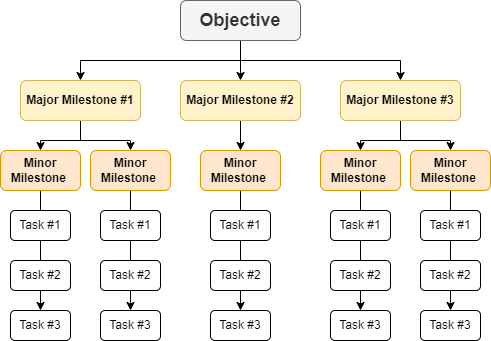
This simple framework for organizing the journey can be applied to any vision in any direction. It begins with imagination. We have to have an objective first, a specific form of time experience we would like to inhabit, a goal that anchors us to a known future of our own creation. It acts as a beacon, guiding the direction of our focus and energy through the turbulent seas of the moment. While tasks are detailed, our primary objective should avoid absoluteness. Rarely does the journey happen according to plan, and attempting to defy the single truth will only lead to disappointment.
Once the individual establishes their vision of creation, they begin to imagine backward. What major happenings must occur before the moment can be real? You continue to break down the vision into smaller bits until you reach the foundation of becoming: focus and energy in a specific direction. Include tasks you can act toward immediately and that will make themselves available after other tasks are completed. Individual and system are similar in that both reach growth plateaus that cannot be surpassed without the development of alternative directions. As you complete tasks and milestones, new priorities will likely arise. When that happens, focus on reviewing and reimagining the path laid out toward your vision. You can approach this framework for action as a perpetual rough draft, welcoming revisions and reimagination whenever necessary. It’s a method of organization that easily translates into widely available digital task management applications, allowing a high degree of accessibility and convenience within the practice. Our journeys are of constant revision, evaluating where we are and where we intend to be and adjusting course accordingly. Persistent planning and evaluating how and where we direct our focus and energy ensure that we maximize our ability to redirect our trajectory whenever necessary.
Active soulcraft is applicable to both short- and long-term objectives. The simple framework we discussed earlier may be too complex a system for accomplishing some objectives while being inadequate for others. In many directions, mastery is repetitive. The relational universe ensures that the more we direct focus and energy in a specific direction, the more we become it. This is especially accurate for developing our creative and technical skills. If you want to be a great musician, all the planning in the world won’t matter if you are unwilling to dedicate the focus and energy necessary to develop mastery within the moment. Soulcraft is always happening in all moments—such is the nature of an informational relational universe. It is vital to remember this when we are failing ourselves: allowing the flow of our time experience to take us in directions we should otherwise avoid. Like all things governed by a single truth, developing discipline through routine is a choice we make independent of the circumstances we find ourselves in. It is one that we must make over and over again throughout our lives to bring our visions to life.
Our ability to successfully practice active soulcraft correlates to our willingness to dedicate ourselves to a specific direction. Mastery takes time, patience, and practice. As any expert will tell you, the effort of becoming isn’t always fun. This is why individuals should seek to master knowledge and practices that bring joy and empower them to strengthen others. Maintaining discipline through the rough patches is much easier when our focus fosters love within us. We might experience joy within the moment we imagine, for the good we will create during our journey, for the self-empowerment that mastery will bring us, or for continuously getting up after hard lessons knock us off our feet. Developing routines and habits lays the foundation for event chains of knowledge sharing yet unknown to the universe. The relational universe illustrates our intimate connection with all others within any particular moment. This wholeness of being ensures that if we dedicate focus and energy toward strengthening others, we strengthen ourselves. This is why practicing active soulcraft in meaningful directions is vital to individual success.
When exploring directions to pursue, an individual should be mindful of the crisis of doubt, desire, dogmas, and death. Do not allow your fears to dictate the direction of your journey. Ignore the paths others have set for you. Soulcraft is a process by and for the individual, the individual’s chance to develop themselves in the direction of their choosing. Sometimes we must dedicate time to introspection to understand what we really want. All of us are subject to long trajectories of learning and understanding beyond our control. Sometimes it’s easier said than done. Explore. The development of discipline and routine is a practice. This approach to developing a more expansive humanity is guided by the single truth, leveraging our knowledge of choice within the moment. It also starkly contrasts the beliefs and practices of past spiritual technologies. To believe that one direction of focus and energy is somehow less than another is rooted in philosophies of hierarchy we reject.
Soulcraft is universal and accessible to all with awareness of the practice and the security to practice it. Yet many with the ability and knowledge avoid it. We wait for a better time, more motivation; we are afraid of committing and failing, anything to avoid the responsibility of creating ourselves in our image. Do not be intimidated by your latent power. Practicing active soulcraft is absolutely within your grasp. It has nothing to do with motivation and everything to do with discipline. Motivation is a feeling typically related to the convenience of devoting focus and energy toward our intention within a particular moment. Discipline is action. It frees us from the burdens associated with doing difficult things because it separates our emotions from circumstances. Individuals practicing active soulcraft discipline themselves by being aware of their time experience and, at times, choosing to do things they do not want to do. There is no secret to discipline outside of doing. Doing when you’re tired, doing when you’d rather be doing something else, doing when you really just don’t want to, and most importantly, doing now. Repeatedly doing develops routine, routine reinforces discipline, and disciplined routine develops mastery.
Sometimes we avoid trying because we are afraid of the inevitable disappointment that comes with being bad at something we want to be good at. Fear not, because with enough focus and energy, your success is certain. Earlier I shared my journey of letting go of my commitment to the active practice of Brazilian jiu-jitsu. What I didn’t share is that for the first two years of my twenty-five-year grappling career, I amassed a competitive record of two wins and twenty-two losses. When the individual embraces the single truth, there is always choice within the moment. What eventually led me to mastery was not innate talent or superior athleticism, far from it. My mastery developed through routine and my commitment to just showing up for practice. Directing our focus and energy toward a specific direction continually reshapes us in an image of our own choosing.
Our practice of soulcraft is aided by our ability to inhabit authenticity within our time experience. Specifically, letting go of what no longer serves us. When we practice disciplined routine to align with the single truth, we change ourselves in the process. The directions we choose become a part of us, a wholeness of internal and external infinity that develops a more expansive individual. This is the nature of a relational universe, and the choice to change direction can be difficult. Sometimes our paths fork, and the only option is to leave behind practices, places, and people we share deep connections with in order to become more. This is fine, and the individual should bear no burden in redirecting themselves. Unfortunately, redirecting the focus of your choices also means leaving others behind. At times, they will be people you love and care about, and that’s not easy. If two individuals stop sharing alignment of their focus and energy, they will cease to grow together and begin to grow apart. This is especially relevant when making sizable alterations in your course, like significantly reducing or stopping the practice of a present mastery and starting anew in a different direction. Knowing when to redirect your focus after achieving your objectives can be challenging, but it always begins with imagination. There are just not enough moments in the day to do all that we wish we could. In my personal journey, I have reimagined and redirected myself several times. Some things you never stop doing; you just reduce their level of priority. Others you abandon completely. Do not waste energy burdening yourself with feelings of guilt. When you continue to devote energy toward a focus that misaligns with your values and vision, you will fail to realize the extent of your power. You owe nothing to the past, but the present demands much. Creation is an act of the universe expressing itself. Whenever possible, the individual must strive to create something they love. It is the highest act of divinity the individual may express.
Note the distinct difference between letting go and quitting because the journey is difficult. The language of difficulty measures our present skills in contrast with the tasks at hand. These surpluses or deficits only represent information, but it’s easy to become frustrated or flustered when things don’t go our way. I, too, want everything immediately and perfect at all times, but the human time experience ensures otherwise. Separate your individual worth from the challenges you face within a given moment. Know that failures of all scales and scopes are still progression toward becoming more. Mastery is a direct path toward crafting meaningful time experiences, but it does not define the parameters of our identity. Our humanity is too expansive to be identified as a specific set of routines and habits. It is common practice to use phrases like “I am” when referring to our productive and personal activities, but it is an inappropriate use of language given our understanding of the single truth and the relational universe. These activities certainly influence us but can never fully encompass us.
Once we commit to soulcraft in a specific direction and develop the discipline necessary for sustained routine, mastery follows. The individual inhabits a state of flow, synchronicity with the moment where intuition and feeling leverage a depth of knowledge that empowers us to shape the moment effortlessly. The martial artist Bruce Lee spoke of being like water, an excellent illustration of the master at work. The individual does not seek to force the universe into a specific shape, rather they become the shape necessary to meet the needs of the moment. The detachment that mastery brings extends beyond the process; it changes our intent. Things that used to matter as we developed our talents, such as demonstrating competency and competitiveness, no longer do. Mastery is not a destination but a starting point for our creative divinity. Just as the individual dictates the why and how behind their path to mastery, they also dictate the directions yet to come. Earlier we explored the embrace of redirection. At the age of twenty-six, I decided to change the primary direction of my focus and energy away from jiu-jitsu and toward building a business. My journey taught me that high-level jiu-jitsu competition wasn’t for me, and progressing to mixed martial arts was out of the question—I had and still retain a strong preference for not getting punched in the face. Without a clear vision guiding my journey into competitive martial arts beyond the black belt, I knew that redirection was necessary. It wasn’t easy. I left behind a second family. Our journeys to mastery are not about achievement; they are about becoming more. When the individual masters something, they develop a relationship with their internal infinity that few will ever know.
Throughout my journey, I have had the privilege of knowing many great masters. Some are renowned in their verticals and highly recognizable public figures; others are unrecognizable in a crowd. One of the most effective practitioners of soulcraft I know is my friend Dave. We met through our mutual journeys of mastering beer brewing. Dave brews some great beer. He is also a master runner. He’s completed several ultra-marathons and keeps a relentless routine. His pizzas are works of art, the kind you pay highly for at a fancy restaurant, except they’re better than you imagined. While none can master the practice of meditation, Dave has been embracing a ritualistic consistency in his approach. He is a Buddhist scholar, mindful of his application within the moment. A loving partner and a pack leader for two pooches, Dave’s application of soulcraft is seemingly limitless. The common theme throughout Dave’s directing of focus and energy is the wholeness of his approach. He pursues for no other reason than pursuing. His development of himself serves only to extend his humanity but in the process elevates those surrounding him. All possess Dave’s capacity to direct focus and energy toward becoming more. Unfortunately, few choose to exercise it with such precision.
Mastery does not limit the individual to specialization in just a few directions, although some may choose it. The beauty of inhabiting an exponentially expanding universe is that every journey toward mastery holds the possibility of a profession. We can share what we master in many ways. Becoming an expert in a few related domains is a choice to pursue deep knowledge. Like the present-day PhD, the specialist develops niche insights few others possess. Alternatively, some might choose to develop mastery in unrelated focuses. The generalist practices discipline in their routines to develop mastery like any other, but their broad experiences provide the ability to connect dots that others may miss. The generalist will rarely be the pinnacle of knowledge in a specific area, but their ability to imagine alternatives to the present way of doing things is unparalleled. There is no wrong way to practice soulcraft, so long as you actively practice. Be mindful of creating artificial barriers for yourself, such as prioritizing mastery in a direction that you believe will generate capital. Any skill or knowledge expertise sufficiently developed can command a price if necessary. The key to success is aligning your imagination and creative powers with the direction of your focus and energy within the moment.
While each individual practices soulcraft for themselves, our development is collective progress. We reimagine ourselves and the world around us, then direct our shared focus and energy toward it. Soulcraft through routine, discipline, and mastery is an act of alignment with the single truth and the relational universe. We project our imaginations into the universe and direct our focus and energy toward their manifestation. Soulcraft is a spiritual effort that aligns our internal and external infinities in a single, harmonious rhythm.
Synchronicity and Premonition
Perhaps the most significant benefit of practicing modern shamanism in our journey toward individual actualization is the realization of what we have lost. In the grand scheme of the collective human time experience, most of our focus and energy has been intertwined with nature in ways that are presently foreign to us. Nature shaped our perspectives, experience, and methods of survival and progress in a universe of dangerous abundance. We understood it to be part of us, and us a part of it, leading to the development and performance of rituals that honor this relationship of wholeness. We embraced the relational universe in the earliest forms of human spiritual technology. Agriculture and accumulation in combination with slow technological growth and information spread violence and dominion as the most effective means of organizing society, thrusting the human time experience into systems far removed from nature. The state leveraging of violence has yet to stop, but the exponential progress of technology has brought us to a moment of awareness.
We inhabit an immediate present of abundance and lack the systems of meaning and value necessary for individual and collective redirection. Meanwhile, the crisis of extinction continues its aggressive expansion. Modern shamanism and the small and high rituals associated with the practice is a journey toward reintegration with nature. It’s a process of developing a sensitivity to the relational universe lost to us in moments long past. By practicing modern shamanism, individuals unlock possibilities and observations within their time experience that might seem fantastical to the uninitiated. This revival of high alignment with the single truth and the relational universe brings visionary observations and awareness of synchronicity and premonition within our everyday lives.
Our spiritual reintegration with nature isn’t an attempt to repaint past human time experiences as better, easier, or more fulfilling than the present. Quite the opposite. There has never been a better time to be alive than the immediate present. Collective humanity’s access to resources and the agency to use them is greater than ever. That doesn’t negate that our arrival to this moment occurred through spiritual philosophies rooted in hierarchical domination. The spiritual institutions supporting these ideas are just as guilty of violence as the states. We have organized ourselves through systems that ensure birth lottery determines the vast majority of individuals’ access and agency.
Integrating nature into our spiritual practice is a path to reshaping ourselves and our systems. Consider the geometry of this suggestion. Hierarchy is a triangle. A single shape organizes us by class and caste. Nature is a multidimensional information web, with each observer in every form playing its role in the larger whole of being within the moment. The earliest human societies created systems modeled after nature to guide themselves, with each individual acting as nodes in a larger network. All held value and purpose. Individual actualization is not a return to worshiping nature in the historical sense. There will be no animal or human sacrifices. Instead, we embrace nature as a part of us in a very literal sense. We are both within and of it, making the crisis of extinction as much an internal struggle as it is a set of external problems to solve. When the individual recognizes themselves as the totality of experience within a given moment, they inhabit a deep alignment with the single truth. We return to the principles that laid the foundation for our present success: cooperation. We are now equipped with knowledge and technologies far beyond our ancestors’ wildest imaginations.
Synchronicity is a naturally occurring phenomenon within the human experience.^49^ It’s defined as when an individual experiences a relationship between unrelated events; the alignment of happenings in the mind and the outside world.^50^ In other words, a harmonizing of the internal and external infinities. Synchronicity is an often temporary but intense feeling of interconnectivity with the external; you observe patterns where before there were none. It is as if an extra dimension of perception has opened, gazing upon the single truth. We recognize synchronicity within the moment as spiritual in nature, a rare harmonious time experience to be pondered.
Through the lens of the individual time experience, synchronicity reminds us that we can never be anywhere else but now. When experiencing synchronicity, you know it immediately, if not by name, then by awareness of the shift. It is a different experience of being than those available within the standard time experience. It reminds the observer that they are not separate from the totality of experience but are a part of a much larger happening. Sometimes it can occur in small and amusing ways, other times in more powerful expressions. Observe the signs and explore the directions they provide.
But what is a sign? How might an individual examine this concept through the lens of their personal time experience? There is no specific answer, as signs are merely just interpersonal interpretations of circumstances. We assign meaning where unaware observation would provide none, simply because we can. I can share several examples that have helped guide my journey to provide some context. When I first met my partner over a decade ago, we lived about an hour and a half drive from each other. We would talk occasionally between visits and often while I was walking my dog. Eventually I noticed a peculiar trend. The nights we were on the phone were the nights I would observe shooting stars. It kept happening, and over time I assigned the event meaning, a quick note from the universe to maintain course. The day before the birth of our child, my partner and I were walking and talking with the future newborn still in the womb. The three of us were enjoying the excitement of the moment when we stumbled upon a double rainbow. It was as if the universe was smiling alongside us, and we took it as such.
My most frequent and recurring bouts of synchronicity surround the spider. The catalyst moment was during a conversation with my partner when I was discussing a spider sighting unlike any I had previously witnessed. The giant spider was resting on the tiles directly above our kitchen sink. It captured my attention for some time, but after turning my gaze to find a container to transport it outside of the house, it disappeared. Halfway through the conversation, I came to realize that what I was describing couldn’t possibly be true. The timeline of happenings didn’t add up, and yet it felt so real. It was as if the memory awakened within me was as real as any other past I can recall. For about two years after the initial memory manifestation, I found my attention drawn to the spider’s entry into my time experience in moments of choice and opportunity. It occurred throughout different environments and circumstances, and the timing always stood out as surreal within the context of the moment. It was as though it was there to call my attention to being the observer, to remind me of who I was and what I was working for.
For example, in 2018 I was invited to introduce the Governor of New Jersey and share my perspective and efforts in supporting the statewide minimum wage increase. While I waited in the back room to kick off the event, I decided it would be a good time to review my speech. I pulled out two pages from my jacket pocket, unfolded them, and began to practice. Within seconds I noticed something odd—there was movement in between the two pages. As I peeled back the first page, a spider greeted me, casually crawling from the center of the page to the edge, after which point I set it onto a windowsill. How it found its way there still perplexes me, but the signal brought me to an intimate awareness of the moment. These are all examples of small synchronicities, coincidences that seem to connect dots between our internal and the external infinities. They make us feel like our imagination is coming from our minds and taking shape before our very eyes.
More powerful expressions of synchronicity exist but do not seem to be commonly accessible. In my personal journey of modern shamanism, I once entered a state of synchronicity that lasted about two weeks. A few days earlier, I had performed a high ritual after an eight-year absence that resulted in a paradigm-shifting commune. I was out walking my dog after work one spring evening when suddenly I felt a forceful wave of sensation come over me. It was as if a silent but strong wind had appeared. It was just enough to turn my head toward the trees, birds, and pond to my right. To this day, I find it difficult to illustrate the experience because it was otherworldly. It was as if the world had a rhythm that I was just discovering, similar to the synchronicity I’ve experienced on an LSD trip but lacking the overwhelming intensity. Randomness was removed from my experience of nature, replaced with an effortless flow. I felt it vibrate through my body, providing an understanding of relation I could not have possibly conceived prior to the moment, an alignment with the single truth I did not think possible. Yet there I was. The event was most intense on the first day, where I remained in a hyperaware state until I went to sleep. It decreased significantly upon waking the next day and gradually subsided over two weeks until I felt returned to my standard time experience. I remember sharing that moment with my partner, fully aware that the scope of my perception had expanded significantly. To this day I have yet to reinhabit the altered time experience.
Premonition is our insight into possible futures. Like intuition, it is both feeling and vision, an understanding of a moment we should not possess, but do. Unlike visualization, it extends beyond the application of imagination. Like synchronicity, premonition varies in degrees of intensity. It takes the form of a hunch, dream, vision, or memory calling you to a future you already know. It is as if the individual is drawn toward something with all of their being, a curious phenomenon in a relational universe. Premonitions bring the future into a present influenced by the past, an individual experience of existing in all temporal directions. It is most certainly information, and it enters our awareness within the moment, but is it reliable or trustworthy?
When I find myself inhabiting a state that seems supernatural, I find it best to embrace the moment as is—without preconception or doubt, uninterested in assigning any meaning or history outside of my observations. In the moment of premonition, it is ideal to be in a state of high awareness, to take in what is happening with all of our being so we can understand the insight it brings. Whether the individual embraces the information and applies it to personal philosophy or practice is up to them. It is trustworthy if we believe it so, but maybe not. The moment of premonition is a state of being in high alignment with the single truth, so ultimately it is a question of trusting yourself.
My personal experience with premonitions began late into my journey of modern shamanism. I begin by stating no claim that these results are replicable or even desirable, simply that they are. The premonitions have come not in the form of visions of the future but rather long extended memories of a past that never occurred—an alternative trajectory of events not at all attached to my immediate present, yet distinct in their realness and happenings. At the time of this writing, they began a little over a year ago and would have since come to a conclusion by my editing of the text. Except they never happened. It’s as if I enter a new moment with the memories of previous experiences, like watching a movie for the second time, except this time, the outcomes are different. In these moments, there are two potential choices: stay or alter course. My awareness of these moments recognizes the contradiction immediately. Here I am within my time experience of the immediate, yet I possess detailed visions of how these circumstances play out in alternative directions. It is not possible, and yet it is.
Since I first explored this topic, the premonitions have continued. For some time, I dismissed them, but a significant event triggered a memory that made them very real. Where the memory was a place of deep sadness, the actual event—while eerily similar in its framing—had an alternative outcome. These events may or may not have an alternative meaning, but I find it curious that they occurred during my exploration of alternative relationships with time. That humanity may possess the ability to transcend the linear perception of the time experience beyond philosophy and mathematics seems to support the notion of aligning with the single truth as the greatest expression of divinity one can possess.
Alternatively, there is the possibility that these experiences have been some sort of fantastical imagination—perhaps some sort of looming psychosis hidden away despite a clean bill of health. What is certain is that the personal examples I use to illustrate synchronicity and premonition are real within my personal time experience. That does not mean they will play any role in your personal journey. It’s as if my exploration of the time experience through the lens of the single truth and the relational universe blurs the rigid lines of limitation. Synchronicity and premonition enter a territory of mysticism that is distant from the many practical implications of aligning individual and system with the single truth. In many ways, they raise more questions than answers, and our ability to understand these concepts will remain limited until collective humanity possesses the access and agency necessary to fully express their divinity within the moment.
The Child
Children have always shared a common struggle throughout human history. Born into a universe they had no say in crafting, the child immediately enters a set of inherited circumstances that will significantly impact their development as an individual. Where they are born and who they are born from will shape their understanding and perceptions of the universe well before they possess the knowledge and capacity to evaluate the world for themselves. Physically weak and intellectually limited by the slow progress of human maturity, the child is always a perpetual target for abuse and misguidance. Enlightenment thinker John Locke popularized the idea that each child is a tabula rasa, a blank slate with no ability or understanding of how to process information beyond what they receive. We understand now that aspects of understanding are biologically coded into the individual, but this statement remains accurate when it comes to contextualizing the informational universe. Regardless of age, the individual practices soulcraft and small rituals to develop their capacity to direct the flow of their time experience in alignment with the single truth. Therefore, we embrace a reality where the child is understood as an individual, inheriting all rights and divinity that come with our awareness of being and choice within the immediate present. It is our responsibility to develop the child in a direction that maximizes their opportunity for actualization within the moment, both through our individual practice and our shaping of systems surrounding them.
It is scientifically understood that infants are conscious.^56^ It is easy to conceptualize that their experience of being is different from that of an adult human. Consider parental communication with the child. We place our language, gestures, and interactions with the child within specific frameworks that we believe are within their range of understanding. We forget that knowing nothing means everything is new. We underestimate their capacity to learn because we are far removed from our own infancy. It is a mistake to believe that the child exists in a state of limited consciousness; the reality is quite the opposite. The newborn inhabits a space of hyper-consciousness, where all they see and perceive can be observed in its truest form within the confines of the single truth. Unbound by the limitations of inheritance of event chains of moments past, the infant is unmolded divinity. As parents focusing on the development of individual actualizers, we must never forget this. We assume infinite potential from our youth, understanding that they will become what their focus and energy are directed toward. It is therefore the individual parent’s choice to remain aware of this and intentionally direct the child’s time experience to the best of their ability.
Birth lottery ensures that the direction of guidance the child recieves varies because each parent draws from a long history of event chains shaping their vision of the good. The struggle that humanity has always faced is that many of us draw from histories of trauma. Many parents’ approaches to development do not resonate with their child’s personal values and vision of the world within the immediate present. Maturity in adulthood allows us to recognize flaws as deeply human while also understanding the outsized role our philosophies of meaning and value play in the development of these traumas. Our reimagination of the spiritual journey toward individual actualization, guided by the single truth and relational universe, provides a simple, common framework we can apply to guide youth into actualization. But it is not without cost. We have all inherited so much history influencing what we do and do not find acceptable as parents that separating the signal from the noise is difficult. There is also inherent social pressure associated with parenting. No one wants to be a bad parent; therefore, it has become taboo to discuss best practices and be critical of methods we know to be less than ideal. This is a social norm that reinforces the idea of children as property. We cannot circumvent these widespread insecurities by presenting a rigid framework for childhood development and success. Unlike the salvation religions, our approach to youth spiritual development is not guided by guilt and the false notions of sin and judgment in a paradise beyond. Instead, we embrace the same basic philosophy applicable to child and adult alike. The maximization of divinity is drawn from awareness in the immediate present.
Beyond the primary objective of survival and health, we strive to accelerate the development of communication between parent and child. This begins with embracing the child as both highly capable and willing to communicate. We inhabit our individual infinity at all stages of being. In many ways, the child possesses a purer mastery of it than any adult could. They are unbound to the static frameworks of our inheritance, if only for a short time. For too long we have underestimated the capacity of the child, projecting limitations we believe they have onto them. At the same time, we are careful to restrain our belief so that it does not evolve into expectations. Every child is different, and our focus on developing communication is in no way restricted to any specific span of moments or techniques. When we recognize the inherent divinity of choice the child possesses, we allow them to develop at their pace by creating an environment that actively exercises their imagination and creativity. This depth of belief in the individual child reinforces a broader theme of expansive love within the self-actualizing society. Extending our embrace of relation and equity to the child recognizes them as expansive yet undeveloped individuals. It translates to empowering collective society to reimagine a wide variety of systems through the lens of the single truth and the relational universe. When every individual is sacred, their inhabiting system of diminishment is immoral and unjust. Developing communication early in an individual’s life provides them access to and agency within the world. It also compounds quickly, allowing the individual to rapidly ingest and process new information networks.
One of the most effective ways to accelerate communication is teaching the infant sign language, ideally from day one. Plenty of low-cost and free resources exist, and the process is fairly straightforward: identify what attracts their attention and attach the appropriate hand signal and word to it. Repeat. Gradually expand this process as you notice the child developing a higher degree of awareness of their surroundings. This exercise is not a contest; we are developing a proactive practice of empowering the child to communicate before developing their ability to vocalize. Do not project personal frustrations of lack of progress onto the child; it will take some time before the child makes associations. Trust in the fact that they desire to communicate with you and know that your efforts will compound until a eureka moment occurs within. Beyond the initial communication, proactive sign language practice will rapidly develop the child’s cognitive capacity for language. The more we nurture the expression of intent, the more rapidly it advances. This same logic applies to spending time and energy focusing on the phonetic and common pronunciation of letters, numbers, and reading each day. The parent’s objective is to solidify the relationship between sound, symbol, and context early and often. The child who can express themselves will inhabit a much happier and healthier space in the universe, laying a foundation of inquiry and exploration they might otherwise lack for months, if not years. The sooner the parent and child communicate, the earlier that individual’s journey toward actualization begins.
What about punishment? Is striking a child ever an appropriate form of discipline? According to our scientific understanding, no. We understand physical discipline to be both harmful to the child and ineffective at shifting behaviors.^57-59^ Consider also how we answer this question in regard to our core values in alignment with the single truth. The child exists in relation to the parent as a single being, more so than all others, yet they will operate from a perspective of biological immaturity for the first two decades of their lives. Parents must practice awareness, flexibility, and restraint when evaluating the behaviors and outcomes of said actions. Like us, the child inhabits a relational universe. Their biological development always impacts the scope of their perception. Striking a child is misaligned with the single truth and the relational universe and only serves to demonstrate a lack of restraint in the parent. At the same time, we recognize that some have only ever known violence. When the child experiences violence, they inhabit it; it becomes a part of them. We cannot collectively transcend violence so long as we continue to reinforce it in our youth. Self-actualizing in the age of crisis draws from a transcendent vision of our personal divinity and the sacredness of the other. When we leverage physical violence, or the threat of it, against those who love and depend on us, we shape their understanding of what is and is not acceptable behavior toward others. Frameworks of love and punishment shape our perspective into specific forms. Self-actualization in the age of crisis is the choice to create a present free from the influence of the past. To do that, we must embrace alternative forms of discipline outside of striking the child.
As the child grows, we encourage their exploration in the directions they choose. Individual inheritance of the moment defines what one can and cannot provide for their child, binding the child to a past they had no say in choosing and a present they cannot escape. Our intent in creating new systems of meaning and value ensures individual access and agency within the world for all. This includes the child. Our love for the child is a source of fervency in our journey toward systemic actualization. At some point in time, we’ll have to choose to be better—to be more than our present arrangements allow us to be. Nowhere is this vision more righteous than when applied toward the transformation of trajectory for the child. Compared to them, we are imposters. But eventually, they grow up. From this moment on, all children inherit the crisis. That is, of course, unless we choose an alternative.
Now we explore the uncomfortable. Our recognizing the child as a source of immense but latent power challenges one of the most commonly accepted philosophies of parenting. A child is not a vehicle for furthering parental dogmas. The parent who frames their child’s existence as furthering their personal interests is a slave to their own ego and actively harms the child. It is a narcissistic and selfish behavior that intentionally leaves the child ill-prepared to embrace a more transcendent vision of humanity in favor of attempting to reinforce static beliefs in an ever-changing universe. This is especially accurate in the context of spiritual technologies. Every child is an independent being, wholly divine in their internal infinity. By indoctrinating the child into rigid philosophies of spirituality and thought, we actively limit their capacity to transform themselves in a universe governed by change. The exponential expansion of human knowledge and consciousness illustrates the inadequacies of our hierarchical spiritual philosophies, and attempting to force them onto a child will leave them ill-prepared to navigate the world they will grow up in. Even worse is the infusion of bigotry onto the blank canvas of childhood imagination in the name of God. Spreading hatred and ignorance of the other under the guise of sin and spirituality is completely misaligned with the single truth and the relational universe. It is a practice not at all concerned with the spread of divinity and grace, only power maintenance and domination. It is difficult to imagine a more shameful practice. That the present hierarchical spiritual philosophies are so commonly leveraged to spread hate and violence toward others further solidifies their inadequacy in the face of crisis.
As a parent, I recognize the personal desire to impart specific philosophies of meaning and value onto the child. Where the self-actualizer differs in their work toward developing youth is an openness to alternatives. The single truth is a spiritual philosophy rooted in change, one that demands its own evolution over time. It is a rejection of static visions of the world and others that have led us to the age of crisis. We share the knowledge of the single truth and the relational universe as the natural phenomenon it is, part of our scientific understanding of the universe. At the same time, we are unafraid to share and encourage the study of traditional hierarchical spiritual philosophies. The children of the immediate present are the catalyst generation, those who will choose transcendence over crisis if given the opportunity. Unlike practitioners of the salvation religions, self-actualizers understand that it does not serve the child to deny them knowledge of the universe as it is in favor of what was.
We possess the courage to put our spiritual philosophies under the stress of challenge and change, knowing that our embrace of meaning and values must evolve in parallel with our expanding consciousness. We build community around self-actualization in the age of crisis, through which we share our practices of alignment with the child. The child becomes both participant and creator within the spiritual journey, empowered to express their divinity within the moment toward the collective betterment. Just as the individual shapes themselves through soulcraft, so must the family. It is our responsibility as individuals and collective to develop, share, and proliferate best practices for the academic and spiritual education of the child while at the same time never claiming a divinity or infallibility in our knowledge. We recognize that humanity has never been in communion with any god outside of high ritual, that the present texts are artifacts of human creation that deserve no reverence outside of their immediate use. Our embrace of the child as wholly individual and part of the relational time experience obligates a best effort to develop the child, even when that conflicts with our personal opinions. All have preferences for the direction of our children’s explorations, but we must abandon them. But what of dreams? We do not deny our imagination of the possible, but we restrain ourselves from projecting it upon the individual child. The sincerest expectations we can ask of the child are to raise a storm in whatever direction they choose. All paths present the opportunity for reimagination and change. We share this with the child because the sooner they understand their divinity of self-direction within the moment, the more powerful they become.
The Partner
The act of coupling in partnership is the interweaving of two time experiences into a single thread. Two become and remain one by choice. Each bring their own unique inheritances into a joint process of directing focus and energy within the moment. Although the individual is one with the collective in both the literal and figurative sense, they are never more whole than when they are with their partner. Partnerships are ancient in practice but presently subject to frameworks that are relatively short-lived in the scope of human history. We reimagine partnership in alignment with the single truth not to dictate or direct like past spiritual technologies, but rather to enhance our capacity to love each other.
The most successful partnerships are rooted in a willing commitment by two individuals. Partners enter an arrangement of perpetual impact, continuously receiving and being influenced by the information expressed by their significant other. Over time we inherit aspects of our partners, habits and traits formed through constant exposure and embrace. Within the relational universe, a partnership is an act of mutual becoming that we cannot avoid. Therefore, our frameworks of valuing our partners should focus on becoming more together. At the same time, we want to ensure that our individuality remains intact.
The best partnerships grow from mutual contribution. They go far beyond responsibility to household or sexuality, although both are important. We want to actively engage in the process of becoming more not only for ourselves, but for our partners. We want to remain interesting as our looks fade, but our obligations to meaningfully engage do not. There is always the risk of stagnation within relationships, especially when we fall into routines of exhaustion and entertainment. Our practice of active soulcraft provides us with an alternative. Individual time experience is always fleeting, and if we consistently default to the path of least resistance, we will soon find ourselves without much to say. We will become a distant shadow of who we were, who our partners learned to love. The individual is responsible for developing themselves over time, and when two commit to this shared vision of greatness, love blooms.
Commitment to a partnership takes focus and energy within the moment. The single truth and the relational universe ensure that choosing to direct our focus and energy toward one path always negates several others. To ensure that we embrace this commitment to growing our love with another, it is ideal that partners develop custom rituals for themselves. This can be any form of shared activity that brings two together as one for a dedicated period of time. These shared practices are likely to evolve over time as well. This is good and should not be met with resistance or dismay. The single truth is change, and it is unreasonable to think that our partnerships and personal rituals are immune from it. Some examples of rituals you might undertake with your partner include the daily practice of yoga together, a short evening dance, or ritualistic morning walks—anything that allows two individuals to grow in parallel with one another by directing their shared focus and energy. There is no wrong choice for shared ritual because the commitment itself is most important. Avoid claiming mindless entertainment as a shared ritual, as our purpose is to grow together, not stagnate. Keep in mind that all commitments generate expectations, obligations we choose to fulfill. Successful partnerships are rooted in trust, the belief that when a partner says they will do something, they make their best effort to do it. If the individual is unwilling or unable to consistently meet commitments they make to their partner, they should have the courage to say so. All partnerships are bound to the single truth and ultimately defined by choice. By embracing our core values, we develop ourselves to love and be loved. We choose deep mutuality with our partners through the willingness to become greater together.
Partnerships combine two unique journeys into a single path, which is why any attempt to be prescriptive in how two individuals should manage their relationship is undesirable and unhelpful. Here we reject the ethos of hierarchical spiritual philosophies and their designation of what is and is not appropriate within the private relationship of two individuals. The single truth provides insights into how we might enhance our relationships in meaningful ways that promote mutual growth. First and foremost, all partnerships must be rooted in absolute consent. We reject any spiritual philosophy justifying hierarchy within a partnership as divine or natural. They are nothing more than the proactive proliferation of power dynamics falsely claiming divinity in attempts to maintain dominance. Self-actualizing in the age of crisis is the process of embracing the mutual divinity the individual, other, and relationship share within the moment. We therefore reject any attempts to intertwine love and spirituality with the obedience of one to another.
Instead, we embrace radical openness and the assumption of good intent. It is no secret that open communication is the cornerstone of a successful relationship, and our core values help develop us in the direction of high comfort with openness. Every partnership should eventually mature into an agreement of intent, some combination of guiding principles that act as a compass during the shared journey. For example, when I married my partner, the vows I wrote focused on four key elements of our future: exploration, creation, contribution, and observation. We share ECCO as a philosophy, guiding how we construct our journeys, but what is right for one partnership may not be right for another. Take the time to dedicate energy and focus to understanding why you love your partner and what the two of you hope to experience together. Engage them in meaningful conversations about journeys you intend to construct, and begin the shared work toward creating them. Recognize that a partnership translates into finding ways to develop two separate visions of the good into a shared direction of focus and energy. When two align their time experience toward mutual creation, their efforts become a force multiplier in the practice of active soulcraft.
The Science of Individual Actualization
Academically, there is a consensus about what is necessary to individually actualize. Abraham Maslow laid the foundation for understanding the specific conditions that need to be met for individual actualization, which much of psychology still draws from. Contrary to popular understanding, Maslow never described the components of individual actualization as a pyramid of needs,^1^ but rather as an overlapping ebb and flow. Therefore, we should not conceptualize our individual journeys as climbing a ladder. This idea only reinforces hierarchy as a framework of human experience, which self-actualization in the age of crisis requires us to break free of.
Alternative models have since been developed. For example, Dr. Scott Barry Kaufman suggests that we visualize Maslow’s framework of individual actualization as a sailboat, which more accurately represents our potential to find momentum. Figure 5 highlights the fundamentals. The term “safety” refers to basic necessities, such as food and water. The term “connection” refers to our networks of individuals and access, which influence our self-esteem. Together, safety, connection, and self-esteem represent the stability required for individual actualization. The sail is founded on exploration, which is the driver of growth and from which love and purpose arise. The boat metaphor helps us understand individual actualization as the interconnectivity of circumstances. Overlooking any of the aspects will cause the vessel to lose momentum or sink. Kaufman argued that the sailboat is a better metaphor than the pyramid because life is a vast ocean of possibilities, not a senseless climb to the top to some arbitrary point.
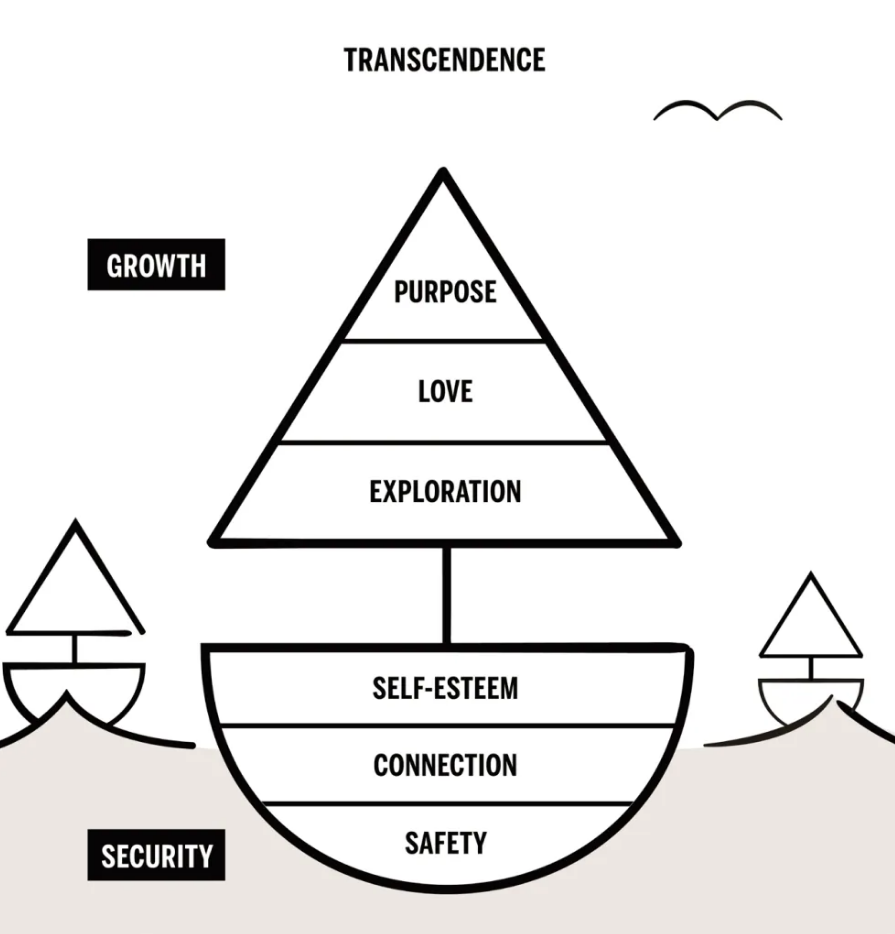
Safety represents specific material and informational standards that must be met in order to accomplish individual actualization. In 1943, Maslow identified these requirements^2^ that have played a foundational role in the science of individual actualization. In the context of the single truth, every individual lacking access to these resources and systems is squandered potential. As our time experiences progress, the gap between who is and is not safe and secure in their personhood will continue to expand. In combination with the surrounding crises, our present trajectory ensures that individual actualization becomes more difficult by the moment for many.
Connection is the embrace of our oneness with the relational universe. Grouping is a natural phenomenon we observe in many species. We observe it through animals forming packs, flocks, or schools, and within the human development of community, friendship, and companionship. We all struggle with tribalism and the desire to be accepted as we are. Depending on our circumstances, the degree of our desire for connection varies in direction and depth. The need for connection is a biological phenomenon, part of our human machinery that cannot be avoided. It is also connected to our experience as observers within the relational universe. When two people communicate, they enter a temporary state of neural coupling where their brain waves mimic each other within a shared time experience.^3^ It is therefore unsurprising that an absence of connection is harmful to human health. For example, loneliness is reported to be more dangerous than smoking. It is a significant cause of suicidal ideation and para-suicide, Alzheimer’s disease, and other dementia and adversely affects the immune and cardio-vascular system.^4^ Encouraging connection is a journey undertaken both through the practices of individual actualization and the organization of systemic actualization.
Maslow detailed the idea of self-esteem in his 1954 book Motivation and Personality. He broke the concept down into secure and insecure self-esteem. An individual with secure self-esteem understands that self-worth and confidence are the foundations of personal growth. People with insecure self-esteem build themselves up by hurting and diminishing others. Studies suggest that those with poor self-esteem are at high risk for depression.^5^ Insecure self-esteem is an aspect of the relational universe that draws from our crisis of desire. How often do we feel insecure as a result of observing others who have more? To struggle with self-esteem is deeply human. This struggle is made more difficult by our being surrounded by systems encouraging comparison, competition, and consumerism.
Secure self-esteem is the byproduct of accomplishment. People who feel good about their efforts and outcomes are more likely to internalize their judgments of self-worth. They draw value from challenging themselves to be more than they were in past moments, caring little for what others do or say. In combination with healthy connections to others, the individual develops a growth mindset that further solidifies their oneness with the relational universe.
In a universe governed by the single truth, exploration is a core component of individual experience. Exploring interests is an exhilarating experience. Exploration is how we become more. Every moment we spend focusing on something, we spend becoming it. A process of learning and loving makes work and hobbies worth doing. Exploration is also a healing mechanism, a means of overcoming trauma through growth. It encourages openness to new experiences, imagination, intuition, and sensitivity.^6^ To be open is to avoid imposing static ideas on an ever-changing universe. We can embrace known frameworks without personally attaching ourselves to them. Individual actualization is developing an understanding that no system we create can ever adequately represent or embody us. We are always more than the ideas and things we create. The single truth ensures that all systems and philosophies lose value over time. Each spreads the ideas and values of the moment of their creation onto the immediate present. Therefore, the individual should avoid defining their identity as the specific undertakings, beliefs, or groups they inhabit. How and why the individual explores are not important, as long as they have the knowledge and resources necessary to do so.
Love takes many forms. How we love ourselves, how we love others. How we love our partners, our children. Friends and strangers, family and neighbors. Love is central to mythos past and present because it is transcendent. It is an experience that changes us in ways we did not know existed. It defines us; those who are loved are able to love more. Maslow wrote, “Clinical study of healthier people, who have been love-need-satisfied, shows that although they need less to receive love, they are more able to give love. In this sense they are more loving people.”^7^ He segmented love into two categories, deficiency love (D-love) and “love for the being of another person” (B-Love).^8 ^D-love is wanting; I love you because I need you. B-Love is selfless; I love you because loving is part of who I am. To be a highly loving person in the relational universe permeates everything the individual does. It influences intent, which influences imagination and action. B-Love extends outward, a bond with the vast otherness surrounding us to create wholeness in an otherwise fractured world. Those embodying B-Love excel in universal concern, universal tolerance, trustworthiness, and benevolence. These traits manifest in our interactions with others as belief in equal opportunity, blind justice, and vital security for all. B-Love is a characteristic we seek to develop within ourselves because it aligns with our understanding of oneness with the relational universe. Yet, as Maslow mentioned, those able to achieve transcendent love are often the ones who were loved. Love is a form of information we give and receive. Birth lottery determines how the individual understands love.
Love highlights the inseparability of individual and systemic actualization. We recognize love as a vital component of the human experience yet understand that each inherits a circumstance completely out of our control. This does not define the individual, so long as they have alternative pathways of access and agency available. Our development of a more secure individual through systemic actualization is an act of self-love. It recognizes the value and divinity of each individual and constructs the systems necessary to further promote loving atmospheres. The insecure parent is a stressed parent. Stress, like all emotions, influences our time experience. Security does not guarantee that the child will receive love, but it is always preferable to the alternative.
Embracing the philosophy of system and individual as a single self is an act of self-love that aligns us with the single truth. We recognize ourselves as the totality of our circumstances, a form of observing being that is inseparable from the world around us. The pathway toward personal connection with the universe, a love for oneself and others, blooms into an expansive trust. When the individual realizes selfless love, they become comfortable with vulnerability, opening themselves to deeper connections with others and the universe around them. To be willingly vulnerable is to understand that genuine control in the universe is attained by letting go. Letting go of our desires to maintain control of circumstances, of others, and of outcomes, and instead directing our focus and energy toward the immediate present. What am I doing to enhance the love I give and receive within the universe right now? Synchronicity is an understanding and application of the knowledge of the relational universe. To understand and embrace the totality of the moment alongside your agency within it. Like the spiritual technologies of past and present, individual actualization requires a relinquishing power to become more powerful. Unlike our present decaying institutions, there is no blind allegiance to the single truth. We seek radical love and trust within ourselves and our systems because we understand that doing so aligns us with the nature of our universe.
To encourage love and trust within society imbues harmony into our relationships. It is easier said than done, as the systems surrounding us today encourage mistrust. These informational arrangements input ways of thinking and being into the individual that calcify over time. We don’t trust others, and perhaps more disturbingly—we don’t trust ourselves. If you find either of these statements true within your experience, do not stress. We cannot control the factors that brought us to this moment. However, choosing to direct our focus on a new direction is always within our power. Our options are plentiful, but there are only two that matter in the moment. Do I embrace radical love and trust, or not? Only one answer brings us closer to the wholeness we seek.
Purpose is the synchronization of meaning and system within a moment. Those able to realize purpose reorganize their beliefs and behaviors to breathe life into their vision. It becomes a productive labor of love. Creation permeates the moment, and individual and universe align. Our purpose impacts our systems, just as our systems influence our purpose. Purpose is imagination applied over time; it continuously expands the capacity of both individual and collective to be more than they are.
Purpose tips the sail because it is the culmination of exploration and effort on a focus we love. As the individual is driven toward purpose, they begin to embody hope in a way that extends beyond positive thinking and visualization. Hope helps us identify alternative options when we are faced with challenges.^9^ It helps us understand failures as opportunities for growth,^10^ be more resilient in the face of adversity,^11^ and is unique in its ability to buffer the individual against the negative impacts of traumatic experience.^12^ Purpose generates hope, which threads itself throughout the immediate present. At this stage of individual actualization, habits, practices, and beliefs become self-reinforcing feedback loops that empower us to create significant change in the world.
Individuals living their purpose often become leaders within their respective passions. Purposeful work is a defining characteristic of knowledge economy labor, environments where the relationship between individual and system is known and nourished. Purposeful leaders operate organizations that rely on high degrees of trust and cooperation, viewing each individual as a valuable source of insight and value. They create cultures where peers focus on seeing the best in others, value their feedback, and collaborate to mutually enhance their professions. Purposeful work environments and the knowledge economy they exist within are most commonly associated with software start-up culture, but we can find examples in all industries. They are forms of work where learning, creativity, exploration, and experimentation are blended into productivity that is as enjoyable as it is effective.
Through the lens of history, purposeful individuals and their impacts may be judged as good or evil in relation to the immediate present. Individually actualized beings are powerful forces within our universe, and their impacts often ripple through time experiences well beyond their personal expiration. Gandhi and Hitler were both purpose-driven individuals, yet today we possess the hindsight to understand the difference between noble and nefarious deeds. Exploring the process of shaping ourselves and our systems to encourage individual actualization en masse forces us to grapple with the reality that positive only exists alongside negative. Good and evil are immature and inadequate labels for individual actions; we grapple with a conflict of good versus good. Even the most heinous of our species act in support of a good that they imagine to be true. We have been recording events long enough to understand that spiritual technologies of the past lack the necessary meaning frameworks to prevent malicious visions of the good. So long as salvation religious texts dominate popular belief, they will be used to encourage the violence they contain. When individuals frame purpose in the context of otherness, they deny basic universal tenets as we now understand them. These individuals perpetuate actions that greatly misalign with our present understanding of the natural universe and our relationship with it. The separation of self-actualization into individual and systemic actualization within the framework of the single truth provides humanity a pathway to reshape our definitions of meaning and purpose. In doing so, we significantly reduce the possibilities of developing individuals claiming rigorous cause in visions of the good that rely on actively harming others, such as the subjugation of one group for the benefit of another.
The science surrounding transcendent experiences is detailed and growing. Present understanding tells us that individuals operating at the highest degrees of individual actualization open themselves up to the potential of mystical, or peak, experiences. As we’ll explore throughout the chapter, several pathways exist to these moments—some quicker (and more temporary) than others. There are many names for the transcendent experience and various degrees of intensity through which it may be felt. At its lowest intensity, there is a state of being commonly referred to as flow. Flow is the state of being in “the zone.” Absolute Unitary Being^13^ is a psychological term referring to the greatest intensity of transcendent experience, a mythical illumination revealing our complete unity with all else.^14^ All forms of transcendent experience share the dissolution of boundaries, providing the individual with an understanding of the inherent interconnectivity between themselves and the universe outside of them. When you and I sit for a coffee, we are a single happening experiencing itself from two unique coordinates. We each enjoy the moment in our own way, but both lack the capacity to grasp its totality.
In a universe governed by the single truth, there is no correct or specific path toward individual actualization. We are always changing, so the language of correct and incorrect cannot apply to our process of becoming with any authority outside of individual preference. Yet, despite this, many of us apply our practices to define our identities. It is a habit rooted in our ego, a desire to be something. The technical term for transcending our individual ego is healthy self-loss,^15^ a state of awareness where our ability to define personal meaning is not limited to definitions in relation to something else.
If this sounds fantastical and unrealistic from the perspective of your time experience, don’t stress. It is a lifelong practice that you have already begun to undertake. Some may experience the mystical through meditation, others through self-hypnosis such as prayer, and others still through the ingestion of sacred plants. My personal journey is anecdotal evidence that supports the accuracy of our scientific understanding of individual actualization. The mystical experience is very real, and while it may extend hours, days, or even weeks, it is not permanent. However, there is an aspect of momentary divinity that most people are familiar with: awe. Awe can best be described as a sense of wonder and amazement, experiencing a moment that takes your breath away. The view from the mountaintop you just hiked, the music that moves you to tears, or the art that you cannot look away from. These are just a few awe experiences that provide the uninitiated with a glimpse of the divinity readily available within the moment.
The collective works of social scientists, past and present, provide a detailed framework of individual actualization and what milestones must be met in order to obtain it. We understand it as an achievable elevation of the human spirit. Through practice, we can change the way we experience reality in the most literal sense, becoming aware of a way to bring higher purpose, order, and interconnectivity into an otherwise chaotic time experience. It is not presently available to all because many inhabit time experiences of perpetual struggle. We know how vital a secure and loving environment is for early childhood development, and those who experience scarcity and struggle in youth often carry the trauma into adult life. Therefore, we connect the dots between individual actualization and the need to eliminate birth lottery as a factor in determining fate.
Consider the science of individual actualization from the lens of the single truth and our understanding of the time experience as a momentary totality. An individual occupies a moment from a unique place in space. Surrounding them is an environment: whatever exists outside of their body. Together, the individual and the environment create a single experience, a happening. This is the self; one cannot exist without the other. Humanity is an introspective observer within an informational universe. If there were no flow of information, we would not be—at least not within any framework we can comprehend. Existence is the process of observing and being observed as information by others. I see you. You see me. Yet we embody different realities, our individual journeys carving universal frameworks that no other can truly grasp. Together we’re just snapshots of one ever-changing and ever-evolving universe. We are time, embodied in a complex meat machine powered by a gray mass housing infinity. As the expression of our being is always in relation to others and the outside world, the information inputs we receive from our environments program us to think and act in certain ways. There are no circumstances where we can escape this relationship, and in examples where we try—such as long-term solitary confinement—we know the results to be extremely harmful to the individual.^16^ Just as the single truth ensures that our environments exist in perpetual change, so do we as individuals. We cannot separate or stop the influence of the outside on the internal; therefore, they are one.
It is inappropriate to label individual actualization as self-actualization, but academia is not to blame. Human understanding of our relationship with the universe has advanced significantly thanks to modern cosmology. However, the creation dogmas of the salvation religions have long been ingrained in the human psyche, giving the individual a static and distant form from the divinity they possess. To understand and embrace the belief that the individual and the system is a single self is to reject the dominion past mythos places on present thought. In doing so, we better align ourselves with the single truth and the relational universe.
Visualization
Visualization is the act of imagining a future that we direct our focus and energy toward, an expression of our internal infinity. Visualization is without limits and supports individual productivity and participation in many ways. When we desire change, visualization is most effectively used to establish frameworks for action. By exploring our imagination of the possible, we begin the process of creation. We build frameworks for a future we desire and direct our time experience in such a way that we are pulled toward it. Visualization is the spiritual act of creating ourselves in our own image, a small ritual we combine with the practice of active soulcraft to proactively navigate our journeys in alignment with the single truth.
Much has already been written about the practice of visualization. The strategic planning model explored in the previous chapter is a single example that supports individual development of the practice and the embracing of our roles as self-directing observers. Visualization takes the form of a spiritual small ritual in its being the direct expression of our internal infinity. The more we focus our visualization on a specific vision, the more real it becomes. Through visualization, the individual develops a wide variety of possibilities, alternatives, pitfalls, and outcomes that are otherwise unavailable. Some we choose to direct action toward, others are simply thought exercises. Visualization is like anything else within the relational universe: the more the individual dedicates focus and energy to it, the more proficient they become at leveraging it.
The most commonly illustrated examples of visualization are athletes visualizing their success. The athlete trains themselves to imagine the entirety of their contest from a variety of possible circumstances. Their imagination extends into a complex web of happenings that dictate the next steps should they find themselves within a specific moment. Throughout my wrestling and Brazilian jiu-jitsu career, I used visualization for both repetitive practice and competition. I was obsessed with the sport and spent much of my time off the mat dreaming of techniques to drill, much to the detriment of some of my university courses. The same was true when running my small business; it consumed me both on and off the job. Again, it happened during my journey in building a nonprofit. If you’re sensing a pattern, it is not by chance. The relational universe applies to both the internal and external infinities expanding within the immediate present. Our prolonged practice of focused imagination empowers us to become more than we are. At its most basic levels, imagination is a form of self-therapy. We make the time to reconnect with our ability to imagine alternatives to what is and direct our beliefs and actions toward their creation. That we can always imagine more is a source of incredible power. Visualization fuels a passionate obsession through which we express our divinity in the moment.
The phrase “internal infinity” represents the limitless places the imagination can take us. We leverage it to inhabit fantasy and the future. When we act upon it, we express awareness, enthusiasm, and courage in our chosen directions. Consider visualization within the context of the single truth. Change is always happening in all directions at all moments. Within any given moment is a universal network of information interacting with itself. We inhabit the role of observer, a set of consciousness coordinates processing information within a specific set of limitations that our biological and mechanical technologies support. As the individual engages with visualization, they expand their capacity for imagination. However, visualization is distinctly different from fantasy or rumination in that it is directed, focused, and serves the purpose of empowering us to express creation within the moment. The individual should be wary that the positive outcomes the relational universe supports through the direction of focus and energy equally apply to negative circumstances. Sometimes our circumstances place us into pessimistic internal spaces, especially when happenings do not align with our wants and expectations. Visualization is the active direction of our awareness and is a valuable technique for guiding our inner narratives away from wasteful obsession and toward the realities we seek to create.
Individuals should practice visualization in whatever capacity they have available in the moment. Do not wait for a special event on the horizon; imagine a known future now. An easy way of incorporating it into your daily routine is to attach the small ritual to other aspects of life. As little as ten minutes of imagination is all that’s needed to begin developing your powers. Over your morning coffee, before settling into evening entertainment or bed, or as an alternative to staring at your phone in the bathroom—there is no wrong time to direct your focus and energy on visualizing milestones within your journey. Distraction and doubt play the biggest role in our ability to imagine, yet they are two components of life quickly vanquished through the act of impassioned creation.
We embrace visualization as an aspect of modern shamanism and spirituality because it is the technique through which we develop our greatest powers. It is a vital component of both individual and systemic actualization in providing a pathway to alternatives beyond what is. Without visualization, we know only our present trajectory toward the age of crisis. Therefore, we embrace it deeply in our being and exercise it often.